
Community Events
SAR presents “Young George Washington” at sponsored tea party
On February 13, 2023, the Warren Heritage Society, Vine and Leaf and Colonel James Wood II Chapter of the Virginia Society, Sons of the American Revolution combined to sponsor a tea party at The Vine and Leaf wine bar in Front Royal. An assortment of teas, chocolates and desserts were provided while Dale Corey gave a presentation on “Young George Washington”.
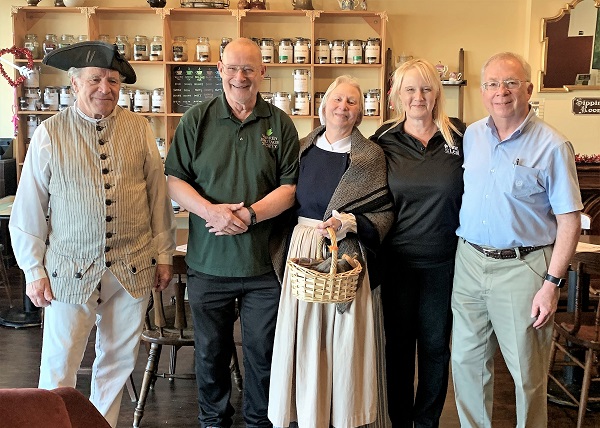
Members of the Warren Heritage Society, from left to right: Dale Corey, Eddie Long, Jan Long, Melanie Gregory and Craig Laird. (Photos/Melanie Gregory)
Washington was born at Popes Creek Plantation to Augustine and Mary Ball Washington. The family moved when he was three years old to Little Hunting Creek, and in 1738 to Ferry Farm on the Rappahannock River near Fredericksburg. This was where he spent the majority of his childhood. The farm had been settled by John Washington, his great-grandfather in 1657. It was here in Parson Mason Locke Weems’ “Life of Washington”, young George had chopped a cherry tree. Weems wrote that 6-year-old George barked one his father Augustine’s favorite English cherry trees with a new hatchet. When confronted by his father, the boy confessed, saying: “I cannot tell a lie, I did it with my little hatchet.” It was also at the farm the he was said to have tossed a silver dollar across the Rappahannock River.
Augustine died when George was eleven years old. His older half-brothers inherited the largest part of the estate, with Lawrence getting Little Hunting Creek Plantation. After Lawrence served in the British Navy, he renamed the plantation Mount Vernon after Admiral Edward Vernon, under whom he served while in the service. George inherited Ferry Farm, which was operated by his Mother until he reached the age of 21. George would often visit Mount Vernon and became close to his older brother. When their father died, he left a small set of surveying instruments that George learned to use. At the age of 16, he began using these and became an accomplished surveyor. n 1748 he was invited to join a survey party organized by his neighbor and friend George William Fairfax of Belvoir to survey land in the western frontier belonging to Lord Fairfax. George inherited Mount Vernon after Lawrence died in 1752 and his daughter in 1754.

Washington had received a commission as a Major in the militia from Governor Robert Dinwiddie. By this time, the French were encroaching on land that the British felt belonged to them in the western frontier. Major Washington was sent to deliver a message, demanding they leave the area. Known as the Allegheny Expedition, he met the French at Fort Le Boeuf on December 11th. The French refused to leave, a message that Washington would return to Virginia to report to the Governor. It was a few months later that he was dispatched as a Lieutenant Colonel to assert Virginia’s claims on the land. They skirmished with the French, killing 10 men, including the French commander, Jumonville. The French with their Indian allies pursued Washington and his men on their return trip to Virginia. The British had constructed Fort Necessity in what is now Fayette County, Pennsylvania. Here the French and Indians fought and defeated Washington. After the surrender, he resigned his commission and returned to Mount Vernon.
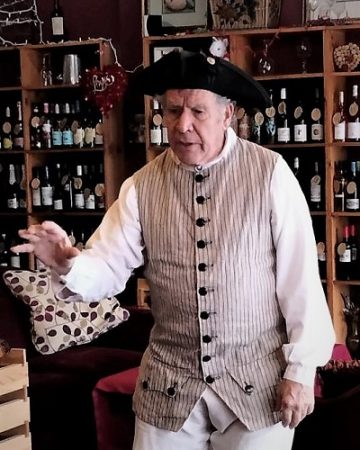
Dale Corey giving a presentation.
In 1755, Washington joined General Edward Braddock’s Army as a volunteer to help drive the French from the Ohio Country. Barddock’s army was routed near the Monongahela River and fled in confusion to Virginia. During the battle, while attempting to rally the British soldiers, Washington had two horses shot out from under him and four bullet holes shot through his coat. He led the survivors to safety. In recognition of his conduct, he was given command of Virginia’s military force. Washington learned from his experiences as a youth in a well-to-do family. He was not able to receive the education his older brothers had due to the loss of his father at an early age. He overcame this through determination and a drive to succeed. This was the basis for the man who led the colonies through the War for Independence and then the birth of the nation as the first president of the nation.
The presentation was given to two groups. Assisting with the event were Craig Laird, owner of The Vine and Leaf, Melanie Gregory, Eddie Long and Jan Long of the Warren Heritage Society.





Samuel’s Public Library Packs October With Programs for All Ages

EPA to Give $90M for Clean Water and Restoration Projects in Chesapeake Bay Watershed, 28 in Virginia

Hiring Slows in September with Job Growth of 29K

Avis Arline Earley (1930 – 2026)

Josh Ingram Seeks Another Term on Front Royal Council, Points to Water, Jobs and Data Centers

The Collective Farms in Your Grocery Cart

Mayor Lori Athey Cockrell Looks to Water, Economic Development and Rail Trail in Another Term

WCHS vs. Brentsville HS – Girls Volleyball – October 6, 2026

BMI Is Only One Piece of the Health Picture

The Eye Surgery Factory That Could Not Expand

Ancient Ownership of Israel

VDOT: Warren County Traffic Alert for October 5 – 9, 2026

Reaching Out Now Expands Programs and Opportunities for Warren County Youth

Dance and Arts VA Finds New Home, New Opportunities on Water Street

Ann L. Shuman (1933 – 2026)

Wendy Lee Whitacre-Stout (1966 – 2026)

Spanberger’s Energy Plan Keys in on Clean Energy to Meet Growing Demand and VCEA Goals

Jean Elizabeth Grubbs Fogle (1939 – 2026)

Feds Provide Guidance on New Federal K-12 Scholarship Tax Credit Program

Why Wait Till November? Mid-Term Election Early Voting Processes in Place Now

US Senate Leaves Nation’s Capital in Advance of Midterms With Much Still Undone

Business Growth Series: If You Don’t Control Your Day, It Controls Your Business

The End of a 20-Year Monopoly on the Credit Score
Voltron and Immigration
