
Local Government
Sheriff Cline Details Flock Safeguards, Uses and Limits at Warren County Work Session
Two residents raised concerns about automated license plate readers during public comment before Tuesday’s Warren County Board of Supervisors work session. Article author Lewis Moten spoke during public comment about privacy, reported security vulnerabilities, and the experiences of other Virginia localities that have reduced retention periods or reconsidered their use of the technology. Before speaking, Moten provided Deputy Clerk of the Board Zachary Henderson with printed copies of the questions and reference material he had previously sent electronically to Sheriff Crystal Cline and the supervisors. A copy was also provided to Sheriff’s Office personnel at the meeting.
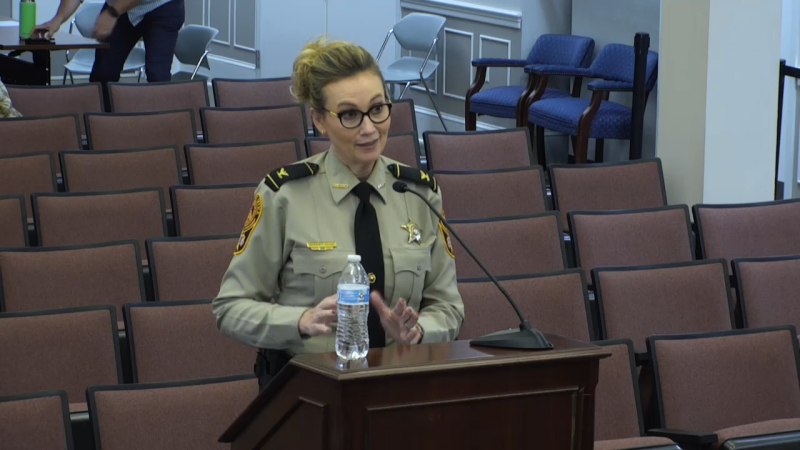
The Warren County sheriff gave supervisors a detailed explanation of the county’s automated license plate reader program, including how searches are authorized, how data is retained, how misuse is audited, and why she believes the technology remains valuable to public safety.
James Contreras also addressed the Board after seeing Flock listed on the agenda. He raised concerns about law-enforcement misuse of surveillance systems, private companies receiving data, facial-recognition technology, and risks to women and children. Some of the examples he cited involved capabilities that Cline later said are not part of Warren County’s current Flock deployment, including facial recognition.
Later that afternoon, the issue returned as a scheduled work-session topic. The item was listed as a discussion only, with no motion or vote requested. Supervisor John Stanmeyer asked that Cline’s presentation be moved earlier in the work session because he needed to leave before the meeting ended and wanted to hear it before departing.

Cline then began a 31-slide presentation on the Flock program covering how the system works, local cases, retention, auditing, data sharing, officer misuse, cybersecurity, and court decisions. The accompanying packet included Virginia’s ALPR statute, the Warren County Sheriff’s Office policy governing the system, and the Supreme Court of Virginia’s 2020 decision in Neal v. Fairfax County Police Department.
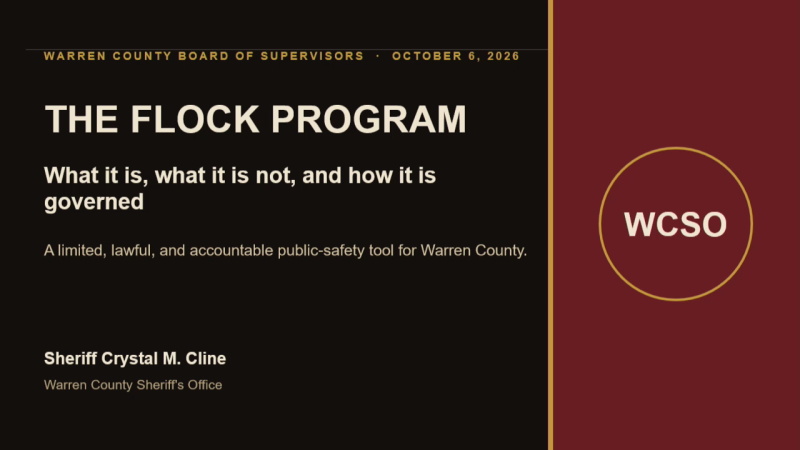
Sheriff Crystal Cline’s presentation described Warren County’s Flock program as a limited, lawful, and accountable public-safety tool. Source: Warren County Sheriff’s Office presentation to the Board of Supervisors, Oct. 6, 2026.
Cline said her purpose was educational: to explain how the Sheriff’s Office uses Flock, what information it records, how it has helped investigations, and what Virginia law requires. She also acknowledged at the outset that photographing vehicles traveling on public roads raises legitimate privacy questions.
“People in this county have raised those questions, and they deserve direct answers rather than reassurance,” Cline told the Board.
Cline organized the presentation around four questions she said any law-enforcement tool should answer: Is it useful? Is it lawful? Is it proportionate? Is it accountable?

Cline framed the discussion around usefulness, legality, proportionality, and accountability. Source: Warren County Sheriff’s Office presentation.
Oversight and program history
Some of the accountability questions had already been answered in writing before the work session. Cline said no formal privacy-impact assessment was conducted before the system was adopted, and WCSO does not currently provide the Board of Supervisors with a separate recurring operational report on Flock use. The office conducts internal audits and must submit and publicly post an annual state report.
Cline also said WCSO participated in broader statewide, national, and federal sharing before Virginia’s current ALPR law took effect on July 1, 2025. She said the office changed its practices when the law changed and now limits sharing to uses Virginia law permits. Separately, the Town of Front Royal no longer shares access to its six Flock cameras with WCSO.

Those facts formed part of the backdrop for Tuesday’s discussion alongside the Sheriff’s Office’s examples of investigative value and the safeguards added by Virginia law.
What Warren County’s system records
Cline described automated license plate recognition, or ALPR, as a system that photographs a passing vehicle and uses software to read the plate. The record can include the plate number, issuing state, date, time, camera location, and visible vehicle characteristics such as make, model, color, damage, racks, toolboxes, or stickers.
She repeatedly distinguished the vehicle record from a person’s identity. The Flock system used by WCSO is not directly connected to DMV records, she said. If investigators need to determine who a vehicle is registered to, they must run a separate search through other law-enforcement databases.
Cline also said the system does not perform facial recognition, determine guilt, or decide whether to stop or arrest someone. A camera alert is a lead deputies must verify.
In a written response to questions provided before the work session, Cline also drew a line around what Warren County’s present equipment does not collect. She said the current WCSO ALPR equipment does not collect mobile-phone identifiers, Bluetooth identifiers, Wi-Fi signals, MAC addresses, or similar radio-frequency/device identifiers.
The question about wireless-device data arose partly because some ALPR vendors now market technologies beyond cameras alone. Leonardo’s ELSAG SignalTrace, for example, is designed to correlate certain publicly broadcast signals from consumer devices with vehicle observations. SignalTrace is not a Flock product, is not part of Warren County’s deployment, and there is no indication WCSO uses an equivalent system.
Cline also said WCSO does not currently subscribe to Flock FreeForm and has not decided to expand its current package. FreeForm is an AI-assisted search tool that lets authorized users search enabled Flock video and license-plate-reader evidence with ordinary-language descriptions instead of relying only on fixed filters. For example, an investigator could search vehicle evidence for a description such as a dark SUV with rear bumper damage. On enabled video systems, FreeForm can also search for people by visible, non-biometric characteristics such as clothing or accessories; Flock says those person searches do not operate on its LPR cameras and do not use facial recognition. Cline said any materially new capability would be evaluated before adoption for legal compliance, operational need, privacy impact, policy requirements, security, training and cost.
Several of those distinctions responded directly to concerns raised during public comment. Moten had questioned what information might be accessible from or around the cameras and cited reports of systems being compromised, while Contreras raised concerns involving faces and facial recognition. Cline later said WCSO’s present Flock equipment is camera-based vehicle-identification technology and does not use facial recognition.

Cline also addressed cybersecurity directly. She prefaced that portion of the presentation by saying she would make “only the claims that I can defend.” According to Cline, Flock states that its data are encrypted on the device, in transit, and at rest, and that the company holds SOC 2 Type 2 certification. She said Virginia-approved vendors must also meet state information-security standards.
On the Sheriff’s Office side, Cline said users have individual accounts, passwords may not be shared, access is removed when an employee’s duties change, and system access is logged. She said WCSO has had no known security incidents involving its Flock system.
Those safeguards address the current Warren County deployment, while the security concerns raised during public comment were broader and included reports involving other camera systems and the possibility of future vulnerabilities.
Board members briefly asked about the cameras’ direction. Cline said the county’s cameras are positioned to capture the rear of vehicles rather than photographing drivers through the windshield, and said the system is intended to capture vehicles rather than pedestrians.
Four stationary cameras and one mobile unit
The Sheriff’s Office currently operates four stationary Flock cameras and one mobile unit. Cline said the equipment was obtained in 2023 using $50,150 in ARPA grant funding.
The mobile camera can be temporarily placed for a specific public-safety purpose. Cline gave the Warren County Fair as one example and said it could also be deployed in connection with an active investigation when legally appropriate.
The presentation also identified six Flock cameras operated by the Front Royal Police Department and one private Lowe’s camera. Cline said Lowe’s shares access to its camera with WCSO, while the arrangement does not allow the Sheriff’s Office to provide its law-enforcement data back to Lowe’s.
Recent Royal Examiner coverage of Front Royal’s own Flock presentation reported that the Town’s six ALPR cameras include a location at the intersection of Leach Run Parkway and Happy Creek Road, near Warren County Middle School. That same report said Front Royal no longer shares its Flock access with other agencies. Cline separately referred Tuesday to investigators having searched Flock cameras on Leach Run Parkway in a past case; because sharing arrangements have changed over time, that reference should not be read as establishing which agency owns a particular camera today.
The area around Warren County Middle School also has a separate automated speed-enforcement program, which can make the roadside equipment easy to confuse. Royal Examiner reported when the school-zone speed-camera pilot launched in 2024 that Warren County Middle School was one of the targeted school areas. A later School Board work-session report described the speed-camera enforcement results. Those school-zone devices are used for speed enforcement and are separate from the Town’s Flock ALPR system.
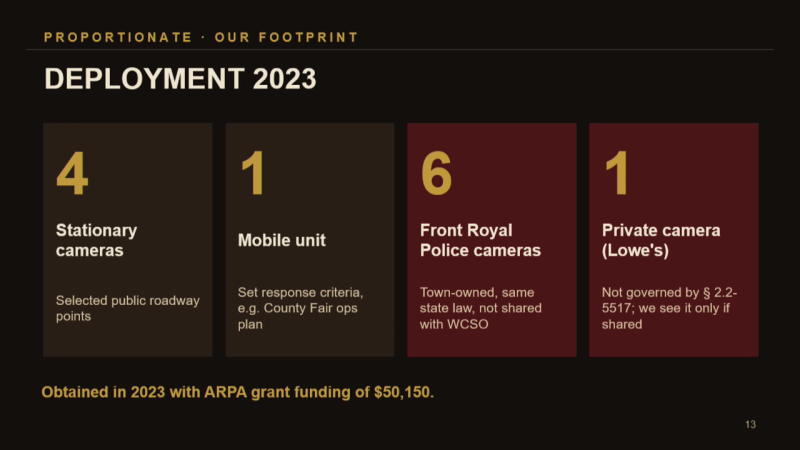
The Sheriff’s presentation lists four stationary county cameras, one mobile unit, six Front Royal Police cameras and one private Lowe’s camera. Cline said Front Royal’s cameras are not currently shared with WCSO. Source: Warren County Sheriff’s Office presentation.
Alerts are not the same as searches
A major part of Cline’s presentation was the distinction between an automatic hotlist alert and an officer-initiated search of stored data.
Hotlist alerts may involve stolen vehicles or plates, outstanding warrants, fugitives, AMBER Alerts, or missing and endangered people. Cline said an alert does not automatically justify a traffic stop. Deputies must verify the underlying record and confirm the plate and vehicle before taking enforcement action.
Virginia law also includes that safeguard, stating that an ALPR notification by itself does not constitute reasonable suspicion for a stop.
A search for historical data is different. Cline said a WCSO user must enter an offense type, a case or call-for-service number, and a reason before a search can be run. The search is associated with the named user so it can later be audited.
Cline gave local examples in which the system helped investigators develop leads. In one case involving a reported sexual battery at the Crooked Run shopping area, investigators did not have a readable plate from the shopping center’s video but knew the suspect left in an RV. A search using vehicle characteristics produced an RV matching the time frame and gave investigators a plate number to continue the case.
She also described cases involving wanted people, stolen vehicles, and an assault in which a suspect vehicle was located shortly after a search.
Her point throughout the presentation was that the technology provides information, but deputies still have to investigate and verify what it means.
“The camera, it’s just a good lead,” Cline said. “We still have to do police work.”
Why Warren County keeps data for 21 days
Retention was one of the policy questions supervisors raised.
Stanmeyer noted that the Town of Front Royal had discussed a seven-day retention period and asked why the Sheriff’s Office keeps its data for 21 days.
Cline said Flock’s standard retention is moving from 30 days to seven days, while Warren County remains at 21. One slide in her presentation described Flock’s seven-day default as part of safeguards to be in place by January 2027. Flock’s current public materials now describe seven days as its standard/default retention period, while existing customers may keep approved retention periods consistent with applicable law. Virginia law requires Warren County’s ordinary system data to be purged after 21 days, or earlier if the contracting agency requests a shorter period.
Cline said she chose 21 days because crimes are not always discovered or reported immediately. A property owner may not realize something was stolen for several days, she said, and families may not immediately know that an endangered person is missing. She said the additional time can preserve an investigative lead that would otherwise already be gone.
Cline was direct about her preference, telling supervisors that she considers 21 days short and would be comfortable with 30 days if Virginia law permitted it.
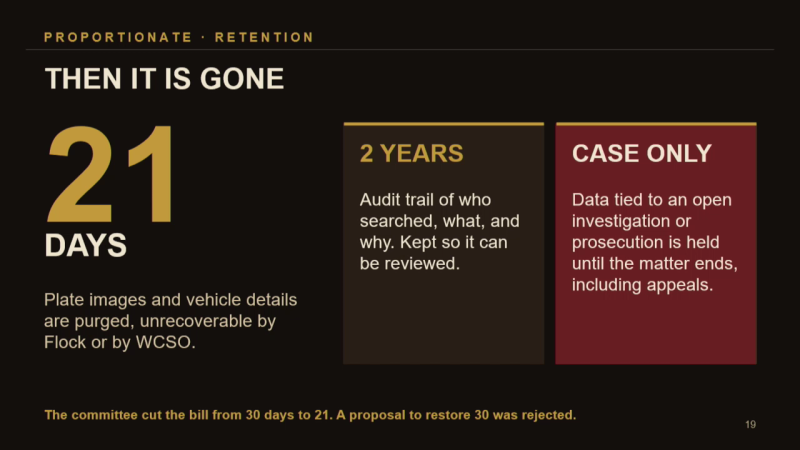
Routine plate images and vehicle details are purged after 21 days. Audit records are kept for two years, while information preserved as part of an active case can be retained as required for that case. Source: Warren County Sheriff’s Office presentation.
At the same time, Cline did not dismiss the privacy argument behind shorter retention. Later in the presentation, she acknowledged that the cameras photograph many vehicles that have no connection to a crime and that, in theory, enough observations over enough time could reveal patterns about a person’s life.
“It’s true,” she said, calling that concern legitimate.
Her position was that the answer lies in limits on retention, access, authorized purposes, and auditing rather than abandoning the tool.
Misuse addressed directly
Cline also spent significant time discussing one of the most serious concerns surrounding ALPR systems: misuse by law-enforcement employees.
She cited national reporting about officers accused of using plate-reader systems to look up wives, girlfriends or former partners. Instead of dismissing those reports as irrelevant to Warren County, Cline said she was “horrified” by them and that officers who misuse the technology should be held accountable.
She then described what she expects to happen if a WCSO employee uses the system for a personal purpose: an internal investigation, termination, referral to the Commonwealth’s Attorney for possible prosecution, and referral to the Department of Criminal Justice Services for decertification.
“I cannot promise you that a human being will never do something wrong,” Cline said. “I can promise you that we will find it and what will happen when we do.”
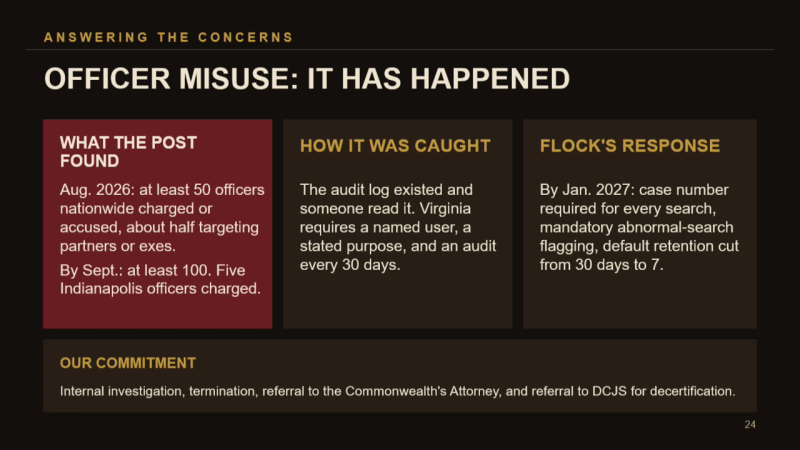
Cline devoted part of the presentation to documented misuse elsewhere and the consequences she said would follow improper use by WCSO personnel. Source: Warren County Sheriff’s Office presentation.
Cline said WCSO conducts an audit at least every 30 days and also reviews every 20th search. In her written response before the meeting, she identified Lt. Fritts as the person currently conducting the monthly reviews. She also said the agency uses Flock’s audit tools to flag unusual activity, such as repeated searches of the same plate, so an administrator can compare the activity with the associated case or call for service.
When Supervisor John Stanmeyer asked whether the Sheriff’s Office uses Flock’s newer automated audit-assistance features, Cline said the agency does use anomaly-detection tools in addition to its own review process.
The Sheriff’s Office currently has 29 people with access to Flock out of a staff of roughly 100, Cline said. Those users include communications personnel, investigators and supervisors. Annual training is required, and access is suspended when required training is not completed.
Sharing changed when Virginia law changed
Cline also addressed data sharing in greater detail. She said current WCSO sharing is limited to Virginia law-enforcement agencies for purposes allowed by law. WCSO policy also prohibits using the system for immigration-status enforcement, civil debt collection, routine fines and fees, personal curiosity, harassment, or other unauthorized purposes.
Cline said she learned from a recent Front Royal Police Department presentation that the town’s six cameras are no longer shared with WCSO. She said that is the town’s decision, but she hopes the two agencies will reconsider because both serve the same community and frequently work together. That matches Royal Examiner’s coverage of Chief Brian Whited’s Town Council presentation, which reported that access to the Town’s system is proprietary to FRPD and is not shared with another agency.
Supervisors focus on retention, auditing and misuse
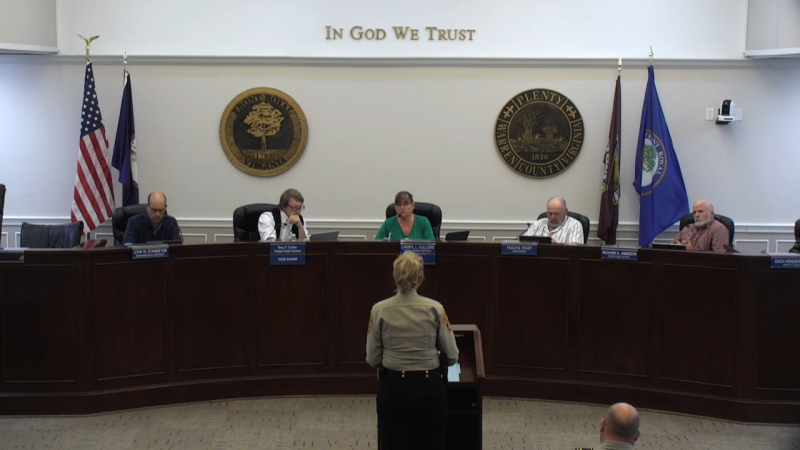
Sheriff Crystal Cline faces the Warren County Board of Supervisors during the Oct. 6 Flock work session. From left are Supervisors John Stanmeyer, Tony Carter, Cheryl Cullers, Hugh Henry, and Richard Jamieson. Screenshot from Warren County Board of Supervisors livestream.
Board questions during and after the presentation focused on camera direction, the 21-day retention period, audit technology, and the source of national statistics Cline cited regarding officer misuse.
Stanmeyer asked several of the substantive follow-up questions. When asking about national reports of ALPR misuse, he prefaced the question by saying he was “not questioning your department’s integrity at all.” He asked whether the national figures Cline cited might understate the number of incidents and whether they came from Flock. Cline said they came from The Washington Post, not from the company.
Supervisor Cheryl Cullers said she understood the privacy concerns and frustration surrounding the technology while also pointing to its potential public-safety value. She said she could understand why residents do not want to feel tracked while also seeing value in a tool that might help locate a missing child or assist in a serious investigation. Cullers added that if opposition to the cameras ever reached the point of broad community outrage, she would prefer to see the issue placed before voters in a referendum rather than make that decision on behalf of the county herself.
Cline remained firm in her support of the program, but she also invited continued scrutiny.
“I’m not asking you for anything tonight except to understand the program well enough to hold me to it,” she told the Board. “Keep asking the questions.”
She closed with a four-part recommendation: keep the tool, keep the limits, keep the audits and keep the public informed.
In her written response before the meeting, Cline also identified circumstances that could cause WCSO to change course. She said the office would reevaluate, modify, suspend or discontinue the program if changes in law made its use impermissible; if the vendor or technology could no longer meet legal, security or operational requirements; if reliability or false-alert rates undermined its value; if it began collecting unauthorized data; if significant misuse could not be adequately corrected; or if cost became unreasonable in relation to demonstrated benefit.
The Board’s question-and-answer discussion can be viewed here.
Virginia localities are taking different approaches
Warren County’s discussion came amid a broader debate over Flock in Virginia, with localities taking different approaches to the same questions of privacy, oversight and investigative value.
In September, the Fairfax County Board of Supervisors paused new Flock installations while reviewing additional questions. Lynchburg temporarily paused its 15 fixed Flock cameras for an independent review of policy, procedure, training and operational practices. Arlington County directed staff to discontinue county-leased Flock technology, saying no local misuse had been reported. Alexandria published an extensive response to City Council questions covering auditing, sharing, retention, alternatives and oversight.
Those actions are not directly comparable: the localities have different camera networks, policies, histories and community debates. In Warren County, no action was requested Tuesday. Cline used the work session to place WCSO’s current practices, legal limits and rationale for the program on the record, while supervisors focused their follow-up questions on a smaller number of specific issues.
Tuesday’s work session did not produce a vote, nor was one requested. It did, however, place additional information about Warren County’s Flock program into the public record.
Cline strongly supported the technology and described its investigative value, while also acknowledging that privacy, human misuse and the accumulation of vehicle-location data are legitimate subjects for public oversight.
For residents who remain concerned about ALPR technology, the debate is unlikely to end with one presentation. The discussion now includes more detail about Warren County’s actual system, the rules under which it operates, and the safeguards Cline says her office uses.
Source note: Reporting for this article is based on the Warren County Board of Supervisors’ Oct. 6, 2026 video archive, the meeting materials provided for the Flock work session, Sheriff Crystal Cline’s written responses to questions before the meeting, and the additional sources linked throughout the article.
Additional Virginia context comes from Arlington County, the Lynchburg Police Department, Fairfax County reporting, and the City of Alexandria’s ALPR response page. Product context on Flock FreeForm comes from Flock Safety’s FreeForm product page. Flock’s current public materials describe seven days as its standard/default retention period. Product context on radio-frequency/device correlation comes from Leonardo US Cyber & Security Solutions’ ELSAG SignalTrace materials. SignalTrace is a Leonardo product, not a Flock Safety product.
Disclosure: Article author Lewis Moten spoke during public comment about Flock privacy and security concerns and provided written questions and reference material to Sheriff Crystal Cline and the Board of Supervisors before the work session. Moten regularly speaks during Warren County public-comment periods on local government issues and maintains an online archive of those appearances.



Middletown Man Killed In I-81 Crash In Frederick County

Cline Backs Veteran Cancer Screening Effort, Highlights Sixth District Programs

Sheriff Cline Details Flock Safeguards, Uses and Limits at Warren County Work Session

Flock Safety: A Tool for the Common Good

Melissa Ichiuji Studio Gallery Reopens With Two Fall Exhibitions

Just Hours Away: Festival Of Leaves Returns To Downtown Front Royal Saturday

Sheriff’s Office Addresses Use of ‘ALPR’ Cameras – Health Insurance, 4-H Week, and Parks & Rec Events Also Presented

Before Relying on a Model, Look at the Assumptions

The Question Is Not Which Apple Tastes Best

Brian Anthony Lamb (1980 – 2026)

Mary Brinham Walton (nee Arnold) (1947 – 2026)

Sandra Jo Alger (1941 – 2026)

All Warren County Schools Fully Accredited as State Releases New Performance Results

This Week’s Showtimes at Royal Cinemas as of October 9th

Samuels Public Library to Expand ‘Library of Things’ With $2,000 Grant

Ask Stewart: Why Do Leaves Turn Different Colors in the Fall?

After Statewide Tour, Virginia Lt. Gov. Hashmi Officially Opposes Dominion-NextEra Merger

Virginia Republicans Urge Spanberger to Call Special Session for Fuel-Tax Holiday

Kratom, 7-OH Laws Diverge Amid the Spread of Potent Synthetic Products

WCHS vs. Manassas Park – Varsity Football – October 9, 2026

A Golf Hazard With an Appetite

Lantern Tours Bring Stories Of New Market Battlefield To Life Oct. 24

Pork And Apples Have A Long-Standing Romance

Israel from Saul to Rome
