
Local Government
Shock result: Supervisors deny rezoning approval for Linden Sheetz
A joint meeting of the Warren County Planning Commission and the County Board of Supervisors held Wednesday night, February 10, produced an unusual set of decisions for the would-be developers of the site adjoining the entrance to the Apple Mountain Lakes subdivision. Planning Commission Chairman Robert Myers opened the meeting by setting some attendee ground rules for the benefit of the room full of citizen participants – properly social-distanced, of course.
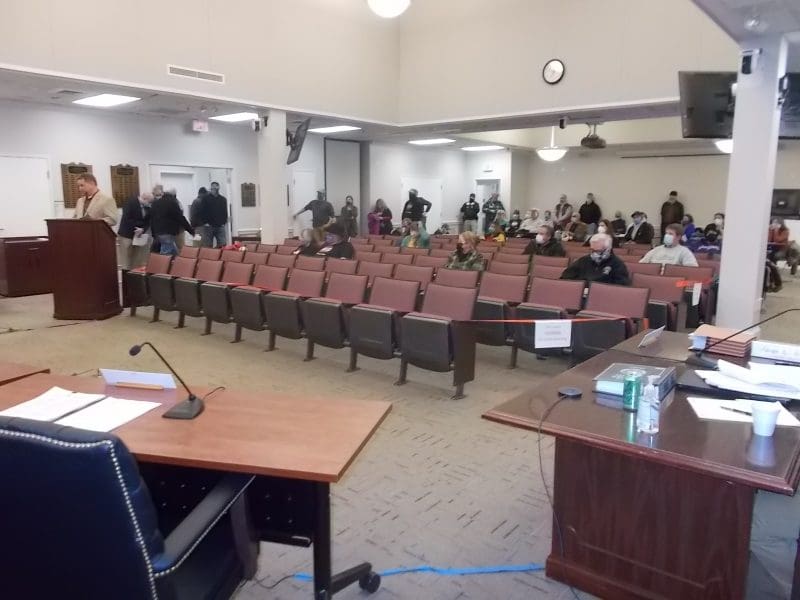
The crowd of citizens at the joint meeting of the County Board of Supervisors and Planning Commission extended out into the hall even as social distancing guidelines kept many seats empty.
The Dudding Commercial Development, LLC representative spent an intensive hour briefing the joint session attendees on the details of their project, which includes the construction of a convenience store and gas station on the north side of Interstate 66 at exit 13. The request to rezone 6.45 acres of the 15-acre plot is the first opportunity that neighboring residents had to see some detail about what the development would entail. The client Dudding intended to locate at that site was Sheetz, Inc., which operates 634 Gas Stations and convenience stores across the mid-Atlantic, Appalachia, the upper South, and Ohio. Sheetz representatives gave a polished presentation highlighting their intention to be a “good fit” in the community and addressed several issues that have been raised by concerned residents. Sheetz or its representatives have been meeting with local groups and officials since June 2020 and have modified their proposal several times as a result.
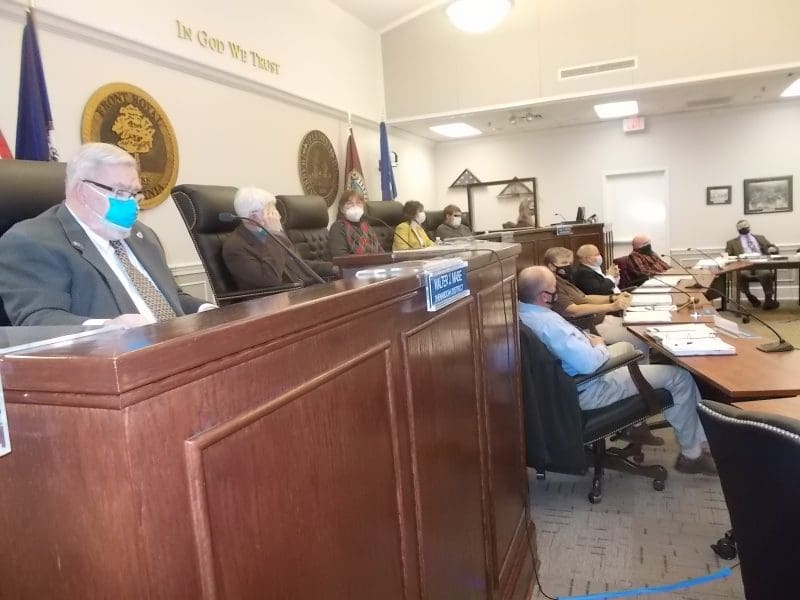
All that power in one room: County Supervisors and Planning commissioners listen carefully to the presentation from Sheetz representatives
Several commissioners and supervisors questioned the representatives about the details of their proposal, including the traffic counts and assumptions for future growth. Commissioner Longo asked about fuel pricing policies, indicating that some retailers vary their posted prices significantly depending on competition, even in the same area. He asked what Sheetz’s policy about that is. The response from Sheetz’s Real Estate Director was generally that Sheetz has a system for determining the prevailing price but that he was not the person to address that question. Commission Chairman Myers was concerned with whether Sheetz’s stated water consumption of 2500 gallons per day took into account peak uses. This drew a “we don’t know yet” response, which does play into resident’s concerns about how their own wells would fare should a large commercial user drive a well into the existing water table.
Deputy Clerk to the Board Emily Ciarrocchi had the marathon task of verbally entering into the record some 80 pages of e-mails from citizens, along with the names of over 70 signers of a petition opposing the rezoning effort. Opposition to the project was nearly universal, with a single communication favorable to the Sheetz proposal entered into the meeting record.
The highly-anticipated public hearing portion of the meeting was enviably well-organized thanks to the hard work of the group of Apple Mountain Lakes (AML) homeowners and the able leadership of volunteer lawyer Sarah Lhymn. The organized efforts have been underway for nearly six months. The residents had prepared a slide presentation that introduced each speaker and the issues they wished to address. The common themes that emerged were groundwater consumption or contamination, child safety and potential for increased crimes, particularly against children, light/noise pollution, increased traffic, destruction of the rural character of the area, negative effect on property values, apparent conflict with the Warren County Comprehensive Plan, and the adverse effect of stormwater runoff. Some presenters were quite emotional, as they pled with the commissioners to deny the rezoning request. Several presenters told the Commission that Sheetz had withdrawn a proposal to build a facility near Columbus Ohio due to its proximity to a water supply and suggested that the Linden site should be seen in much the same way. Andrew Podolak gave an eloquent summation for the homeowner’s group – “Would you want a Sheetz in your backyard?” There were also several references to other businesses in the immediate area on the other side of the interstate that would suffer from a Sheetz store so close by.
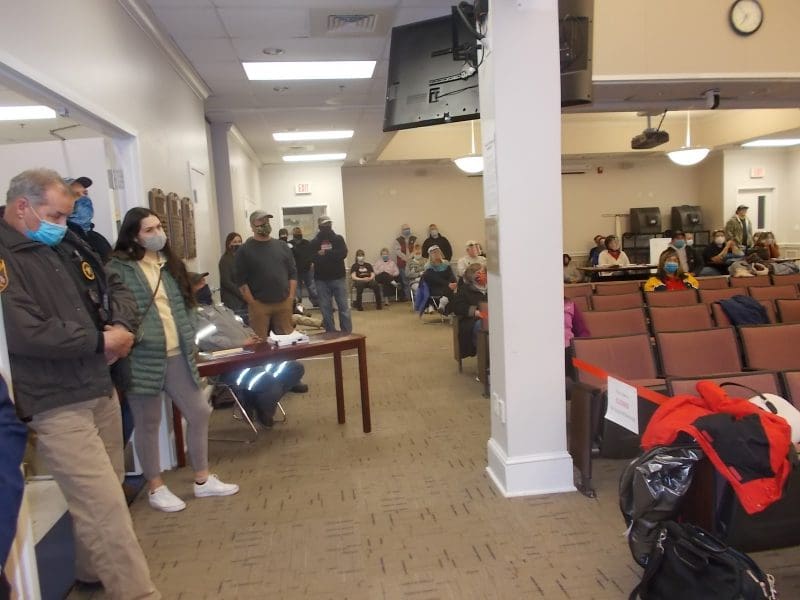
WC Sheriff’s Deputy watches over the citizen group as they listen intently to the presentation.
Several commenters in addition to the homeowners’ group pointedly reminded the supervisors that they are responsible to the voters of Warren County – asserting that this is not merely a Linden issue.
After nearly 3 hours of public input, The Sheetz representative provided some feedback and told the joint meeting that the data provided to them in their information packets had been quite extensive, but that the concerns raised by the homeowners either had been or were being dealt with. The Traffic data had been provided by VDOT and came from 2016 and 2017 so it predated any COVID effects.

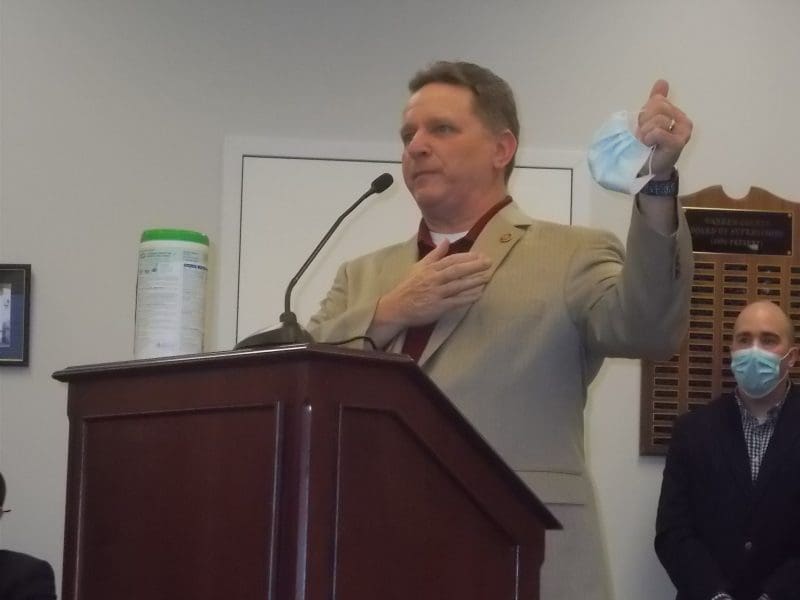
Sheetz Real Estate Manager Rick LaCesa responds to some allegations and conclusions made by the Apple Mountain Lake residents in their opposition to the Exit 13 site.
Chairman Myers was skeptical of the water consumption data provided by Sheetz, and given the history of the water table under the subdivision, he shared the concerns of the homeowners, several of whom had horror stories about falling water levels and burned out well pumps. Several had told of redrilling new wells, only to experience new failures at a deeper level. Commissioner Joe Longo reminded the group that with the current Agricultural (A) zoning, the current property owner could have a hog farm on that property, which he doubted would be preferable to a Sheetz gas station. Commissioner Kersjes observed that it was a surprising site choice for Sheetz, given the lack of established roadways to service it.
Vice-Chairman Henry said that the default zoning for undeveloped areas is Agricultural. There’s no obligation for a landowner to provide a buffer zone for an adjacent residential area. An ideal solution to provide such a buffer space would have been for Apple Mountain Lakes to purchase the property itself. Finally, Vice Chairman Henry continued, “capitalism means people own businesses that may be adversely affected by competition, but who’s looking out for the landowner here?”
Once the commissioners and supervisors had completed their questioning, Vice Chairman Henry offered a motion to recommend approval of the rezoning. The commission passed the motion 3 votes to 1, Commissioner Longo, Vice Chairman Henry, and Chairman Myers “Yes”, Commissioner Kersjes “No”.
The Board of supervisors briefly consulted and offered a motion to deny the rezoning request. Supervisors Carter and Mabe, Vice-Chairman Fox, “Yes”; Supervisor Oates, Chairman Cullers, “No”
Perhaps due to the lateness of the hour – nearly 11:00 PM – it took a few moments for the somewhat smaller audience of citizens to catch on to the fact that the supervisors had voted to deny the rezoning by approving a negative motion, thereby giving the Apple Mountain homeowners the victory they had sought. Scattered cheers broke out and both the Board of Supervisors and the Planning Commission quickly adjourned their portions of the meeting.
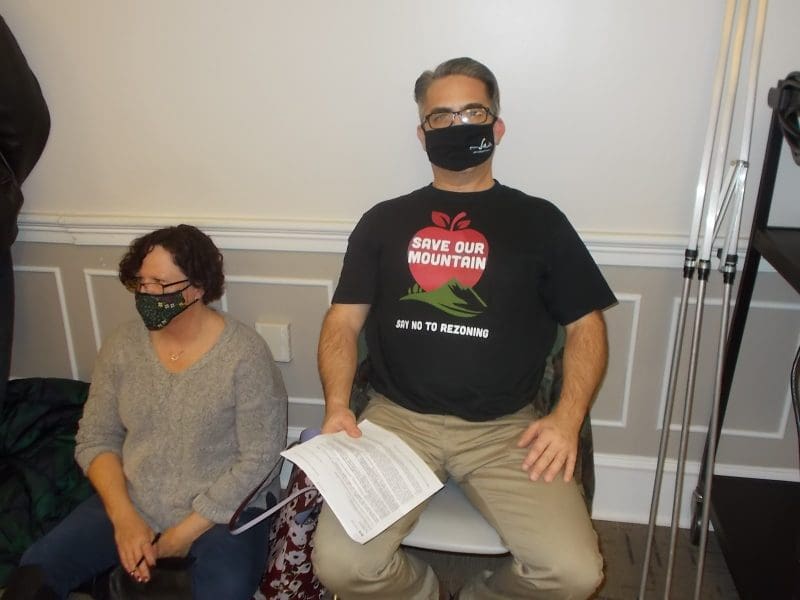
A number of citizen attendees were sporting their opinion on their chests, with “Save our Mountain – say no to rezoning” clear evidence of their commitment to making sure the community voice is heard.
It bears noting that citizen organization and action in the matter of this development were key to the outcome. There would have been no reason to believe that anything would stand in the way of a new Sheetz outlet at exit 13, given the preparation that the developer and their support team had made. The experts who were consulted agreed it was a good use of the property, the client saw a good opportunity to add a lucrative business location, and the property owner saw a good return on his investment. While it could be argued that citizen opposition to development in rural areas often takes the form of “not in my backyard”, “The Great Linden Sheetz controversy” remains a useful lesson as the community learns about the real benefits of working together. As one resident said, “I had no idea we could get so many people working together so quickly!”
Win or lose, such citizen involvement is a good outcome.




Closing Virginia’s Childcare Affordability Gap Could Cost Up To $4.5B a Year

New Coalition Aims to Keep Virginians Covered as Medicaid Rules Tighten

General Assembly Calls Off Oct. 26 Special Session to Elect Judges

Trump Order Sets Up New Women’s Health Research Initiative at NIH, White House Task Force

What Is Puberty?

First New Class of Pain Medicine in Decades Comes with A 14-Day Limit

Front Royal Man Charged with Two Counts of Forcible Sodomy Following RSW Regional Jail Investigation

James Edward “Jimmy” Mahoney (1953 – 2026)

Ask Stewart: Are There Any Scary Trees?

Janet Denny Casarotti (1933 – 2026)

Virginia Breeders Championship Series Opens at Shenandoah Downs with Impressive Performances

Clark Preston “Lucky” Cameron (1961 – 2026)

Commentary: Data Centers and AI – A Rare and Raw Issue in Virginia for This Midterm Election

Douglas MacArthur “Dougie” Green (1964 – 2026)

Dominion’s Energy Roadmap Keeps Fossil Fuels in the Mix, Expands Solar

Richmond No Kings Protest Turns Out Hundreds Ahead of Midterm Election

Dr. William Kent Renas (Bill) (1948 – 2026)

Careful With Money, Invisible to Lenders

3 Car Problems You May Avoid By Paying Attention

American Songs Concert Coming to First Baptist Church in Front Royal on October 25

When Grief Doesn’t Ease With Time

Sudden Cardiac Arrest May Not Be As Sudden As Its Name Suggests

100 Years of Hundred Acre Wood

A Moment of Honor: Veterans Receive a Powerful Tribute at the Tomb of the Unknown Soldier
