
State News
U.S. elections official takes part in secretive GOP conference, sparking backlash
A commissioner of a federal elections agency recently spoke at a secretive conference of conservative voting activists and Republican secretaries of state and congressional staff — a step that election experts call highly improper for an official charged with helping states administer fair and unbiased elections.
U.S. Election Assistance Commissioner Donald Palmer, the former chief election official in Virginia, was a panelist at a February conference organized by conservative groups working to impose new voting restrictions, including the Heritage Foundation.
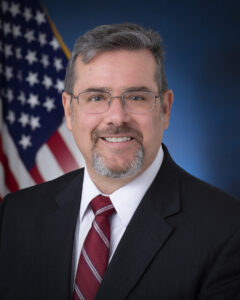
Donald Palmer, U.S. Election Assistance commissioner
Ten chief state election officials, as well as elections staff from three additional Republican-led states, attended the confab, which was described by one prominent organizer as a “private, confidential meeting.”

The existence of the conference, including its agenda and list of attendees, was first reported by The Guardian U.S. and the investigative journalism site Documented.
In a statement to States Newsroom, Palmer defended his appearance, calling it “an important opportunity to engage.” Palmer, who was appointed by former President Donald Trump, is one of two Republican members of the four-member commission, which by law is divided evenly between the two main political parties.
Though the EAC has no ethics code to guide commissioners or staff, it’s one of several agencies subject to heightened restrictions on political activity via the Hatch Act — the U.S. law that restricts federal government employees from involvement in partisan politics.
Amber McReynolds, the former elections director for the city of Denver and a prominent election administration expert, said commissioners should be barred from partisan events.

“With elections, the standard has to be higher. The professionalism has to be higher. The transparency has to be higher,” said McReynolds, who sits on the Board of Governors for the U.S. Postal Service. “[EAC commissioners] should not be participating in partisan activities.”
“I do think it’s important for them to engage,” added McReynolds, who is politically unaffiliated. “But do so with equal access in mind and high ethics in mind, and certainly not in private meetings.”
Michigan Secretary of State Jocelyn Benson, a Democrat, went further, suggesting Palmer should step down.
“Election professionals across the spectrum are deeply disappointed that (a commissioner) of this federal agency abused the trust we placed in his ability to be professional and unbiased in supporting election administration,” Benson said in a statement. “His inappropriate and poor judgment calls into question his ability to continue in his role in the future.”

“It’s the perception of appearing at a highly partisan group that isn’t transparent,” said Thom Reilly, the co-director of the Center for an Independent and Sustainable Democracy at Arizona State University. “In a time when there is so much that’s problematic about how people are viewing elections, I think this is going to add to that. I think it’s problematic.”
In a statement sent via an EAC spokesperson, Palmer responded:
“The Heritage Secretary of State Meeting was an important opportunity to engage with chief election officials and key staff. It was a forum to discuss the national security implications of voting system standards and testing, federal legislation and funding, and interstate voter registration data sharing, and I appreciated hearing from states and answering their questions.”
Trey Grayson, a Republican former secretary of state of Kentucky who served on the bipartisan Presidential Commission on Election Administration created by President Barack Obama, said he doesn’t have a problem with Palmer’s appearance at the event.

“I don’t think the rules of the EAC require him to step back from being an active Republican,” said Grayson. “Don has extensive election administration experience, which he brings to the job as commissioner. He also maintains strong relationships with Republicans across the country. That can help him do his job better. It is possible to still be a partisan and do your job well.”
Panel appearances
According to the event’s agenda, Palmer appeared on a panel entitled “Realistic ERIC Fixes and Reforms” alongside Missouri Secretary of State Jay Ashcroft and Logan Churchwell of the Public Interest Legal Foundation, whose founder and president, Christian Adams, served as moderator.
Palmer also appeared on an “Updates from the Hill” panel alongside two Republican congressional staffers.
Ashcroft has been a key supporter of his state’s strict new voting law. He was one of several Republican chief election officials who recently pulled his state out of the Electronic Registration Information Center, an interstate compact that helps states maintain clean voter rolls and reach out to unregistered voters.

PILF has filed lawsuits aimed at forcing election officials to pare the rolls and has sought to raise fears about illegal voting by non-citizens, which experts say is extremely rare. Cleta Mitchell, a lawyer for Trump who worked with him to overturn the 2020 election, sits on PILF’s board of directors.
The conference was organized in part by the Heritage Foundation’s Hans von Spakovsky, who for decades has been prominent in the conservative push to raise fear about illegal voting in order to impose new voting restrictions.
Also appearing at the event were former Virginia Attorney General Ken Cuccinelli of the Election Transparency Initiative, Jason Snead of the Honest Elections Project, and — giving the keynote speech — Ken Blackwell of the America First Policy Institute, another PILF board member. All three are leaders of the Trump-backed effort to tighten voting rules.
In an email to the staff of a Texas Republican state legislator who was set to appear at the event, von Spakovsky wrote: “There is no live stream. This is not a public event. It is a private, confidential meeting of the secretaries. I would rather you not send out a press release about it.” The email was obtained by Documented.
Chief elections officials from Indiana, Florida, Kansas, Mississippi, Missouri, Montana, Nebraska, Tennessee, Virginia and West Virginia attended the conference.
Former DOJ lawyer
Palmer joined the EAC in 2019. A former lawyer in the voting section of the Justice Department’s civil rights division, he has served in senior election administration posts under Republican administrations in Florida and Virginia.
Palmer has tweeted about efforts to add Antifa to the FBI’s list of terror groups and in opposition to gun control policies. Antifa is shorthand for anti-fascists, far-left-leaning militant groups that violently resist neo-Nazis and white supremacists.
And this isn’t the first time Palmer has appeared with activists working to restrict voting. In 2020, Palmer and EAC Commissioner Christy McCormick, a fellow Republican and currently the agency’s chair, went on a podcast hosted by Catherine Engelbrecht of True the Vote, another leader of the effort to raise fears about illegal voting.
On the podcast, Palmer questioned the security of mail-in voting, which many states expanded during the pandemic, and which has not been associated with significant fraud in the states that use it widely.
“There have been studies that say that vote-by-mail and absentee is just simply more vulnerable to fraud because an election official is not confirming the identity of the voter,” Palmer said. “It’s obvious when you look at reports of fraud that take place occasionally. Election officials and election offices need to be vigilant to make sure that increased probability of fraud doesn’t take place on a scale that swings an election.”
Palmer also appeared on Mitchell’s podcast in 2021 — though in that appearance, he sought to knock down fears among right-wing voting activists about the vulnerability of voting systems.
At his confirmation hearing in 2018, Palmer stressed his commitment to fairness and impartiality.
“The principles of democracy and justice are greater than the singular success of any political party or candidate who may win or lose an individual race,” he declared.
What the EAC does
The EAC, which was created as part of the Help America Vote Act of 2002, sets standards for voting systems and supports states with other aspects of election administration, including distributing federal funds.
It also publishes widely used voting data and maintains the national mail voter registration form. Its four commissioners are appointed by the president based on recommendations by congressional leaders and confirmed by the Senate.
Though it often flies under the radar, the commission can play an important role in setting voting policy. In 2016, its executive director worked to make it easier for several Republican secretaries of state to require proof of citizenship from people registering to vote before being blocked by a court.
McReynolds said part of the problem is the structure of the EAC, whose commissioners must be either Republicans or Democrats.
“Literally, Congress crafted a law that you have to be a D or an R, which leaves out 45 percent of the country and also a boatload of experience due to the lack of a party label,” she said, adding that the U.S. should learn from other advanced democracies and ensure nonpartisanship in the conduct of election administration.
“There is independence when you look around the world, with the election authorities,” McReynolds said. “We have to decouple partisan political party activity from election administration and ensure nonpartisan guardrails are in place with high ethical standards for those who oversee elections.”
by Zachary Roth, Virginia Mercury
Virginia Mercury is part of States Newsroom, a network of news bureaus supported by grants and a coalition of donors as a 501c(3) public charity. Virginia Mercury maintains editorial independence. Contact Editor Sarah Vogelsong for questions: info@virginiamercury.com. Follow Virginia Mercury on Facebook and Twitter.




Front Royal Outdoors Founder Don Roberts Named 2026 Protector of the Shenandoah

Front Royal Man Held Without Bond Following Child Sexual Abuse Material Investigation

Performing Arts Center Pointing to 2027 Opening as Local Entertainment, Business, and Educational Partner

Town Planning Commission Continues to Prepare for the Arrival of Cannabis on the Local Market

Warren County Schools Improve, But Federal Rules Lower Seven Ratings

Spanberger Announces $1.3 Million in Scholarships and Incentives for Nursing Students

The First Long-Distance Phone Call Came With Receipts

Middletown Man Killed In I-81 Crash In Frederick County

Cline Backs Veteran Cancer Screening Effort, Highlights Sixth District Programs

Sheriff Cline Details Flock Safeguards, Uses and Limits at Warren County Work Session

Flock Safety: A Tool for the Common Good

Melissa Ichiuji Studio Gallery Reopens With Two Fall Exhibitions

Just Hours Away: Festival Of Leaves Returns To Downtown Front Royal Saturday

Sheriff’s Office Addresses Use of ‘ALPR’ Cameras – Health Insurance, 4-H Week, and Parks & Rec Events Also Presented

Before Relying on a Model, Look at the Assumptions

The Question Is Not Which Apple Tastes Best

Brian Anthony Lamb (1980 – 2026)

Mary Brinham Walton (nee Arnold) (1947 – 2026)

Sandra Jo Alger (1941 – 2026)

All Warren County Schools Fully Accredited as State Releases New Performance Results

This Week’s Showtimes at Royal Cinemas as of October 9th

Samuels Public Library to Expand ‘Library of Things’ With $2,000 Grant

Ask Stewart: Why Do Leaves Turn Different Colors in the Fall?

After Statewide Tour, Virginia Lt. Gov. Hashmi Officially Opposes Dominion-NextEra Merger
