
State News
Virginia’s rule on legislators leaving districts could add more intrigue to 2023 elections
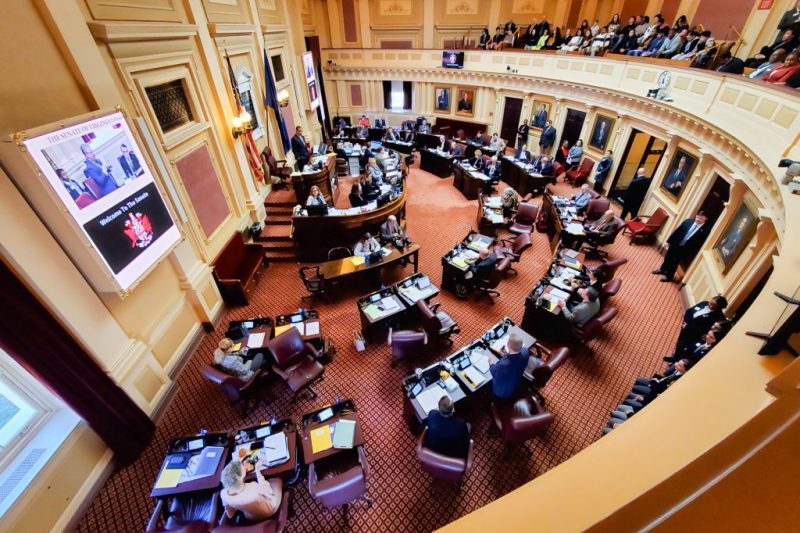
The Virginia Senate. (2020 file photo by Ned Oliver/Virginia Mercury)
After past redistricting cycles, the number of Virginia General Assembly members having to switch districts was kept to a minimum because legislators were allowed to draw careful lines around each other’s homes to avoid damaging incumbents.
That wasn’t the case last year when experts appointed by the Supreme Court of Virginia effectively reset the state’s legislative maps with little regard for keeping incumbents comfortably installed in conflict-free seats. That means an unusually high number of legislators face the prospect of moving to position themselves for the next election cycle.
Those maps are also drawing new attention to a little-known provision in the Virginia Constitution that says any delegate or senator who moves out of their current district to run in a new one automatically forfeits the office they hold. But legislators also have to prove their residency in the new districts in order to qualify as valid candidates, a process that takes place long before the current legislative terms are over.

With the electoral landscape still taking shape for the high-stakes 2023 General Assembly elections, when all 140 state legislative seats will be on the ballot, there have been no residency challenges yet. Still, the question of how the constitutional rule might affect the legislature next year is already being discussed in hushed tones around the Capitol.
“I think it’s making some people nervous,” said Del. Mark Sickles, D-Fairfax.
Under the new maps approved last year, half of the state’s 40 senators were drawn into a district with one or more other senators, according to the Virginia Public Access Project analysis. In the House, 44 of 100 delegates were paired with at least one colleague. Some of those pairings have already been resolved, partly because the maps also created dozens of new districts with no incumbent. Legislators paired with each other have a few basic options: a head-to-head election matchup with a colleague, resignation, or running for a different seat.
Due to the uncertainty over which specific members the rule could impact, some legislators and aides seemed reluctant to discuss the issue candidly.

“I’ll just say I’m aware of it,” House of Delegates Speaker Todd Gilbert, R-Shenandoah, said with a smile in a brief interview on the House floor earlier this month.
The issue has also been raised in Senate Democratic Caucus meetings as members should be aware of as they plan for next year.
Unlike members of Congress, Virginia General Assembly members are required to live in the districts they serve or are running to represent. And the state constitution is clear on what happens if someone moves out of their district.
“A senator or delegate who moves his residence from the district for which he is elected shall thereby vacate his office,” the key section says.

That rule came into play in 2015, when then-Del. Joe Morrissey filed paperwork to run for the state Senate that listed a Richmond address outside his Henrico County-based district. At the time, Morrissey, now a state senator, agreed to vacate his former office and allow a special election to take place but said he would continue to serve his constituents in an unofficial capacity out of his law office.
Over the next six months, an errant move by a lawmaker or an intentional decision to step down early could have a similar impact. Significantly, an empty seat could deprive a political caucus of a vote in the 2023 legislative session, even if the person who vacated it might go on to win and return in 2024 from another district.
It won’t be a problem for General Assembly members who move to run in a new district without leaving their current one. For example, Democratic Sen. Creigh Deeds is able to move from rural Bath County to Charlottesville to run in a redrawn district because Charlottesville is part of the area he represents now.
“They just have to move to an overlapping area,” said Jeff Ryer, a longtime Senate GOP aide. “And I cannot recall a circumstance where there was not an overlapping area.”

The new districts for 2023 are strikingly different than they have been, thanks to the redistricting reform amendment Virginia voters approved in 2020. The overhauled redistricting process led to maps being drawn by court-appointed experts instead of incumbent legislators who could protect themselves by maintaining the status quo as much as possible.
It’s difficult to track which lawmakers live where at any given moment because General Assembly members aren’t required to file that information on a real-time basis. The full scope of the reshuffling may not become clear until next spring when General Assembly candidates have to file campaign paperwork listing an address in the district that matches their voter registration records. That deadline usually falls in late March, after the General Assembly has finished its regular session but before lawmakers reconvene to take up vetoes and amendments from the governor.
“You may have some folks that have to decide how badly do you guys really need me at reconvene,” said Del. Marcus Simon, D-Fairfax.
Even though the law is fairly clear, controversies about political figures’ residency are often clouded by ambiguity. Lawmakers can have multiple homes, and it can be difficult to determine whether an address listed on official paperwork is where they’re spending most of their time.

According to the Richmond Times-Dispatch, questions were raised last year about whether Republican candidate Mark Earley Jr. really lived in the Richmond-area House district he was running in. But a special prosecutor cleared him of wrongdoing after concluding Earley had made a simple paperwork mistake by not disclosing the house he owned outside the district as he moved in with his parents to run for the seat.
Mandatory financial disclosure forms General Assembly members have to file each year require legislators to disclose real estate holdings, but they don’t have to report their “principal residence.” The forms, which are overseen by the Virginia Conflict of Interest and Ethics Advisory Council, also advise state and local elected officials not to list exact addresses for their real estate holdings. However, that information can usually be obtained through searches of local property records.
The General Assembly’s two clerks oversee the legislature’s administrative side and keep lawmakers’ home mailing addresses on file. But there’s nothing requiring lawmakers to notify the clerks when they move. And the lists kept by the clerks aren’t made public.
“It’s considered a personnel record,” said House Clerk G. Paul Nardo.
by Graham Moomaw, Virginia Mercury
Virginia Mercury is part of States Newsroom, a network of news bureaus supported by grants and a coalition of donors as a 501c(3) public charity. Virginia Mercury maintains editorial independence. Contact Editor Sarah Vogelsong for questions: info@virginiamercury.com. Follow Virginia Mercury on Facebook and Twitter.




Virginia State Police Seize More Than $1 Million in Drugs During Weeklong Operations

Jolissa Steele Shifflett Mathews (1944 – 2026)

False Birth Control Claims are Proliferating, Survey Says

Business Growth Series: Your Work Environment Is Affecting Your Growth

Frog Hunting Offers Virginians a Different Kind of Outdoor Adventure

How the Tech Bros Shop for a House

County Supervisors Fill Vacant Planning Commission Seat, Look to Future on Processes and Capital Improvements

America 250: ‘I Only Regret That I Have but One Life to Lose for My Country’

Building Gas Plants More Important Than Dominion Sale, Data Center Politics

Home Inspectors Help Buyers and Sellers Understand a Property’s Condition

Bowling Together: Why Work Is More Than a Paycheck

This Week’s Showtimes at Royal Cinemas as of September 24th

POLICE: 7 Day FRPD Arrest Report 9/21/2026

Blue Ridge Wildlife Center Patient of the Week: Eastern Cottontail

UVA Health Review Examines Real-World Results of Incisionless Liver Tumor Treatment

Maximilian James Donora (1995 – 2026)

Dollars for Dolly Campaign Aims to Turn Small Gifts Into Big Community Impact

Clean Virginia: NextEra’s Utility Takeover Attempts, Alleged Political Moves Relevant to Merger Case

Commentary: If You Enjoy Virginia’s Wildlife, Thank a Hunter or Angler

Spanberger Presses Congress for AI Guardrails as States Forge Ahead

‘Drive Them Into Hell’: Trump Ponders Destruction of Iran at United Nations

National Chicken Month Celebrates a Versatile Source of Protein

Face Paint That Can Read Your Heartbeat

Leisa Wood (1961 – 2026)
