
State News
With court case stalled, skill-game industry keeps cash flowing to Virginia politicians
Almost two years after Virginia lawmakers voted to ban so-called skill games, two of the colorful, slots-like machines were installed at a Richmond convenience store a block from the state Capitol, unmissable to legislators and political aides popping over for coffee or energy drinks.
Similar machines in at least two other Richmond-area convenience stores recently displayed a message saying some of their revenue goes toward Virginia’s COVID-19 relief fund. It did once. But that claim hasn’t been true since July 1, 2021, when the state stopped regulating and taxing the machines as they were formally declared illegal.
The industry is fighting that ban in court, battling the state to a lengthy standstill that, since December 2021, has allowed the machines to continue operating in a sort of legal limbo, with no oversight from regulators and no public revenue from gaming taxes. That uncertain status was meant to be temporary, but the litigation just hit the two-year mark with no clear end in sight and almost no forward movement in the first half of 2023.
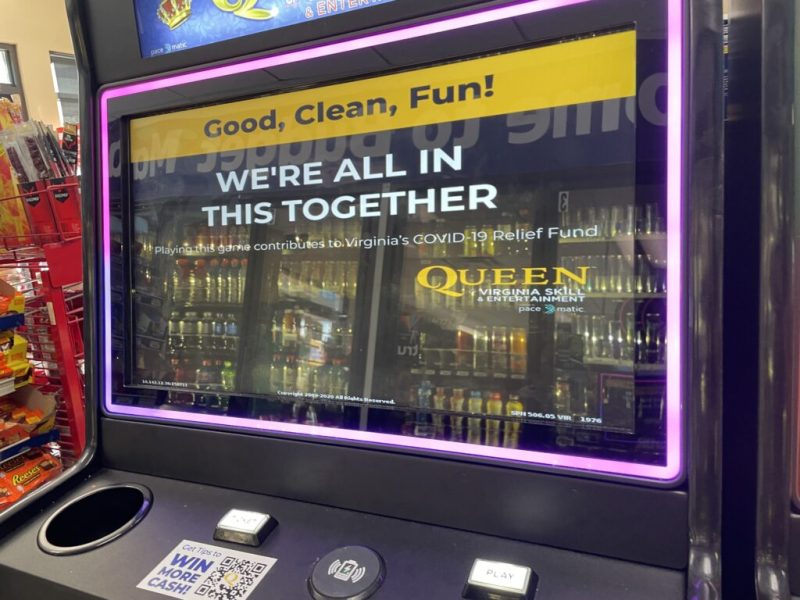
A message displayed on a Queen of Virginia machine at a Hanover County convenience store inaccurately suggests money from the machines still helps with the state’s COVID-19 response. (Graham Moomaw/Virginia Mercury)

The original court injunction that kept skill games running — and raised doubts about the constitutionality of treating them as illegal gambling — was set to expire in May of 2022, with an expectation the case could have been resolved by then. More than a year later, it’s still unclear when and how clarity might come on an issue some see as an ongoing failure by the state to set a clear, enforceable, and legally defensible policy.
Franklin City Manager Amanda Jarratt, one of several local government officials to voice frustration on the matter, said it’s “imperative” that someone makes a final decision on whether the machines are going to be legal or not.
“Having no clear direction on licensure, taxation, or regulation creates a frustrating position for localities,” Jarratt said. “When citizen complaints are filed with the locality, we find ourselves in a position not to be able to provide them with any guidance or resolution to their concerns.”
In late 2021, then-Attorney General Mark Herring unsuccessfully tried to have the court injunction overturned. At the time, his office argued that instead of preserving the status quo while the lawsuit proceeded, what the lower court had done amounted to “an immediate and complete deregulation from the bench.”

“It is now legal in Virginia for a child of any age to go to a corner store and gamble on so-called video skill games,” the state wrote in its failed 2021 petition to have the Supreme Court of Virginia intervene to fix what the state described as an urgent problem.
Many skill machines still have stickers indicating minors are not allowed to play them, but it’s unclear how strictly those rules are enforced by convenience store cashiers, who are often the only ones in a position to supervise the machines.
During the last court hearing in the case in December, the retired judge who issued the injunction indicated proceedings in the Greensville Circuit Court would resume in April or May once the legislative session was concluded. There’s been little action since that hearing apart from the litigants arguing over what Judge Louis Lerner’s last preliminary ruling meant. The two sides will be back before the judge for a status update on July 28.
Lerner has indicated he sees merit to the industry’s contention the ban violates free speech by outlawing a particular type of video game due to its resemblance to traditional gambling. Skill-game proponents insist the games shouldn’t count as gambling because they’re based primarily on skill, not chance. Backers have also said if the state is going to allow casinos, it should give smaller businesses a chance to get in on a new industry.

Attorneys for the state have raised doubts about whether free speech concerns should even apply and have insisted the ban falls well within the state’s powers to regulate and restrict gambling. Supporters of the skill-game ban note that, unlike other gambling interests, the industry aggressively moved into Virginia without asking the General Assembly for permission until the games started to draw attention.
The court records don’t clearly indicate what might be delaying the lawsuit, and the office of Attorney General Jason Miyares said it can’t comment on pending litigation.
The General Assembly’s recent habit of not passing a budget bill on time and the involvement of Sen. Bill Stanley, R-Franklin, in the case were factors previously cited in discussions over the case’s timing. Retired judges are often brought in to handle cases involving a sitting lawmaker, and General Assembly members who work as lawyers have the power to postpone court hearings they’re involved in while the legislature is in session. Stanley, who is representing skill game supporters challenging the ban, has not formally invoked those powers to postpone proceedings. However, Lerner has indicated Stanley’s involvement requires the court to work around the General Assembly’s calendar to some degree.
Georgia-based Pace-o-Matic, the parent company of prominent skill-machine brand Queen of Virginia, also declined to comment on why the litigation is taking longer than anticipated.

Asked why some Queen of Virginia machines inaccurately say some of the money players might lose will go toward the state’s COVID-19 response, a spokesperson for Pace-o-Matic said the company’s hands are tied by the terms of the court injunction that kept the machines running.
“Pace-O-Matic is operating 100% in compliance with the temporary injunction, which states that we are not to make any updates to the software,” said Christina Freundlich, a public relations consultant working with the company. “This includes any messaging featured on-screen.”
The court injunction didn’t explicitly say the company must freeze its software and screens in place, but Freundlich said that’s how the company interprets a court order that only protected “those games” taxed and regulated before the 2021 ban took effect. Company representatives have also claimed the injunction allows for previously regulated Queen machines to be moved to new locations, which would explain why machines are showing up where they didn’t exist before.
Though the General Assembly’s official stance is that skill games are a form of unsanctioned gambling, both Republican and Democratic politicians have continued to accept donations from skill-game companies as both sides scramble for campaign money in an important election year.

A PAC tied to Pace-o-Matic made $141,750 worth of political donations to both parties in 2023 alone, according to the Virginia Public Access Project. That included $30,000 to House Majority Leader Terry Kilgore, R-Scott, after the influential Republican-sponsored an unsuccessful bill to reverse the state’s skill-game ban and restore a regulatory system for the machines. The PAC, Va Operators for Skill, gave to about 30 incumbent legislators this year, roughly evenly split between Republicans and Democrats. Organizational paperwork the PAC filed with the state last year listed a Pace-o-Matic official as its treasurer.
Pace-o-Matic, which has contributed more than $930,000 to Virginia political figures since 2018, also donated $20,000 to Gov. Glenn Youngkin’s PAC in March after contributing over $100,000 to both Youngkin and former Democratic Gov. Terry McAuliffe during their 2021 gubernatorial matchup. The governor’s office declined to comment on the status of the lawsuit.
The company also attempted to make a $25,000 donation to the inaugural committee for Miyares in early 2022. However, that contribution was refunded after a slip-up led to the funds being deposited during the General Assembly session, when legislators and statewide officials are prohibited from fundraising.
In another indicator of the industry’s political ties in Virginia, Pace-o-Matic recently confirmed that Democratic Party of Virginia Chairwoman Susan Swecker continues to work for the company as a paid consultant.
Swecker is not one of the company’s registered lobbyists, but Pace-o-Matic now lists former Virginia public safety secretary Brian Moran, who held that law enforcement-focused role in the administrations of both McAuliffe and former Gov. Ralph Northam, as part of its lobbying team in the state.
Freundlich, a Democratic political operative who worked for McAuliffe’s campaign in 2021, indicated the company is still hoping to work with the General Assembly to find a workable path forward in Virginia.
“It has been no secret that we are working with the General Assembly to regulate skill games in the Commonwealth formally,” Freundlich said in an email. “Last session, the House Majority Leader carried legislation to regulate skill games, provide tax revenue to the Commonwealth and provide funding to law enforcement to root out illegal gambling. We look forward to our continued work together during next year’s session.”
by Graham Moomaw, Virginia Mercury
Virginia Mercury is part of States Newsroom, a network of news bureaus supported by grants and a coalition of donors as a 501c(3) public charity. Virginia Mercury maintains editorial independence. Contact Editor Sarah Vogelsong for questions: info@virginiamercury.com. Follow Virginia Mercury on Facebook and Twitter.




Mayor Lori Athey Cockrell Looks to Water, Economic Development and Rail Trail in Another Term

WCHS vs. Brentsville HS – Girls Volleyball – October 6, 2026

BMI Is Only One Piece of the Health Picture

The Eye Surgery Factory That Could Not Expand

Ancient Ownership of Israel

VDOT: Warren County Traffic Alert for October 5 – 9, 2026

Reaching Out Now Expands Programs and Opportunities for Warren County Youth

Dance and Arts VA Finds New Home, New Opportunities on Water Street

Ann L. Shuman (1933 – 2026)

Wendy Lee Whitacre-Stout (1966 – 2026)

Spanberger’s Energy Plan Keys in on Clean Energy to Meet Growing Demand and VCEA Goals

Jean Elizabeth Grubbs Fogle (1939 – 2026)

Feds Provide Guidance on New Federal K-12 Scholarship Tax Credit Program

Why Wait Till November? Mid-Term Election Early Voting Processes in Place Now

US Senate Leaves Nation’s Capital in Advance of Midterms With Much Still Undone

Business Growth Series: If You Don’t Control Your Day, It Controls Your Business

The End of a 20-Year Monopoly on the Credit Score
Voltron and Immigration

States OK Solar Panels for Balconies. Safety Guidelines Haven’t Caught Up

Trump TV Ads Paid for with $20M in Homeland Security Funds, Dems Find

Blue Ridge Wildlife Center Patient of the Week: Gray Treefrog

Birthday Twins: See Which Famous Face Shares Your Big Day

Meet-and-Greet Set Sunday for Republican-Endorsed Front Royal Candidates

Barbara Ann Mathews Smelser (1943 – 2026)
