
State News
Public Health Officials Warn of Rise in Measles, as Virginia Hantavirus Patient Under Monitor
As the weather warms and travelers prepare to embark on summer vacations, public health officials are warning about an expected uptick in measles cases, which were already climbing.
Nearly two dozen Virginians have been infected with the disease so far this year.
Guidance sent to state and local health departments late last month by the Centers for Disease Control and Prevention outlined public outreach strategies and urged public health agencies to prepare for more cases of the illness in the months ahead.
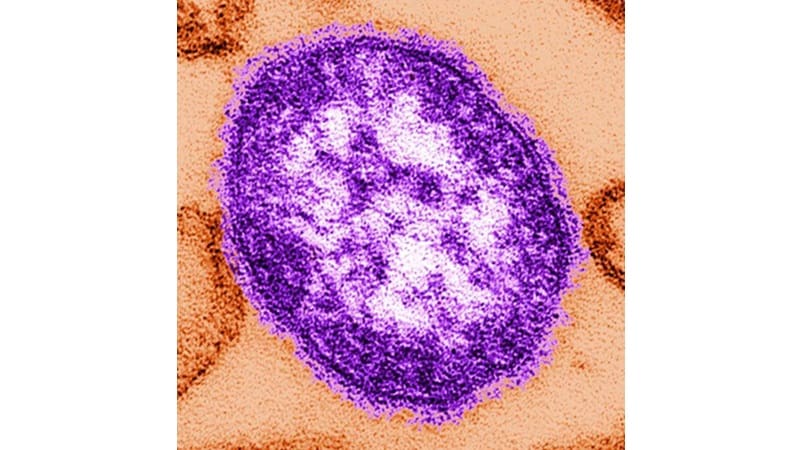
A digitally colorized, thin-section transmission electron microscopic image of a single measles virus particle, or virion. (Photo courtesy Centers for Disease Control and Invention Public Image Library)
As of April 30, the most recent data on the CDC’s website, there were 1,814 measles cases in the U.S. this year across multiple states, including Virginia. Over 900 of those cases this year were reported in South Carolina and Virginia, and so far, 20 people have been reported with the disease.
“CDC is ready to support health departments upon request,” a statement in the guidance read. “CDC remains fully engaged in protecting the nation’s health and will continue providing updates and coordinated support to help ensure communities have the tools they need to prevent and contain measles.”
The federal health agency recommends providers report cases within 24 hours of diagnosis to measlesreport@cdc.gov.
Additionally, the agency encouraged public health authorities to conduct contact tracing to understand where outbreaks are occurring, and enhance outreach about the disease to under-vaccinated communities “through trusted messengers.”
Measles, a highly contagious virus spread through the air, causes a high fever, runny nose, bloodshot eyes, and a rash on the body. Measles weakens the immune system, and it can result in dangerous complications like pneumonia, brain swelling, or a nervous system infection — all possibly deadly.
About 90% of cases affect people who are not vaccinated against measles.

“Obviously, vaccination rates have declined and significantly declined, and that’s the main driver of the current measles outbreak,” said Ashley Apple, a Virginia nurse practitioner-turned-nursing professor.
Measles was once considered eliminated in the United States about two decades ago, but has had a resurgence in recent years as anti-vaccine rhetoric has become more mainstream and misinformation about vaccines has spread, leading to confusion and hesitancy for some parents.
“The uptick in vaccine hesitancy and vaccine skepticism has been fueled by politics,” Apple said. “Public health decisions and investments should be based on peer-reviewed science rather than politics, and unfortunately, we’ve seen the public sort of get caught in the crosshairs of a political battle.”
U.S. Secretary of Health and Human Services Robert F. Kennedy Jr. has also been a longtime vaccine skeptic. His Make America Healthy Again campaign, modeled after President Donald Trump’s Make America Great Again slogan, has routinely been critiqued by health professionals.
During a measles outbreak in Texas last year, RFK Jr. did not recommend the vaccine and emphasized people should decide independently whether to get it or not, advising them to “do your own research.”
By the time of last month’s surge in South Carolina and amid testimony to Congress, he noted that the CDC is recommending the vaccine for measles now.
Virginia Hantavirus patient ‘low risk’
Another virus has sparked concerns from world health leaders and prompted a response from state health officials this week.
A Virginia traveler who was aboard a cruise ship that experienced a deadly hantavirus outbreak has returned to the state and is so far showing no symptoms, VDH communications director Maria Reppas said Thursday.
“This person is currently in good health and is under public health monitoring. To protect the privacy of this person, no further details will be shared about this individual,” she added.
Hantavirus is an illness that typically originates from contact with animals like rodents, but the strain affecting the cruise ship passengers can manifest through human-to-human transmission. The illness can cause respiratory or cardiac failure.

To date, three people have died from the cruise ship outbreak, and another person is in critical condition.
Reppas explained that fewer than 30 U.S. citizens were on the MV Hondius ship, so there is a chance that a small number of potentially exposed Virginians could be identified in the coming days. Reppas estimated it could be fewer than five people.
VDH’s main office is maintaining communication with travelers, its local health districts, and federal officials.
“Generally speaking, we believe the risk to the general public to be low,” Reppas said.
by Charlotte Rene Woods, Virginia Mercury
Virginia Mercury is part of States Newsroom, a nonprofit news network supported by grants and a coalition of donors as a 501c(3) public charity. Virginia Mercury maintains editorial independence. Contact Editor Samantha Willis for questions: info@virginiamercury.com.




This Week’s Showtimes at Royal Cinemas as of October 22nd

Debbie’s Lighthouse Combats Food Insecurity While Helping Small Businesses Grow in Front Royal

Decision on ‘EagleView’ Contractual Oversight of Photographic Assessment Technology Delayed to November 17

Blue Ridge Wildlife Center Patient of the Week: Great Horned Owl

Dominion-NextEra Merger Hits Turbulence, Faces Opposition from Virginia Leaders, SCC Staff

Cheaper Manufactured Homes Could Be Having a Moment, If Only States Can Catch Up

POLICE: 7 Day FRPD Arrest Report 10/19/2026

Sight & Sound’s JOSHUA LIVE! Comes to Royal Cinemas — Limited Run, October 29 – November 4

You Are Not Wasting the AI’s Time

The ‘Beer Belly’ Isn’t Really About Beer

Virginia State Police Launch Two-Day Interstate 81 Safety Enforcement Campaign October 21–22

Everybody Is a Leader Somewhere

Warren County Wildcats Host Meridian in Girls Volleyball Match Tuesday Night – October 20

Closing Virginia’s Childcare Affordability Gap Could Cost Up To $4.5B a Year

New Coalition Aims to Keep Virginians Covered as Medicaid Rules Tighten

General Assembly Calls Off Oct. 26 Special Session to Elect Judges

Trump Order Sets Up New Women’s Health Research Initiative at NIH, White House Task Force

What Is Puberty?

First New Class of Pain Medicine in Decades Comes with A 14-Day Limit

Front Royal Man Charged with Two Counts of Forcible Sodomy Following RSW Regional Jail Investigation

James Edward “Jimmy” Mahoney (1953 – 2026)

Ask Stewart: Are There Any Scary Trees?

Janet Denny Casarotti (1933 – 2026)

Virginia Breeders Championship Series Opens at Shenandoah Downs with Impressive Performances
