
Opinion
A perspective on the Town Council’s view of creek stabilization – Time to catch up with the 21st Century
During the November 9 Town Council meeting, Melody Hotek, president of the Front Royal/Warren County Tree Stewards was assured by town staff that no trees over 4-inches in diameter had been cut down by the Town Public Works crew along Happy Creek next to Front Street. However, an inventory of stumps along the west bank by arborist David Means and myself revealed that 115 trees of that size or larger had been cut down. Of these, 87% were native species, and 77% measured 5-16 inches in diameter.
Unfortunately, we cannot know the size of trees ripped out by the roots before Means reported the work to the Royal Examiner in October. According to town staff some larger trees had to be removed so that the “bench could be sloped” for the installation of rocks.
Interestingly, the oldest trees were about 20 years old. Asking around, we were told that the Town used to cut the trees down every three years – until about 20 years ago. This would also explain our town manager’s claim that clear-cut banks and rocked-in streambeds “will be beautiful.” Those of us over 50, like myself and the town manager, grew up in landscapes like that, with nature tamed and trimmed, shrubs sheared into lollipops, perfect lawns doused in herbicide, and trees with limbs chopped off like amputees.
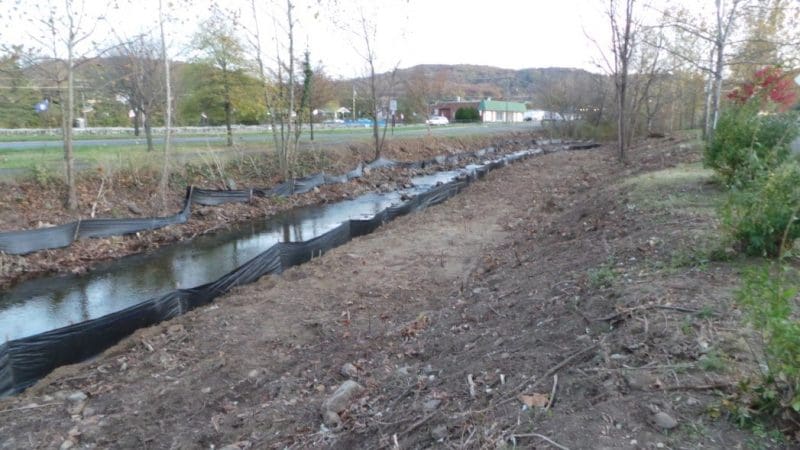
After: Expensive 20th Century flood control concepts replacing effective 21st Century solutions along Happy Creek in Front Royal. Courtesy Photos FR-WC Tree Stewards
But times are changing, and we must change as well. Every 21st-century kid learns about water quality and riparian buffers in school nowadays. But those of us who haven’t been to school in a while may have missed the updates – that clean water, flood control, and healthy trees go hand in hand. Most towns and cities are exchanging the riprap our Council is now installing for exactly what we’re yanking out: 35 to 100-foot borders of broad-rooted trees and shrubs, called riparian buffer zones.

Before: A riparian buffer no longer in place along Happy Creek’s bank on Front Royal’s southside as Tree Stewards plant the now ‘deceased’ willow tree on a rainy Arbor Day 2016.
Unfortunately, the “bad haircut” accurately described by Tenia Smith in her recent letter to the editor is the result of misguided and outdated thinking in stormwater management and healthy water quality. A rock-lined stream acts like a water chute, accelerating and building the volume of excess water as it travels downstream, spreading out at first opportunity into town streets, damaging bridges and buildings along the way. By contrast, tree roots not only quickly absorb water, but prevent erosion and filter out pollutants like dog poop and toxins. In addition, they shade us and the stream on hot days, keeping the water cool enough for fish and other organisms that thrive in healthy streams.
Fortunately, the roots of the remaining stumps along Happy Creek not only continue to secure the banks but contain enough energy to re-sprout next spring – if they’re not removed so that “the bench could be sloped.” Had the trees remained undisturbed, the larger ones would have eventually shaded out the weaker ones, leaving a tall and beautiful low-cost water filter while providing cheap flood control.
That’s not to say that there isn’t a role for riprap. Trees are not allowed within 100 feet of bridges, and if you look off the north side of the South Street Bridge, you’ll see two things – a huge culvert draining the South Street hardscape into Happy Creek and erosion caused by the resulting volume of water. This is where a hardscape mixed with low-growing shrubs and grasses would be a great solution, leaving nature to do the work downstream.

Drainage culvert from hardscape into Happy Creek at South Street.
As buildings are added upstream, such as a likely seven-acre housing development between the Martins plaza and Samuels Library, another enormous culvert will start draining stormwater from new roofs and parking lots. A responsible, forward-thinking Town Council would ensure that Happy Creek remains healthy and that we don’t all have to freak out about another bad haircut along Remount Road. For this reason, a plan should be created and shared with residents for comment well in advance by qualified professionals in our community who understand the importance of both housing and clean water. They are not incompatible.
Our town has an Urban Forestry Advisory Commission appointed by Town Council to address tree care and preservation. But did they obey their own town code by consulting these experts? No, ma’am, they chose a $37,000 bad haircut instead of expanding and beautifying our riparian buffers.
Meanwhile, people must understand that flood control is complex, with many variables. For example, the flooding you observed on downtown a few years back was due to overwhelmed pipes draining excess water into poor old Happy Creek, who could not contain it all. Well-managed communities know that excess water is best controlled at its source. Thus proper zoning ensures that runoff is retained where it hits the ground, to be released over a 24-48-hour period into streams like Happy Creek. Nowadays, beautiful equals healthy – for humans, trees, and water.
Sonja Carlborg
Front Royal