Interesting Things to Know
History in Perspective: ‘Don’t call it a Comeback’ – The culmination of a Civil War chess match: Bloody Antietam
From June 25th to mid-September, one hundred and sixty years ago, the United States witnessed one of the most dramatic comebacks in our history – eventually culminating in the bloodiest single day in U.S. history on the 17th of September. We are currently commemorating the 160th anniversary of these events during the months of June through September.
The year was 1862, and the U.S. was fighting an insurgency against a confederation of states that had broken away from the union. These were interesting times to be sure, and especially exciting for those within a hundred miles of Washington, D.C. The fight in Virginia was raging, and everyone was anxious for the latest news. President Lincoln and his cabinet ran the show from the White House against Jeff Davis and his Confederate cabinet – just 90 miles down the road in Richmond. Many in the north felt their team would prevail as the United States was sporting a two-to-one numerical advantage on the battlefield and threatening the Confederate capital. The Confederate government was equally concerned and had a train on standby in case things went sideways.
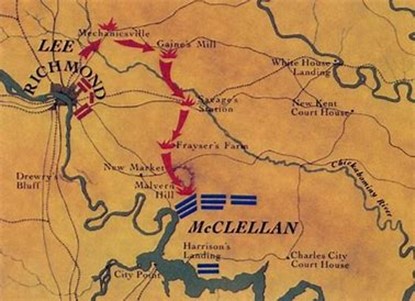 With little time left on the clock for the Confederacy, Stonewall Jackson started a chain of events in the Shenandoah Valley with a string of victories forcing the Lincoln Administration to pull troops from the siege of Richmond to protect Washington. Robert E. Lee assumed the reigns of the defending Confederate Army in Richmond and immediately began attacking the Union Army on the peninsula between the James and York Rivers. The Confederates attacked, forcing seven battles in seven days. The number of casualties during these 7 days surpassed the total number of casualties in the war to date. General McClellan’s Union Army fell back to the safety of gunboat protection and began a time consuming maritime evacuation northward along the Potomac to regroup in the capital region. Bells chimed in the Southern capital. A feeling of euphoria swept through the Confederacy, but General Lee knew it would be just a matter of time before the U.S. forces were back at the gates of Richmond.
The Confederates moved swiftly to put pressure on the remaining Federal army defending Washington while the preponderance of the Union Army was transitioning back to Washington by boat. Outnumbered and outgunned, the Confederates left a small detachment on the peninsula to deceive the U.S. forces and capitalized on their success with one of the most impressive turnabouts in the history of warfare.

General Lee divided his forces and sent Stonewall Jackson’s Corp on an end-around maneuver to get behind the Federal army and smash their logistics hub at Manassas Junction. The tactics of stealth and surprise resulted in the sacking of Union supplies behind their lines. Afterward, Jackson vanished from radar and hid his force along an abandoned railroad cut north of Manassas. The Federal army could not locate him. Meanwhile, Lee followed with General Longstreet’s Corps through Thoroughfare Gap a few days later. Lincoln’s telegraphs alerted the Union Commander, General Pope, that Jackson was lurking in the vicinity, so the Federal army consolidated and moved eastward to defend the capital. Upon learning that Southern reinforcements were within striking distance, Jackson allowed himself to be found, and General Pope stopped to give battle. The Second Battle of Manassas ensued. Jackson and Pope went at it all day and just as General Pope was about to deliver the coup de gras, Confederate General Longstreet’s Corp arrived and exploded into the Federal left flank -sending the U.S. army fleeing into Washington D.C.
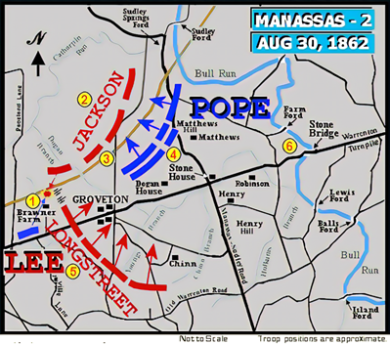 Unbelievable! Within the span of a month, the Confederates turned the tables from defending their capital to threatening the Federal capital in Washington, DC. Now, Lee held the initiative. As the architect of these recent victories, Lee sought to exploit the opportunity that the latest string of Confederate victories along the Peninsula and Second Manassas offered. This set the conditions for the bloodiest single-day battle in American history – the battle of Antietam.
Lee understood from the beginning that the South could not win the war but knew the Confederacy’s best hope for independence rested upon the morale of the Northern people. Northern newspapers depicted strong resentment towards the war from the Democratic Party. The Northern people might vote to let the South go if the war proved too costly. With the recent turn around, Southern independence became a real possibility. Confederate military successes were the means to erode morale and create this political climate. The Northern troops were demoralized from recent losses. The fall elections in the North were approaching. England and France stood on the sidelines watching closely, carefully weighing whether they should recognize the Confederacy.
Never before had the stakes been so high.

The Union army was reeling from recent setbacks, but the Confederate Army was thoroughly exhausted from non-stop fighting and prolonged forced marches. Strategically speaking, the South’s next move may have been doomed from the start. Lee wrote the Confederate President, “The army is not properly equipped for an invasion of enemy territory,” He nevertheless understood that this was his only move. He could not fall back to Richmond and regroup as both armies had ravaged all food subsidies in the Virginia countryside. He also knew that the North would not fall for the same tricks twice. Subsequently, he redirected his supply lines from Richmond to the Shenandoah Valley through Front Royal and Winchester to conceal them from enemy eyes. Simultaneously, the Confederate army moved from the shadow of Washington into western Maryland (pictured here).
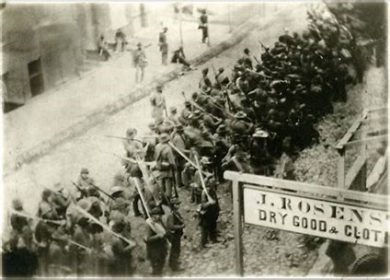 The response was immediate. The telegraph lines hummed from West Virginia, Maryland, and Pennsylvania screaming for President Lincoln to do something. The Confederate invasion of Northern soil allowed the Confederates to simultaneously threaten Baltimore, Washington, and Harrisburg, Pennsylvania. Lincoln had no choice but to dispatch all available forces to go after the Confederates, whether the Union forces were ready or not. Only a month earlier, the Northern press was reveling in the throes of imminent victory – now terror and anxiety ruled the day.
As the Confederate columns made their way across western Maryland, the Army of the Potomac advanced slowly out of Washington with some 85,000 men of all arms, although nearly 20,000 were raw recruits. No one could have envisioned the horror that awaited in Antietam.
After sparring about at South Mountain and Harpers Ferry, the two great armies converged on the banks of Antietam Creek at Sharpsburg, Maryland. Straggling had reduced Lee’s strength to about 35,000, and McClellan had about 70,000 on hand.

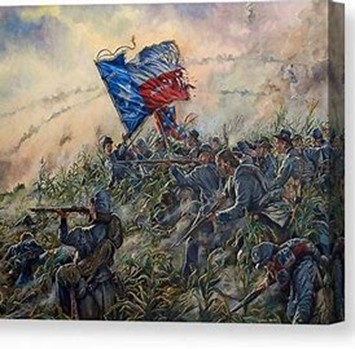 The Battle of Antietam commenced at first light on September 17, 1862. The battle developed into three distinct phases. All shared one common characteristic – it was the bloodiest and most shocking battle the combatants had ever seen. Iconic names like ‘The Cornfield’, ‘Bloody Lane’, and ‘Burnsides Bridge’ have passed into Civil War folklore from this fight. The epic battle ended in high drama when Lee’s right flank began to crumble under an attack by the Union Ninth Corps. Disaster looked eminent for Lee when suddenly Southern forces miraculously arrived from Harpers Ferry at the critical moment and drove the Federals back. Thus ended the epic battle. By sunset, 2,108 Union soldiers were dead, 9,549 wounded, and 753 were missing. Confederate figures gave their losses at 10,291 but provided no reliable statistics regarding the number of wounded and missing. All told, some 23,000 men were casualties; most of them killed or wounded in a single day. The battlefield, wrote one Union officer, was “indescribably horrible.” No other day of the war would surpass Antietam in carnage.
As previously alluded, we are currently commemorating the 160th anniversary of ‘the comeback’ campaign starting on June 25 along the peninsula, through Second Manassas in late August to the horrific conclusion at the battle of Antietam on 17 September.
(Editor’s Note: LanceLot Lynk is a pen-name used by regular contributor John Morgan. Of above graphics, he informed us the final one is a print of a painting attributed to Mark Maritato entitled, “The Heart of Texas – Antietam” depicting the battle in the cornfield.)