
Local Government
Consent Agenda with Data Center Focus Tabled at County Planning Commission Meeting
What could be perceived as an evasion of public accountability could also be perceived as a public victory when the County Planning Commission on May 13 voted to table the consent agenda, which featured two items related to data centers. Those two items, although they were not the subject of public hearings, were the reason that the room was packed with upwards of forty people who desired to register their opposition during public presentations. Upwards of fifteen of them did, but because, in the interest of time, the commission limited presentations to an hour, more than half of the room left disenchanted. Was tabling an evasive measure? Could it, however, be an indication that the commission listens to the public and realizes that their agenda is fraught with questions they have not answered yet? And was the hour-long cap a violation of a First Amendment right, as many members of the audience declared volubly before leaving? As the structure of government was juxtaposed with an angry crowd, democracy in crisis appeared to be the prevalent theme.
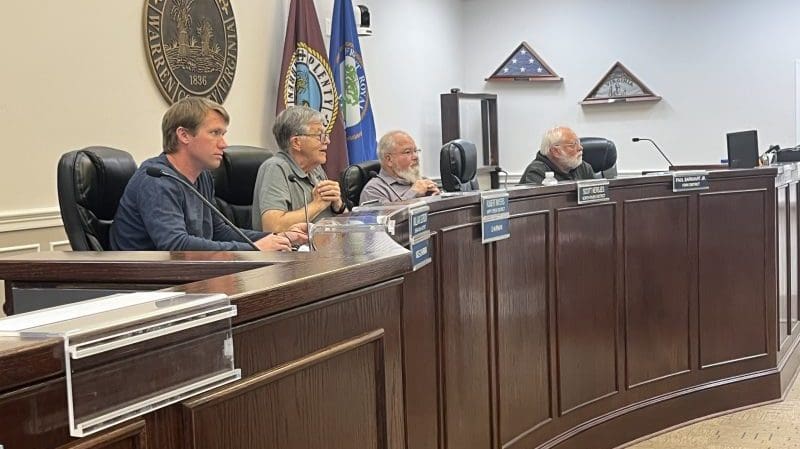
The County Planning Commission met for a regular meeting on May 13. Royal Examiner Photo Credits: Brenden McHugh
According to County Attorney Jordan Bowman, “there is no generalized rule” that the commission is obligated to allow public presentations to run to whatever length the occupancy of the room dictates. Obviously, this is a highly debatable issue, since any disenchanted member of the audience who claims familiarity with the commission’s policy asserts the opposite. But if one thinks in terms of a process that could very well run into the wee hours of the morning, the commission has a commitment to conserve time to ensure that all the public hearings on the evening’s agenda are executed. Also, the commission’s recognition of the need for further, careful consideration was evident later during “commission matters”, as commissioners discussed the advisability of a work session to review the text amendment to allow data centers as a use, as well as the Rockland Road application for the first data center the county might subsequently see.

: Interim Planning Director Kelly Wahl and County Attorney Jordan Bowman.

Those fifteen-plus people succeeded in making a comprehensive case featuring all the points against data centers, a comprehensiveness evident to the Royal Examiner from covering this issue for over a year. All the usual points about limited resources were made, as well as the defacement of natural beauty and the reputation of data centers for being obnoxious in terms of things like noise pollution, but what was extraordinary was the emergence of an argument against restrictive ordinance, identifying it as a Trojan horse that opens the door to an operator that one speaker associated with terrorism. Based on what data centers have reputedly done to Northern Virginia, that connection might have some merit. But it seems more complicated than that. The computing industry is arguably evolving, and even a cursory examination of the Rockland Road application reveals that the game has changed dramatically. Operating with greater efficiency, the developers are at least claiming that they are no longer what one speaker characterizes as a soda straw.
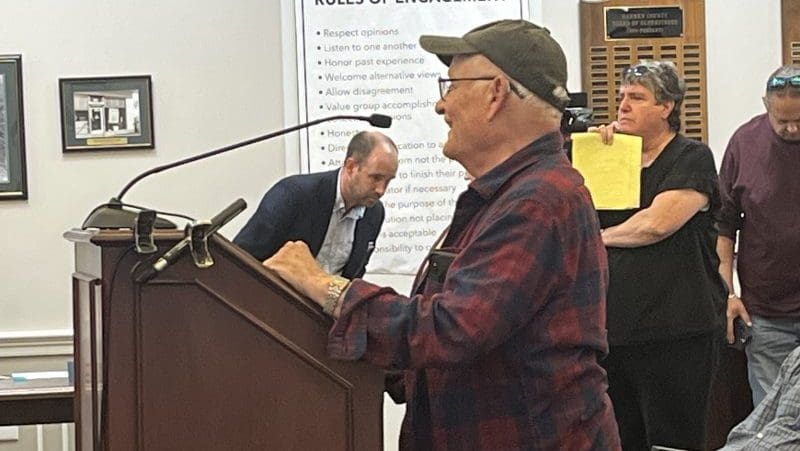
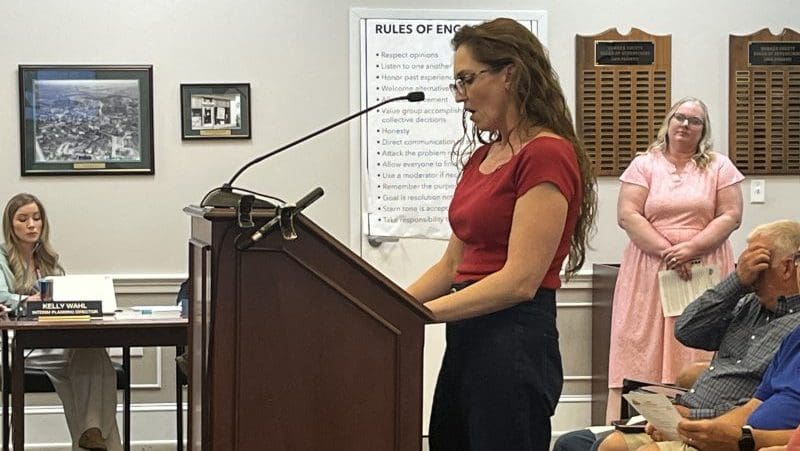
Among upwards of fifteen people who spoke against data centers, Jim Coats (above) and Melanie Salins (below) address the commission.
Why not wait until they can be even more efficient? Thus, the argument for a temporary moratorium enters stage right. The developers do indeed have a legal right to apply, and on some level, the Dillon Rule argument possesses some merit, although that hypothetical court battle could technically be pushed all the way to the federal Supreme Court, thus forcing the ultimate decision on whether a municipality has the right to ban something that the state allows. The American Civil War teaches, if anything, that just because a state says something does not mean it is right. It is not necessarily federally correct. What may be obsolete in five years, while delivering a product of nefarious value, must be weighed carefully within the paradigm of what the Front Royal and Warren County community really needs. One may know that the Viet Cong’s victory is inevitable, but that does not change the fact that one has been instructed to fight.
Other agenda items were addressed that evening, but the Royal Examiner was hardly listening. It was impossible not to be preoccupied with this proverbial Saigon falling to an enemy who is somehow destined to be tomorrow’s ally. When one of the speakers had instructed, “If you are against data centers, stand!” it was necessary to stand, but only to sit down with the awareness that such a gesture does not change the trajectory of history. “Why, God, why?” a Broadway character once asked a silent heaven. Why is it that what kills is somehow going to save? Why is it that one must oppose an industry that was chartered to defend everything one believes in? What is done clumsily can be honed to efficiency, but time is the variable that will not leave the equation. Today’s mistake could be the royal road to redemption, but the echo of it could be haunting.
Watch the Warren County Planning Commission Meeting of May 13, 2026.

bsp;




Walking Malls Don’t Solve Problems

Festival of Leaves 2026 Wraps Up a Successful Day in Downtown Front Royal

Autumn Delights: Spotlight On Pumpkins!

Lord Fairfax Health District Receives $5,000 Grant To Support Local EMS Crews

Why an AI Bubble Could Reach Your Savings

The Platypus: A Truly Amazing Animal!

A Thing of the Heart: Two-Fold Outreach to Children and Award Presentation Brings Hike Kidz to Stone Branch Arts Center

Virginia State Police Seize Drugs Valued at More Than $830,000, Recover 13 Firearms

Commentary: We Hate Technology. Please Like and Share

One Medicare Open Enrollment Decision That Can Be Hard to Undo

Constitution 101: The Postal Clause

VDOT: Warren County Traffic Alert for October 12 – 16, 2026

UVA Poison Expert Warns of Emerging Synthetic Opioids That Fentanyl Tests May Miss

Pumpkins Will Take to the Skies at Front Royal Warren County Airport Oct. 24

Front Royal Remains Under Mandatory Water Conservation As Shenandoah River Flow Drops

Front Royal Women’s Resource Center Opens 2027 Dare to Dream Grant Applications

Warner, Mizusawa Outline Competing Approaches to Disability Policy

Fable Greenhouse and Gardens Breathes New Life into Former Horton’s Nursery

Louise Virginia “Mom” Messer (1936 – 2026)

Business Growth Series: Doing Everything Yourself Is Slowing You Down

The Mystery of the Purple Seal

Front Royal Outdoors Founder Don Roberts Named 2026 Protector of the Shenandoah

Front Royal Man Held Without Bond Following Child Sexual Abuse Material Investigation

Performing Arts Center Pointing to 2027 Opening as Local Entertainment, Business, and Educational Partner
