
Automotive
A history of roads in Virginia: The secondary system

Highways and road signs were vastly improved by the 1930s.
It was against this background that the General Assembly in 1932 approved a means by which the counties could be relieved of road construction and maintenance responsibility. The “Byrd Road Act” inspired by the former Winchester senator who two years before had completed a term as governor, authorized the establishment of the state “secondary” road system. It permitted each county, if it wished, to give its road responsibility to the Highway Commission. One economist estimated that this action would reduce rural taxes by $2,895,102 annually.
Four counties – Arlington, Henrico, Nottoway and Warwick – chose to keep the responsibility; the other counties joined the new secondary system. In 1933, Nottoway reversed its earlier decision and joined the system. Years later, Warwick gave up its county status to become a city that eventually merged with Newport News. Arlington and Henrico counties continued to operate their own local roads.
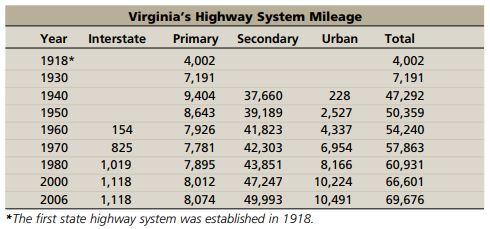
When the secondary system was established, it totaled 35,900 miles. It included 2,000 miles hard-surfaced, 8,900 miles with soil or gravel surfaces, and more than 25,000 miles, or almost 70 percent, of largely unimproved dirt roads. Some counties had no hard-surfaced roads at all.

Within a decade, the amount of hard-surfaced roads had tripled, the mileage of soil or gravel roads had doubled, and the unimproved roads had been reduced by almost half. With the arrival of the secondary system, the main roads for which the state had been responsible became known as the “primary” highway system.
In August 1939, with motor vehicle registration approaching a half million, Commissioner Henry Shirley reported that “The demand for a road that can be used throughout the year is becoming greater and greater, and such a road has become a necessity. Practically all horse-drawn equipment has vanished from the highways, and motor equipment taken its place, requiring a road that can be traveled the year-round.”A year later, Shirley reported another development that was to become a major part of road operations in Virginia and elsewhere. “All the main highways are being marked with traffic lines, and the system adopted we hope will be the means of saving many lives. Under no condition should a vehicle cross a solid line when it is next to the vehicle, or two solid lines,” he said.
Despite the precautions, however, safety problems continued to trouble highway engineers as the number of autos grew. Brig. Gen. James A. Anderson, who had taught civil engineering and been dean of the faculty at VMI, was on furlough from the academic world and was serving as coordinator of the State Defense Council at the time of Shirley’s death in July 1941. Anderson was appointed highway commissioner, a position he held until his retirement in 1957.
“Accidents on the highways are increasing daily, and every care and precaution within the power of the commission is being taken to reduce this heavy toll of life,” Anderson said shortly after his appointment. “It is imperative that something be done to reduce the speed of automobiles on the highways, and to educate the drivers to the courtesy of the road.”

Next up: Another World War Begins
Produced by the
Virginia Department of Transportation
Office of Public Affairs
1401 E. Broad Street
Richmond, VA 23219
VirginiaDOT.org




Judge Calls Trump Mail Ballot Rule ‘Substantively Unconstitutional’ as Court Battle Extends

US House Clears Spending Stopgap Backed by Trump That Averts Government Shutdown

Apple Lawsuit Puts Employee Offboarding and Digital Access in the Spotlight

Virginia Education Board Updates Graduation Requirements, Expands Course Options for Students

Commentary: The Day Virginia Took Down Confederate Statues, a Black Church Remembered a Lynching Victim

Inside Virginia’s City Halls, Concerns, Confusion Rise with Flock Surveillance Protests

A Summer of Recalls Exposes Holes in the Nation’s Food Safety Net

Stewart E. Burke Sr. (1934 – 2026

DLC Acquires Royal Plaza Shopping Center in Front Royal

Food Scares Can Hurt Restaurants That Had Nothing to Do With an Outbreak

Virginia State Police Rap Back Program Tops 55,000 Enrollments in First Year

Warren County Volleyball Set to Host Kettle Run Tuesday Night – September 1

Economic Growth Is Not the Same Thing as Economic Health

Virginia Health Leaders, Lawmakers Share Enhanced Healthcare Resources for Rural Communities

Commentary: Public Utilities Shouldn’t Be Funding the Campaigns of the People Who Govern Them

Voting Rights Struggle Continues, Gov. Spanberger and Advocates Say at March on Washington Anniversary
Warren County Volleyball Set to Host Strasburg Monday August 31st

Trump Administration Announces Venezuela Oil Deal, Space Academy Commission and Other Actions

Recalling the History of Recalls

September Celebrity Birthdays

Wawa to Open New Middletown Store With Grand Opening Celebration Sept. 4

Reaching Hearts Gospel Fest Returns to Downtown Front Royal, Seeks Community Sponsors

VDOT: Warren County Traffic Alert for August 31 – September 4, 2026

Why Should You Care If the Business Down the Street Closes?
