
State News
By The Numbers: Documents Reveal Possible Financial Impact, Risks of $2 Billion Arena Project
After a state senator blocked two of three attempts to help bring two professional sports teams to Virginia, lawmakers are negotiating how — or if — to bring the Washington Wizards and Capitals to the commonwealth before the General Assembly session adjourns Saturday.
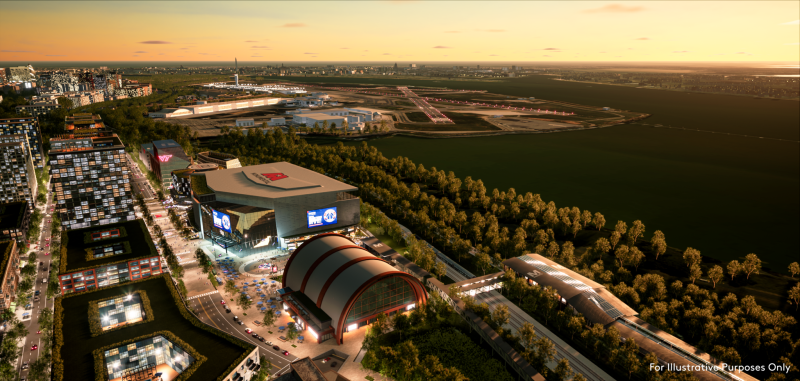
An illustration of the proposed entertainment district in the City of Alexandria. (Courtesy of JBG SMITH)
The proposal, announced by Gov. Glenn Youngkin this December, envisions a sports arena, practice facility for the Wizards, and a performing arts venue, paired with new retail, residential, restaurants, hotels, and conference facilities near Amazon HQ2 and the Virginia Tech Innovation Campus along the Potomac River in Alexandria.
Two documents have been key for supporters in projecting positive aspects of the project, namely generating a fiscal impact of $12 billion and creating roughly 30,000 jobs.

Virginia announces plan to bring two pro sports teams to Alexandria
Those documents appear to show that the potential benefits are contingent on the facility hosting hundreds of events annually and that the success of the 9 million square foot entertainment district hinges on costs and interest rates remaining stable. However, the plan includes some protections against creeping costs.
While the arena project is a priority for Youngkin and Ted Leonsis, CEO of Monumental Sports and Entertainment, which owns the Wizards and Capitals franchises, it has garnered strong opposition from at least one high-profile Senate Democrat, Finance and Appropriations Committee Chair Louise Lucas, D-Portsmouth, as well as Alexandria resident groups, labor unions and others who depict its projections as overly optimistic. Those groups have pointed out that if arena revenues don’t live up to estimates, Virginia taxpayers could be on the hook for as much as $1.35 billion, according to one calculation reported by The Washington Post.
Lucas successfully killed standalone bills, establishing an authority that would have the power to issue $2 billion in bonds for the project. However, the language creating the authority made it into the House budget, with a clause requiring General Assembly approval of the arena plan next year; it is now being considered privately by a select group of 12 legislators negotiating the state’s two-year budget. Youngkin, meanwhile, continues to have “productive conversations” with lawmakers, according to spokesman Christian Martinez, in hopes of convincing them to make the project a reality.
Whether the project comes to fruition may also depend on other negotiations: Lucas and Senate Majority Leader Scott Surovell, D-Fairfax, have previously indicated support may require Youngkin to negotiate with Democrats on other caucus priorities such as raising the minimum wage and allowing cannabis sales.

The two documents
Arguments that the arena will prove a financial net positive for Virginia have rested on the conclusions of two documents: a project brief by investment bank J.P. Morgan and an economic and fiscal impact report prepared for the Alexandria Economic Development Partnership. The J.P. Morgan brief has never been made widely available to the public, while the Alexandria report was released in redacted form in mid-February.
“We released the full report … in the interest of transparency and to provide our community with greater detail on how this proposal could benefit Alexandria,” said Partnership President and CEO Stephanie Landrum in a statement to the Mercury.
The J.P. Morgan brief, which the Mercury obtained, was a key document reviewed by the state’s Major Economic Incentives Project Approval Commission, a group of members of the General Assembly and the governor’s administration tasked with reviewing financing for individual incentive packages extended by the state to companies. The commission endorsed the arena plan unanimously this December, ahead of Youngkin’s announcement.
The brief includes graphical renderings of the proposed project and details of its financing plans, project phases, the proposed number of jobs to be created, and other potential benefits to the city of Alexandria and Virginia.

Some Senate Democrats have criticized the reliance of the MEI Commission on the report as questionable, saying J.P. Morgan has a conflict of interest because even as it has analyzed the arena deal for the state, its asset management arm is advising a member of the partnership that owns the land where the arena would be sited.
Surovell said he is unaware of any code of business ethics or state law that would explicitly prohibit such an arrangement but said, “I think it’s more of an appearance issue.”
Youngkin’s office has insisted that the analysis conducted by J.P. Morgan for the MEI Commission was done by a completely separate part of the bank “and adhered to the intensive compliance regulations required,” Martinez said. He added that J.P. Morgan was selected to analyze the project for the MEI Commission through a bidding and procurement process.
The J.P. Morgan brief also relies on the conclusions of a separate report analyzing the economic and fiscal impacts of the proposed project produced by HR&A Advisors, a development consulting firm hired by the Alexandria Economic Development Partnership.

In its analysis, HR&A looked at two potential development scenarios: one in which the arena and its associated entertainment district are developed and a baseline scenario in which they are not, and the development of residential, retail, and office space on the site occurs organically.
The arena scenario is based on a three-phase development schedule — the first to be completed by 2029, the second by 2031, and the third by 2036.
Overall, it concludes that developing the arena and its associated entertainment district would produce “roughly 2.5 times the economic output of what would otherwise be built based on current development plans.”
The HR&A analysis and the J.P. Morgan brief indicated the project could be supported through multiple revenue sources, including a 10% ticket tax on arena and performance venue events, underground parking, and campus naming rights.

220 events or more
The HR&A analysis assumes 221 events will be held at the arena and 115 events will be held at associated performing arts venues. The J.P. Morgan brief also cites the 221 annual event figure, projecting that events at other facilities could increase that number.
J.P. Morgan notes revenues could suffer if the arena doesn’t host at least that many events. The bank also indicated there could be cost overruns, interest rate changes, and unforeseen challenges.
“Underperformance could be caused by the arena not supporting 221 events a year, another pandemic, or various other factors outside the control of the commonwealth,” the brief states.
However, J.P. Morgan said the project’s risks are reduced by measures such as a financing structure that sets aside funds in a reserve to cover debt service.
The management group said revenues could decline by 50%, and debt service would still be paid without the commonwealth or city needing to contribute funds.
Michael O’Grady, a research economist and doctoral candidate at Virginia Commonwealth University, said he believes the number of projected arena events is “highly inflated,” there’s a high likelihood that many won’t occur. Alexandria, O’Grady said, would still have to compete with other events in Washington, D.C., at Capital One Arena, which currently hosts the two teams and other sports and entertainment events.
He said Capital One Arena is able to pull in visitors from three Metrorail lines that converge at the adjacent Gallery Place-Chinatown Metro station, compared to only two that go through the Potomac Yard Metro station.
“I don’t see a lot of non-Monumental entertainment moving to Alexandria, just because location-wise, it’s a less desirable venue,” O’Grady said.
Risks: cost overruns and interest rates
While the HR&A Advisors analysis did not identify any fiscal concerns, the J.P. Morgan brief cites cost overruns as one of the project’s risks.
“While significant work has been put into scoping out the project, it may still end up costing more than currently estimated,” the brief said. “However, the project is expected to be designed to the sources available, with the contractor responsible for overruns.”
Overrun risk, it noted, would be combated by “a fixed-price construction contract to protect against delay and cost overruns.”
Still, the question has troubled some lawmakers, with Sen. Adam Ebbin, D-Alexandria, who represents the area where the project would be built, saying, “It’s already very costly, and we can’t afford cost overruns on top of that as well.”
J.P. Morgan also noted increases in interest rates could drive up project costs, estimating an interest rate change of 0.5 percentage points could increase or decrease project costs by around $100 million.
In the event that revenues aren’t sufficient to cover the costs of paying back the project debt, the brief states Virginia and Alexandria would share responsibility for paying debt service on subordinate bonds or loans that get paid back after others are repaid.
The brief says Virginia and Alexandria are each backstopping $560 million in debt, although it totals the various bonds Virginia is backstopping at $577 million.
According to the brief, Public Resources Advisory Group, a financial adviser to Virginia that has reviewed the structure of the project, does not expect that the backstop will impair the commonwealth’s AAA credit rating.
30,000 or more jobs
The HR&A Advisors and J.P. Morgan documents said the project will generate at least 30,000 jobs by 2036.
A supplemental one-page document to HR&A’s report to the Mercury said the entertainment district could create 29,555 permanent jobs with an average wage of $75,000, and 17,645 construction jobs. A separate document produced by MonumentalALX, which is responsible for the promotion of the project, indicated the project would generate 29,925 permanent jobs.
According to the two documents, monumental Sports would have an estimated 658 full-time office staff, and the arena would employ 242 people at an average salary of nearly $26,000 each. O’Grady said that is “not a livable wage for anyone in Northern Virginia or in the D.C. area.”
The J.P. Morgan brief estimates the project would produce 36,960 permanent jobs and 17,645 construction jobs. Most of its permanent jobs — 20,940 — would not be created until the project’s final phase is completed in 2036. A total of 11,310 permanent jobs would be at the arena.
What all of those jobs could be would vary. Phase 1 of the project would add residential buildings, office space for Virginia Tech and Monumental Sports and Entertainment’s headquarters, a concert venue, parking, hotels, and a conference center. Phases 2 and 3 would add more residential buildings, retail, and office space.
O’Grady questioned the economic impact of more office spaces given that more of the workforce is remote since the pandemic.
“The amount of actual office or economic activity that’s going to happen in this area is greatly inflated compared to what it probably will be,” O’Grady said.
$12 billion economic impact
The J.P. Morgan brief projects that the arena and entertainment district will have a $12 billion economic impact on the city and state. Presentations by MonumentalALX based on the HR&A analysis cite the same figure.
Study finds arena plan would need $135 to $215 million in transportation investments
O’Grady questioned how soon Virginia would see a return on the project’s costs, estimating it would take 24 years for the bond debts to be paid off.
It’s tough to tell the true price of the project based on HR&A’s cost analysis document, O’Grady said since parts of it are redacted and some of the projections were collected from developers, which have “private incentives to have this project go forward.”
“Because the break-even point is so far away, there is no real accountability mechanism here,” O’Grady said. “If this deal doesn’t generate what they promised, we can’t go back and hold leadership accountable. Gov. Youngkin will be long gone from office, along with most people in the state legislature and Alexandria government.”
$200 million in transportation costs
While HR&A did not include any information about transportation, the J.P. Morgan report said the project would require an additional $200 million for offsite transportation needs, including widening bridges and roadways, creating pedestrian and bicycle infrastructure, and relieving traffic congestion.
A later study, commissioned by the Youngkin administration, Alexandria and Monumental and produced by engineering firm Kimley-Horn, found that $135 to $215 million in transportation investments would be needed. That would be in addition to an extra $2.5 to $7.5 million annually for operational improvements such as increased Metro service.
According to the J.P. Morgan brief, the $2 billion in bonds needed for the project would include $110 million of investments in the development of onsite transportation.
Deputy Editor Samantha Willis contributed to this story.
by Nathaniel Cline, Virginia Mercury
Virginia Mercury is part of States Newsroom, a nonprofit news network supported by grants and a coalition of donors as a 501c(3) public charity. Virginia Mercury maintains editorial independence. Contact Editor Sarah Vogelsong for questions: info@virginiamercury.com. Follow Virginia Mercury on Facebook and Twitter.




Voting Rights Struggle Continues, Gov. Spanberger and Advocates Say at March on Washington Anniversary

Warren County Volleyball Set to Host Strasburg Monday August 31st

Trump Administration Announces Venezuela Oil Deal, Space Academy Commission and Other Actions

Recalling the History of Recalls

September Celebrity Birthdays

Wawa to Open New Middletown Store With Grand Opening Celebration Sept. 4

Reaching Hearts Gospel Fest Returns to Downtown Front Royal, Seeks Community Sponsors

VDOT: Warren County Traffic Alert for August 31 – September 4, 2026

Why Should You Care If the Business Down the Street Closes?

Going Shopping? Don’t Forget to Ask About a Senior Discount

Virginia State Police Seize More Than $2.6 Million in Drugs During Weeklong Operations

Give Downtown Front Royal a Place to Sit

Warren County High School Welcomes E. Wilson Morrison Students After Emergency Closure

Warren Heritage Society Opens New Main Street Pocket Museum and Tour Headquarters

Carla Schwarck Slater (1947 – 2026)

PickleStock Returns to Warren County Fairgrounds September 12

William “Bill” John Mathers (1935 – 2026)

Trump Orders Commission to Explore Creation of U.S. Space Academy

First Warren County GOP Meeting Under Scott Lloyd Stalls in Procedural Disputes, Ends Without Officer Vote

Virginia Officials Announce Disbursement of $122 Million in Rural Health Transformation Fund Awards

If Virginia’s Reproductive Rights Amendment Passes, Challengers Say They’ll Fight to Overturn It in Court

Agritourism Summit Brings Farmers, Tourism Leaders and State Officials Together in Frederick County

Terry Wayne Foster (1962 – 2026)

Cottonwood Ranch Hosts Saturday Social With Live Music, Wine and Local Food
