
National News
US Supreme Court Upholds Transgender Athlete Bans in Idaho, West Virginia
WASHINGTON — The U.S. Supreme Court on Tuesday kept in place state laws banning transgender athletes from participating on women’s and girls’ sports teams.
The decision stems from challenges to bans in Idaho and West Virginia and marks a major setback for transgender rights across the country. The opinion also came as President Donald Trump’s administration has pursued a broad anti-trans agenda that has extended beyond athletics.
The nation’s highest court found, 6-3, that the bans in Idaho and West Virginia do not violate the Equal Protection Clause of the 14th Amendment — a key question in both cases before the court.
The court was unanimous that Title IX, a landmark 1972 law that mandated sports teams be equally provided to male and female students, does not block bans like the ones in Idaho and West Virginia.

The majority opinion, written by Justice Brett Kavanaugh, rejected the argument from Becky Pepper-Jackson, the transgender West Virginia girl in the case, that excluding trans girls from boys’ teams ran afoul of a 1974 amendment to Title IX that schools set “reasonable” provisions about sports participation.
West Virginia’s law — similar to those imposed by 27 other states, the International Olympic Committee, the NCAA, and other sports bodies — was at least reasonable, Kavanaugh said.
“Whether biological males may participate in women’s and girls’ sports teams may be a debated policy question,” he wrote. “But the legal question for Title IX purposes is whether West Virginia may limit women’s and girls’ sports teams to biological females. As a matter of text and history, West Virginia may do so.”
Liberals would impose more scrutiny
The court’s three liberal justices agreed that Title IX did not prevent laws such as West Virginia’s and Idaho’s.

But they disagreed on the equal protection issue and would have remanded the case back to the West Virginia federal trial court for further fact-finding.
“In not taking this modest step, the majority badly errs in two ways,” Justice Sonia Sotomayor said in a dissent joined by Justices Elena Kagan and Ketanji Brown Jackson.
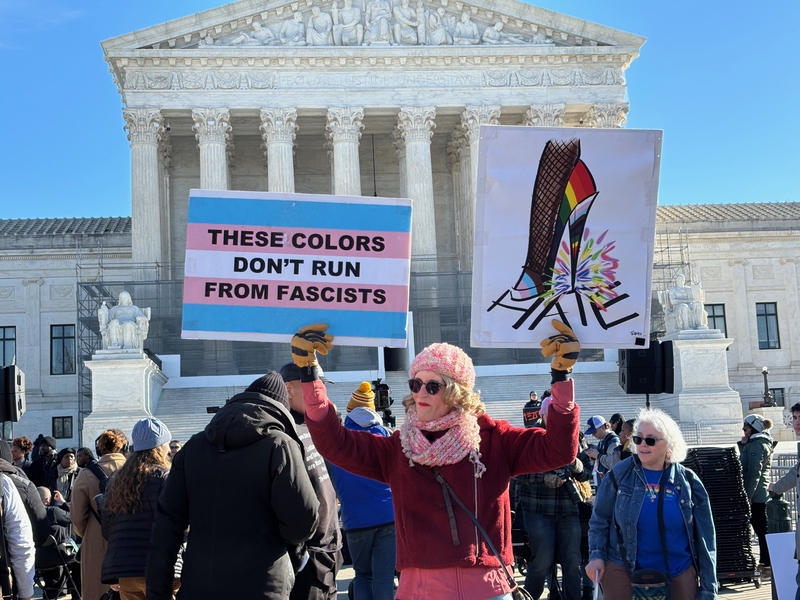
Demonstrators rallied outside the U.S. Supreme Court on Tuesday, Jan. 13, 2026, as justices heard two cases on state bans of trans athletes. (Photo by Jane Norman/States Newsroom)
There is an “unresolved factual dispute” about if transgender and cisgender girls “are similarly situated,” Sotomayor said. And the majority invoked “scientific uncertainty” to give too much deference to West Virginia. Both matters could have been resolved at lower courts, Sotomayor wrote.

“None of this is to suggest what the eventual outcome of this litigation would have been, or even should have been, had the majority allowed the courts below to make the missing factual determinations and had those courts correctly applied heightened scrutiny with the benefit of those facts,” she said. “The point, rather, is that this Court’s equal protection precedents require a very different approach.”
Idaho law
The Idaho case contested the Gem State’s 2020 law categorically banning trans athletes from competing on women’s and girls’ sports teams.
Lindsay Hecox sued over the ban in 2020, just months before the law — the first of its kind in the nation — was set to take effect.
Hecox wanted to try out for the women’s track and cross-country teams at Boise State University, but the Idaho law would have prevented her from doing so because she is transgender.

An Idaho federal court halted the law from taking effect later in 2020. A federal appeals court upheld the ruling in 2023 but later adjusted its scope in 2024 to only apply to Hecox, not other athletes.
In July 2024, Idaho appealed to the Supreme Court.
Hecox later asked both an Idaho federal court and the Supreme Court to drop the case.
Though a federal judge in Idaho rejected that attempt in October, the Supreme Court deferred the request until after oral arguments were heard back in January.

Idaho Republicans cheer
Several of Idaho’s leading elected officials, all Republicans, issued statements praising Tuesday’s ruling.
Gov. Brad Little noted in an emailed statement that the Idaho law was the first of its kind at the state level.
“We are leading the nation in supporting generations of women and men who fought hard to uphold Title IX protections and keep girls and women safe,” he said. “I want to thank the Idaho Legislature and Representative Barbara Ehardt in particular for her leadership on this issue of great importance to female athletes across Idaho and the nation. This is a historic moment for common sense!”
Ehardt, who sponsored Idaho’s ban in the state Legislature, called the decision the end of an “amazing journey.”
“I said from the very beginning that it would end up at the Supreme Court, and when it did, I was privileged enough to sit in that courtroom and listen,” Ehardt said. “I expected my legislation, and thus Title IX, to be upheld as it should be. Opportunities for girls and women should never be confused with male feelings!”
West Virginia law
The case in West Virginia surrounded a 2021 Mountain State law that also bans trans athletes from participating on women’s and girls’ sports teams.
Pepper-Jackson wanted to try out for the girls’ cross-country team when starting middle school, but would have been prevented from doing so under the state law because she is transgender.
In 2021, Pepper-Jackson’s mother sued on her behalf.
A federal appeals court in 2024 barred the state from enforcing the ban, which prompted West Virginia to ask the Supreme Court to weigh in.
Trump’s anti-trans agenda
Meanwhile, the Trump administration has sought at the federal level to prohibit trans athletes’ participation in women’s sports teams aligning with their gender identity, including through an executive order Trump signed last year.
That executive order made it the policy of the United States to “rescind all funds from educational programs that deprive women and girls of fair athletic opportunities, which results in the endangerment, humiliation, and silencing of women and girls and deprives them of privacy.”
The NCAA promptly changed its policy to comply with the order, limiting “competition in women’s sports to student-athletes assigned female at birth only.”
Trump has signed other executive orders targeting trans people, including orders that make it the “policy of the United States to recognize two sexes, male and female,” restrict access to gender-affirming care for kids, and aim to bar openly transgender service members from the U.S. military.
Trump posted on his social media platform, Truth Social, to commend the justices.
“BIG WIN: The United States Supreme Court just RULED AGAINST MEN PLAYING IN WOMEN’S SPORTS,” he wrote. “Wow! That takes that ridiculous situation off the table!!!”
Other reaction
Reaction poured in Tuesday from lawmakers and other officials, both in favor and against the court’s ruling.
Many who endorsed the decision, including U.S. House Education and Workforce Committee Chairman Tim Walberg, made some version of the declaration that “women’s sports are for women.”
“Unfortunately, radical gender ideology bolstered by policies pushed under the Biden-Harris administration chipped away at Title IX protections. As a result, the very female athletes the law was meant to empower were sidelined in the name of ‘equality,’” Walberg, a Michigan Republican, said in a statement.
He added that he was “grateful” to the justices and said his committee’s Republicans “will always stand with women athletes.”
U.S. Sen. Shelley Moore Capito made a similar statement in a social media post
“Girls’ sports are for girls. It’s common sense,” the West Virginia Republican said. “I’m thankful SCOTUS has upheld West Virginia’s law protecting female athletes.”
Critics of the ruling vowed to continue efforts to create protections for trans people.
League of Women Voters CEO Celina Stewar said the decision “sends a dangerous message that some students are less worthy of dignity, opportunity, and belonging.”
“Policies that intentionally target and marginalize young people simply for who they are weaken our democracy and violate the values of fairness and inclusion that define who we are as a nation,” she said. “The League stands in solidarity with all affected students, and we remain committed to ensuring that equality becomes a lived reality for everyone.”
U.S. Rep. Melanie Stansbury, a New Mexico Democrat who co-chairs the Democratic Women’s Caucus, said in a post to social media the decision centered on “whether LGBTQ+ rights are civil rights protected by federal law.”
“The answer is YES—and we will keep fighting until it is clear this is the law of the land!” she added.
And leaders in blue states that do not have laws like the ones upheld Tuesday said they would not be affected.
“Today’s ruling, while predictable, is yet another disturbing affront to personal liberties by providing states with a license to discriminate,” Maine Attorney General Aaron Frey said. “The Court was clear that this decision had no bearing with respect to a state’s choice to include transgender athletes and as such, will not implicate the Department of Justice’s case against Maine.”
by Jacob Fischler and Shauneen Miranda, Virginia Mercury
Virginia Mercury is part of States Newsroom, a nonprofit news network supported by grants and a coalition of donors as a 501c(3) public charity. Virginia Mercury maintains editorial independence. Contact Editor Samantha Willis for questions: info@virginiamercury.com.




Now They Want to Rein It In

From Oil Field to Gas Pump: What Really Determines What We Pay?

When Fields Flood: How Farmers Protect Crops and Plan for the Future

Draw Your Circles: A Map of the People Who Matter

A Heartfelt Farewell and Thank You

Data Centers Are Necessary. That Doesn’t Mean Warren County Needs One

Diesel Prices Shoot Upward as Top Farm-State GOP Senator Begs Trump for Export Embargo

From One Barrel of Oil: What Do We Actually Get?

CNN, MS Now, Politico Sue Trump Over White House Ban

Virginia-Made Marine Mattress Nominated for 2026 Manufacturing Cup

Virginia Works Plans October Job and Resource Fairs in Front Royal, Winchester

UVA Health Prince William Medical Center Earns Third Consecutive Magnet Recognition

Virginia Hunger Study Finds 37% of Blue Ridge Households Faced Food Insecurity

WCHS Volleyball Hosts Manassas Park on Sept. 22

ORDER OF PUBLICATION: In the Circuit Court for Warren County, Virginia

The Papers You Would Grab in Ten Minutes

Spanberger’s Carbon Tax Sets New Record, Could Add $1 Billion to Electricity Costs in One Year

Ask Stewart: What Should I Be Doing for My Trees This Fall?

Next Hearing in Supervisor Tony Carter’s DUI Case Set for Dec. 8

Commentary: We All Use Data Centers. So Where Should They Go?

From Wine to Whodunit: Local Events Raise Money for Community Programs
The Data Center Debate Should Include Data Security

Greenville Didn’t Become a Destination by Accident

Nancy Grace Roman Observatory Launched by NASA on August 30 Will Be Ongoing Public Event
