
Local News
Warren County School Board Aims to Refine Budget Request, Emphasizes Need for Stronger Advocacy
At its May 28 meeting, the Warren County School Board turned its final work session item into a pointed discussion on how best to advocate for funding ahead of the Board of Supervisors’ final budget decision. Board members focused on presenting a clear and compelling case for school funding, especially regarding employee health insurance contributions, and voiced concern over a lack of follow-through from earlier meetings.
The conversation began with Chair Kristen Pence introducing two key budget documents. The first outlined what different percentage increases from the county would yield, and the second showed that a $750,000 allocation would meet the board’s goal of covering 10% of employee health insurance costs. “That 750 gets us to that 10%, which is what we originally budgeted for,” Pennce explained.
But some board members pushed back on why they were still looking at the $750,000 figure.
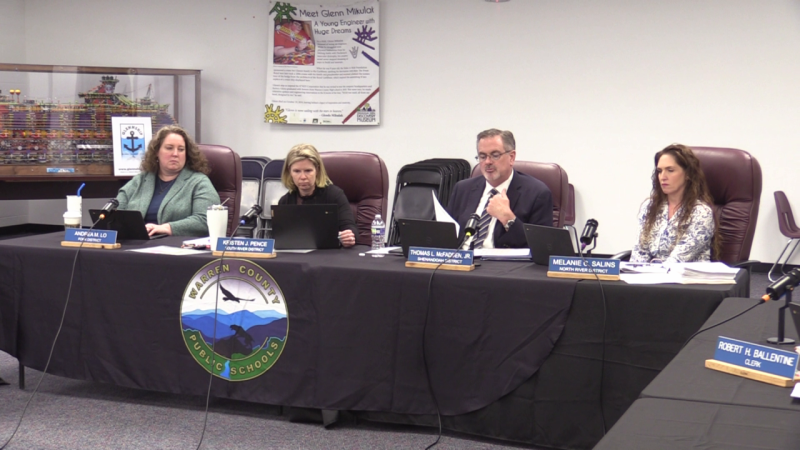
Board Member Thomas McFadden questions why updated budget figures promised at a May 8 meeting were never shared with the full board, calling for clarity on the county’s per-employee insurance contribution.

Board Member Thomas McFadden said, “We brought this up at the last budget committee meeting. We said we were done with the percentage model—we wanted to know what the actual dollar figure would be to match the county’s per-employee contribution.” He added, “That meeting was on May 8. We said we would come back with real numbers. I haven’t seen that yet.”
Superintendent Dr. Christopher Ballenger replied that he and Finance Director Rob Ballentine had hand-delivered the updated figure—around $900,000—to County Administrator Dr. Ed Daley. “We gave that to him that day to show what the request was,” Ballenger said. “We met their deadline, which was to provide it by Tuesday before their meeting.”
However, Board Member Melanie Salins criticized the delivery method and lack of visibility. “Dr. Daley doesn’t vote on the county budget,” she said. “He’s not an elected official. Our budget needs to be presented publicly, to the full Board of Supervisors—not just handed off behind the scenes.”
Board Member Tom McFadden emphasized that board members, especially those on the budget committee, had not received the updated numbers either. “We’re the budget committee… McFadden said. “We didn’t even get this document.”

Ballenger responded, “I apologize if I didn’t send that to the budget committee. I’ll make sure it gets posted on BoardDocs and sent to everyone.”
Salins wasn’t satisfied. “We’ve been up here flying blind. We agreed on May 8 that this document would be created and publicly presented. And now, three weeks later, we’re hearing it was quietly dropped off to one person, and we still haven’t seen it.”
She called for a stronger push: “Our sheriff stands up there and makes her case. So does our fire chief. I want to see our schools have the same level of advocacy. We can’t just accept a number handed to us—we have to sell it. Let’s put forward our best and final offer and make sure every supervisor understands what’s at stake.”
Board Member Andrea Lo acknowledged the importance of advocacy but noted that, unlike other departments, schools are governed by a board. “The sheriff controls her budget. We control ours. So the conversation needs to happen board-to-board.”

Salins agreed with the structural difference but reiterated the urgency. “Then let’s go board-to-board. Let’s update our ask and explain it publicly. We cannot settle for this idea that Dr. Daley said we’re getting $750,000, and that’s the end of the story.”
The board discussed preparing a revised budget request, including new calculations based on matching the county’s health insurance contribution and the addition of a student support coach—a position that received favorable feedback from supervisors in earlier conversations. Salins also suggested asking the county to transfer funds earmarked for converting a county tennis court to a basketball court to instead help repair deteriorating school tennis courts, including Skyline High School’s, which may soon be closed for safety.
“Those courts are in worse shape than the county’s,” Salins said. “If they’re willing to spend money on converting theirs, why not use it to keep ours open for students and the public?”
Board members agreed to bring the updated figures and proposals to their next meeting as an action item, giving them time to finalize a clear request before the county’s public budget hearing.

“We’ve been saying it all year—we want equity with county employees, we want strong support for student services, and we want to maintain our facilities,” Salins said. “We just need to make the case—and make it loud.”


Three Common Myths About STBBIs Explained

Standing Counts, but Walking Counts More

VDOT: Warren County Traffic Alert for September 28 – October 2, 2026

Virginia Health Committee Considers Mandating Licensed Nurses in Every School

After Obama-Era Chesapeake Bay Executive Order Rescinded, Environmental Groups Brace for Fallout

Federal Judge Strikes Down SNAP Deadline That Put Virginia at Risk of Added Costs

Children Activities by Samuels Public Library for the Month of October

$5,000 Match Challenge to Support Warren County Children on Give Like Dolly Day

October 23rd Set for Post-Discovery Motions Hearing in Bradley Treece Gunfire Incident With Neighbors

Virginia State Police Seize More Than $1 Million in Drugs During Weeklong Operations

Jolissa Steele Shifflett Mathews (1944 – 2026)

False Birth Control Claims are Proliferating, Survey Says

Business Growth Series: Your Work Environment Is Affecting Your Growth

Frog Hunting Offers Virginians a Different Kind of Outdoor Adventure

How the Tech Bros Shop for a House

County Supervisors Fill Vacant Planning Commission Seat, Look to Future on Processes and Capital Improvements

America 250: ‘I Only Regret That I Have but One Life to Lose for My Country’

Building Gas Plants More Important Than Dominion Sale, Data Center Politics

Home Inspectors Help Buyers and Sellers Understand a Property’s Condition

Bowling Together: Why Work Is More Than a Paycheck

This Week’s Showtimes at Royal Cinemas as of September 24th

POLICE: 7 Day FRPD Arrest Report 9/21/2026

Blue Ridge Wildlife Center Patient of the Week: Eastern Cottontail

UVA Health Review Examines Real-World Results of Incisionless Liver Tumor Treatment
