
Automotive
A history of roads in Virginia: Financing the roads
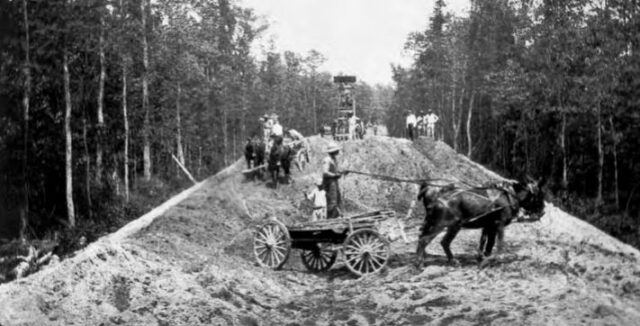
Wet subgrade is removed in an Amherst County project.
After the war, the road development program regained momentum and sought to keep up with the growing popularity of the auto. More than 25,000 vehicles would be added to the state’s roads in a year’s time. Inevitably, questions persisted about how to raise additional highway revenue to meet the mounting needs.
The state Constitution of 1869 had prohibited any state debt except to meet casual deficits in the revenue, to redeem previous liabilities, or to protect the state in the event of insurrection or war. The same restriction remained in a revised Constitution of 1902, but a later amendment, pushed by the Good Roads Association and approved by 61,000 votes in a 1920 referendum, had permitted the legislature to issue bonds to build or repair roads. Statewide political debate developed about using that permissive borrowing power, however.
State Sen. Harry F. Byrd Sr. of Winchester, chairman of the Virginia Senate Roads Committee, opposed bonds and urged the levying of a tax of three cents on a gallon of gasoline to produce the revenue. Early in 1923, Gov. E. Lee Trinkle called an extra “roads” session of the General Assembly to decide a course of action. He recommended a temporary “pay-as-you-go” policy until the question of bonds could be considered again by the voters in a referendum.

The legislature approved the Byrd gasoline proposal and ordered that a suggested $50 million bond issue be submitted to referendum in November.
By a margin of some 46,000 votes, the citizens this time rejected the bond issue idea in what was considered in many ways a victory for rural voters. Only 19 counties voted for the bond issue, while it won approval in 17 of the state’s cities. The gasoline tax was destined to become the largest single source of revenue for road building and maintenance and was to be increased gradually over the years. At the national level, a gasoline tax approved by Congress was to become the principal revenue source for the federally aided road program as well.

During the debate about financing, Virginia’s highway organization continued to be refined. In 1922, the legislature directed that the state be divided geographically into eight highway districts and that available funds be distributed among them in equal shares. Other organizational changes in the commission led to the appointment of Henry G. Shirley, who had been Maryland’s highway administrator, as chairman. Coleman stayed as highway commissioner until his resignation in 1923, and later the positions of chairman and commissioner were combined.
In 1927, as part of a reorganization of state government, the Department of Highways was formally established as a state agency, although the commission staff had been called the “highway department” since the outset. As disconnected sections of improved roads were linked into continuous long- distance routes crossing many states, travelers found themselves steadily more bewildered by a confusing array of directional and informational signs. There was little continuity or standardization from state to state, and it was easy for motorists to get lost in unfamiliar territory.

At the request of the American Association of State Highway Officials, the U.S. secretary of agriculture appointed a committee in March 1925 “to undertake immediately the selection and designation of a comprehensive and uniform scheme for designating such routes in such manner as to give them a conspicuous place among the highways of the country as roads of inter-state and national significance.”
It was this move that led to the beginning of route numbers and to uniform signs for the convenience of motorists throughout the nation, and that produced greater continuity in marking Virginia’s roads. The basic plan provided generally for assigning even numbers to east-west routes and odd numbers to north-south roads.
By 1930, a total of 386,664 motor vehicles were registered in the state. The license tax produced $6,564,000 in revenue, and the gasoline tax produced $7,251,000. The state highway system had been increased to 7,191 miles.
The counties, however, still were plagued by problems of improving and maintaining the local roads for which they were responsible. Most of those roads remained in extremely poor condition. Few counties had engineers on their staffs, and not many had the necessary equipment.

And yet about two-thirds of the state’s workers earned their livelihoods from the land and faced the continuing need of hauling farm products to market. The Depression that swept the nation brought more serious problems, and most rural Virginians had little money to pay the property taxes that had continued as the main source of income for the county roads.
In Richmond and in the district highway offices that had been established around the state, adjustments were made in road operations to aid as many families as possible during the economic crisis of the Depression years.
During the fall of 1931, the commission found that under normal work schedules it could provide employment and wages for only a few additional workers. But a “stagger system,” providing jobs for one force of men one week and another force the next week and continuing the procedure through the construction season, made jobs and income available for 8,000 additional workers. The commission kept this system in effect throughout the Depression.
Next up: The Secondary System

Produced by the
Virginia Department of Transportation
Office of Public Affairs
1401 E. Broad Street
Richmond, VA 23219
VirginiaDOT.org




Supervisors Terminate Interim Administrator’s Contract ‘Effective Immediately’ Before Delving Into Variety of Action Items

Christendom Graduate Runs Across America to Support Front Royal Pregnancy Center

They’re All Crazy Here…But Most of the Best People Are!

L. Allen Neel Outlines Economic Development, Infrastructure Priorities in Town Council Campaign

China’s “Sun” Gets Hotter

Prosciutto and Arugula Pizza Brings Elegant Italian Flavor to the Table

Tree Staking Can Help Young Trees Stand Strong

Town Council Begins Process for Data Center Prohibition

Virginia State Police Investigating Fatal Crash on Interstate 81 in Frederick County

Virginia Legislators Advance $205 Billion Budget Including New Tax on Data Centers

Commentary: Front Royal Showed Up, and Council Listened

Final Walton Wednesday of 2026 Set for Tomorrow, June 24

Dueling Disco Fundraiser to Help Two Local Families Receive Donated Cars

Endowed by Their Creator
Why I’m Voting for Ben Cline in 2026!

Debbie Martin Beal (1955 – 2026)

Virginia Should Tell Parents the Truth About Student Performance

Edinburg Man Arrested in Warren County Undercover Child Solicitation Investigation

If You See Something, Say Something

Progress on Organ Transplants Offers Hope

Hot Cars Can Turn Everyday Items Into Safety Risks

County EDA Sets Operational Parameters Including Officer Re-Appointments, Approves 2nd Recent Small Business Loan

OmniRide to Offer Free July 4 Bus Service to Metro for D.C. Fireworks

Amid Statewide Drought Conditions, Data Centers Face Same Restrictions as All Water Customers
