
Local Government
Supervisors commit to continuing in regional effort to attain countywide broadband service
At its initial meeting of the month, Tuesday morning, September 7, 2021, the Warren County Board of Supervisors voted 4-0 (Carter absent) to make a $6.9 million investment in the future. That future of achieving countywide quality broadband service was compared by Leesburg-based All Points Broadband Chief Executive Officer Jimmy Carr to an early 1900s municipal commitment to achieving full electrical infrastructure capability at the dawn of the Nickolai Tesla/Thomas Edison-driven age of electricity, upon which human civilization is now built.
For if the past year-and-three-quarters of COVID-19 Coronavirus restrictions has shown us anything, it is the growing necessity of quality online communications capabilities as pandemic-driven impacts on fundamental institutional networks, educational in particular, have become apparent during a time of crisis.
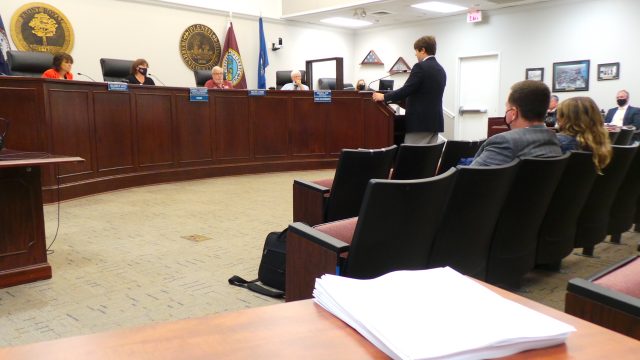
All Points Broadband CEO Jimmy Carr, at the podium, makes his case to supervisors for Warren County to proceed with other counties into Phase 2 of a regional application to achieve countywide quality broadband expansion. The vote was 4-0 to proceed. Royal Examiner Photos by Roger Bianchini
The supervisors’ vote, approving a Resolution in support of continuing into Phase 2 of the All Points Broadband “Regional Application” process, aligns Warren County with at least three other communities that have approved similar resolutions. Clarke, Augusta, and Rockingham Counties were identified as having approved their continued participation in recent days. Three others – Frederick, Page, and Rappahannock Counties – are scheduled to vote on Resolutions of Support of the All Points Broadband regional partnership within the next two days, Carr told the Warren supervisors. Shenandoah County is the lone dropout from Phase 1, apparently due to an opportunity with electrical provider Shentel, based in Shenandoah.

Board Chair Cheryl Cullers noted that despite the board’s commitment to the County’s $6.9-million funding match, it will be achieved without a county tax hike. That is because as noted in our story on the August 23 Virginia Port Authority-hosted Roundtable featuring Virginia’s U.S. Senator Mark Warner, with grant money tied to both the federal Infrastructure Act and American Recovery Plan Act (ARPA) funding coming Virginia’s way, it now appears all of that County share will be covered by federal grant funding. In fact, County Administrator Ed Daley told the board that it appeared the County would receive a total of $7.7 million of fed money through the State to cover its projected cost of $6.9 million. Half of that money, $3.8 million, has already been received, Daley added. And with broadband expansion being a priority of both the board and constituents in those unserved areas, this was the County’s opportunity to make a cost-effective infrastructure move to achieve full broadband coverage within the next several years, with some money possibly left over for other infrastructure projects.
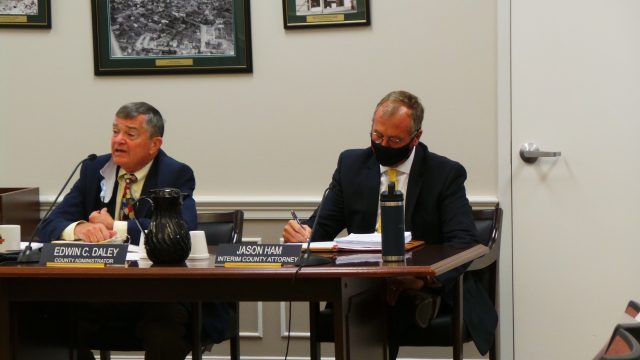
County Administrator Ed Daley, seated left, elaborates on grant financing variables that appear poised to cover the County’s Phase 2 matching cost of $6.9 million.
Details of exactly who will be eligible for the one-time hookup fee connection price of $199 for the new broadband service were addressed in Carr’s post-power point Q&A with the supervisors. In response to questions from Shenandoah District Supervisor Walt Mabe, Carr explained that the federal grant funding can only be utilized to bring service to currently unserved areas. However, later in the expansion process, post-grant funding, the potential of expanding into previously served areas would be an option to offer competitive service, were seen as a cost-effective move, Carr said.
The actual timeframe of achieving countywide broadband remains uncertain. That is due to variables in partnering electrical utilities laying the required fiber infrastructure down to achieve the broadband service in currently unserved portions of the county. However, Carr said his company’s communications with partnering Rappahannock Electric Cooperative (REC) and Dominion Power are promising on the scheduling front.

“You’re correct that we cannot complete our deployment until all the upstream infrastructure provided by electrical utilities is in place. Our construction sequence for our portion of the network will be completed in 24 months. That is, provided that all the electrical utilities also remain on their schedule. Based on our most recent conversations and indications we have from them, we do not expect any issue with that. But I want to be very clear, I cannot commit to delivering our portion of the network before the electrical utility infrastructure that we rely on is in place,” Carr said in response to Mabe’s question on installation variables.
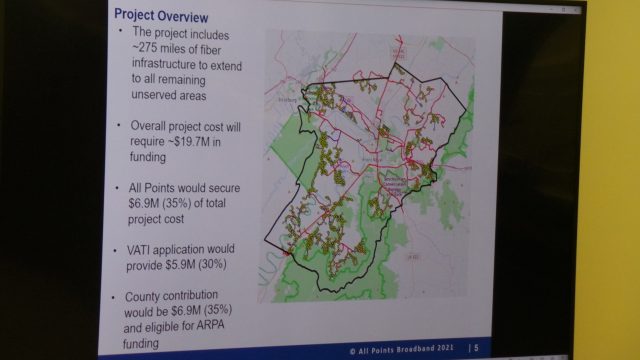
The plan, as outlined in frame from All Points Broadband PowerPoint presentation.
County Administrator Daley also responded to a Mabe question, saying the County would have a staffer at the point of communications with citizens on their eligibility, costs, and timeframe on realizing broadband access. All Points Broadband CEO Carr said as the point of connecting the main fiber infrastructure to individual homes was reached, potential customers would be given a 90-day notice of the coming connection in their area, and a three-day notice for linking their homes to the system.




Warren County GOP Prepares for November Election, Constitutional Amendment Fight

Rural Road Safety Takes Center Stage During National Farm Safety and Health Week

The Submarine That Attacked New York — in 1776

CSM Aesthetics Celebrates Growth With Front Royal Ribbon Cutting

VDOT: Warren County Traffic Alert for September 21 – 25, 2026

Spanberger Presents Slate of Data Center Regulation Proposals, Puts First Directives in Motion

Early Voting Begins in Virginia, as Trump Mail-Ballot Restrictions Remain Blocked

Virginia Confronts $1.7 Billion Shortfall in Highway Maintenance Funding

Trump Admin Aims to Shift Homelessness Grants Toward Addiction Treatment, Enforcement

James I. “Jim” “Bubba” Benjamin Jr. (1942 – 2026)

Business Growth Series: Distractions Are Costing You Customers

GPS Dog Collars Can Give Hunters Added Peace of Mind in the Field

Encouraging Peonies

E. Wilson Morrison Physical Plant Engineering Update Leaves Questions on Path Forward in Most Cost-Effective Manner

In Cannabis Ordinance Review, Commissioners Identify Direction from Town Council as Critical

Fed Raises Interest Rates for First Time in 3 Years, Battling Persistent Inflation

Barbara Tilden Neitzey (1940 – 2026)

Ronald Wayne Montgomery (1957 – 2026)

If You Have a Story, Tell It: Pentagon Responder Reflects on 9/11

Nancy Grant Boger (1936 – 2026)

Community Leadership: The Visibility That Shapes Tomorrow

Spanberger Declares State of Emergency as Drought Strains Virginia Farmers

Cars Changing Lives Plans Murder Mystery Fundraiser as Nonprofit Nears 100 Vehicle Milestone

Childhood Cancer Awareness Month Focuses on Education, Support and Action
