
Local Government
Commentary: Front Royal Showed Up, and Council Listened
That became the central question hanging over the entire room Monday night.
Not whether people opposed data centers — that was overwhelmingly clear.
The real question was whether that level of public opposition would change the political calculation for the Front Royal Town Council.
By the end of the night, it did.
After hours of public comment from residents overwhelmingly opposed to data centers, the Town Council voted to deny the proposed zoning text amendments to Town Code §175-3 and §175-64 that would have defined and permitted data centers within the Industrial Employment District by special use permit.
Council went further, directing staff and the Planning Commission to return within 60 days with a zoning text amendment prohibiting data centers in all Front Royal zoning districts, while establishing a temporary moratorium on applications due to infrastructure, utility, environmental, fiscal, and community concerns.
The motion stated that the council determined that data center development could adversely impact the town’s health, safety, and welfare, as well as its infrastructure capacity, environmental resources, and community character.
That vote came after one of the largest public turnouts many longtime residents could remember for a local zoning issue.
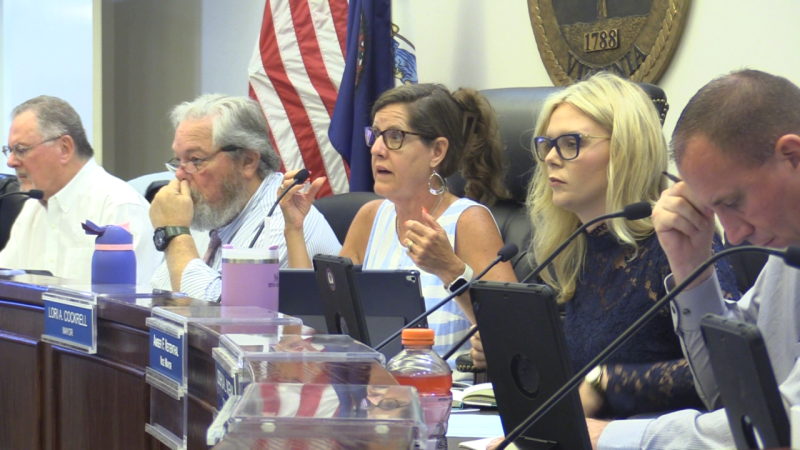
Mayor Lori Cockrell assures the audience during a Town Council meeting that everyone will have time to speak on the proposed data center.
Mayor Lori Cockrell assured the audience early in the evening that everyone would be given time to speak.
By the time the public hearing began, every seat inside the council chambers had already been filled. Additional chairs were brought in. Residents packed hallways shoulder to shoulder. People stood along walls and in doorways waiting hours for the chance to speak.
The estimate circulating through the audience was more than 350 people.
For a national election, that number would be small.
For a local zoning hearing in a town the size of Front Royal, it was enormous.
Especially when nearly every speaker opposed the proposal.
Council members are human beings. They can feel the atmosphere in the room just as everyone else does. And Monday night’s atmosphere was unmistakable.
This was not a small group of activists repeating prepared talking points.
What made the evening politically significant was the breadth of the coalition.
Speaker after speaker represented diverse backgrounds and perspectives — longtime valley families, newcomers, business owners, retirees, parents, environmental advocates, technology professionals, and residents who raised both conservative property-rights arguments and environmental concerns.
That kind of public unity is difficult for any elected body to ignore.
Many speakers admitted they had never spoken publicly at a council meeting before. Some appeared nervous as they walked to the microphone. But they came anyway.
For nearly five hours, residents voiced concerns about water use, electrical infrastructure, noise, pollution, property values, tourism, and the long-term identity of Front Royal.
Again and again, speakers argued this was not simply about industrial development. It was about what kind of town Front Royal wants to become.
Several residents said they moved to the Shenandoah Valley specifically to escape the kind of industrial expansion they feared was moving westward from Northern Virginia.
Others warned that communities elsewhere had once been promised economic opportunity, only to face unintended consequences.
One speaker called data centers “a crime against rural America.”
Another warned against “selling the soul” of the community.
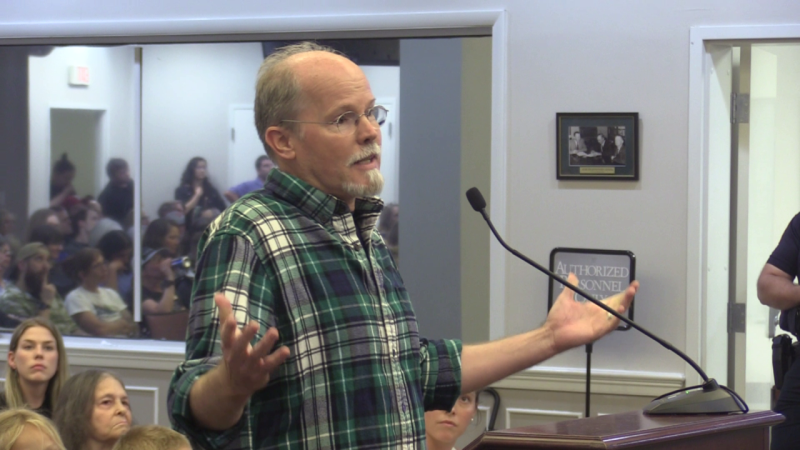
Dennis Ward speaks during a Town Council meeting on a proposed data center, calling a “yes” vote “governance against the will of the people” and urging council members to vote no.
Resident Dennis Ward perhaps summarized the political tension most directly when he told council that approving the proposal “would be a clear example of governance against the will of the people” before urging members to vote no.
By the end of the meeting, the council did exactly that.
Does public turnout always change votes? No.
Local officials still balance legal concerns, property-rights questions, economic development pressures, tax revenue discussions, and the possibility of litigation.
But Monday night demonstrated something increasingly rare in modern civic life: a visibly united community.
People who likely disagree on many other issues sat shoulder to shoulder, applauding the same message.
And in the end, that unity mattered.
Front Royal showed up.
Council listened.
And whatever happens next, Monday night proved that a united community can still make a difference.
Watch the Front Royal Town Council Meeting of June 22, 206.

Agritourism Summit Brings Farmers, Tourism Leaders and State Officials Together in Frederick County

Terry Wayne Foster (1962 – 2026)

Cottonwood Ranch Hosts Saturday Social With Live Music, Wine and Local Food

Business Growth Series: Why Simple Businesses Grow Faster

As Student Well-Being Concerns Grow, Virginia Advocates Push for Stricter School Tech Guidelines

With Six West Nile Cases Reported Statewide, Infected Mosquitos Are on the Rise in Virginia Beach

Commentary: A Pesticide-Free Farm Can Have Worse Soil Than One Sprayed With Roundup

Warren County Sheriff’s Office Foundation Expands Community Programs, Plans Fall Events

New Proposal from Grid Operator PJM Would Require Data Centers to Gring Their Own Power

Apple Wallet Adds Driver’s Licenses and IDs for Virginia Residents

Samuels Library Sets September Lineup With SamiCon, Community Programs and Family Activities

Virginia to Receive $353 Million in Landmark Meta Child-Safety Settlement

Trump’s Second-Term Immigration Agenda Extends Beyond Border Enforcement

Reverend Michael Duesterhaus (1965 – 2026)

Groovy for a Good Cause: Vintage Fashion Show Supports Bridge of Hope

Why More Robots Can Mean More Workplace Injuries

American Legion Post 53 Builds New Pavilion for Veterans and Community

Missing Bricks Led to Discovery of Structural Concerns at E. Wilson Morrison

Spanberger Orders State Agencies to Prepare for Medicaid, SNAP Changes

Amazon Changes Course on Water Use for King George Data Center Campus

Tree Stewards Prepare for 30th Anniversary While Offering Community Tree Care Class

Challenges and Future Uncertainties

Our Young People Are a Reflection of Our Community

America 250: The Battle of Long Island
