
Local News
Independence Day 1863: The Confederacy Goes 0 for 2 in the bottom of the 4th – Episode 3 – Lee’s Retreat from Gettysburg
On July 22nd, 1863, the Army of Northern Virginia marched through Warren County on its retreat from the Battle of Gettysburg, PA. The previous two weeks had been hell on earth for the Army of Northern Virginia. The gray procession that was greeted in Front Royal with much jubilation and promise a month earlier had taken on a solemn demeanor. The Army of Northern Virginia was still formidable, but their spirits were dampened. Miles of ambulance wagons passed southward through town that was once laden with ammunition during the trip north.

Bel Air Mansion (Photo taken recently of Bel Air by the Civil War Trails historical marker in Front Royal).
According to a local family diary of Lucy Buck, General Lee stopped over for a while in Front Royal on his way back from Pennsylvania. The woeful retreat was subsiding now as the army was comfortably south of the Potomac River.
She wrote, “General Robert E. Lee and his staff took a breather at Bel Air Mansion for some much-needed refreshment. The officers arrived and stretched their cramped limbs, and drank fresh buttermilk. I shall never forget the grand old chief as he stood on the porch surrounded by his officers, a tall, commanding figure clad in dusty travel-stained gray but with a courtly dignified bearing. The family regaled the general with songs at his request while General Lee stood by the piano. Afterward, the General inscribed his name on a piece of paper and gave it to the two young ladies.” (Photo taken recently of Bel Air by the Civil War Trails historical marker in Front Royal). Upon bidding farewell to Front Royal, the Confederate army moved on to familiar environs behind the Rappahannock River and resumed a defensive posture.

Let’s visit the most historic July 4th Anniversary in U.S. history: A couple of weeks earlier, on July 4th, 1863, while the United States celebrated their good fortunes on Independence Day, the Confederacy was reeling from two devastating losses. Lee was defeated in Gettysburg, and Vicksburg surrendered on the Mississippi. Both occurred on Independence Day, 1863. That’s two huge defeats in one day. This signaled doom for the Confederacy. Let’s drift back to July 4th.
On July 4th, while Lee was preparing his retreat from Pennsylvania, General Grant was adding another win to his string of W’s in the western theatre of the war. Grant had bottled up Confederate General Pemberton’s garrison out west in Vicksburg in a 47-day siege that had left the town exhausted and humiliated. The daily Union bombardments of the city reduced its citizen to eating mules, dogs, and rats. The Confederates were out of food and surrounded. On the hot afternoon of July 3, 1863, Confederate General Pemberton’s gray-clad horsemen rode out to parlay with his adversary — General Grant. The two officers discussed surrender terms under the shade of a tree. The final amended terms were forwarded to Pemberton that night. The following day at 10 a.m. on July 4th, long columns of Confederates stacked arms, furled their flags, and surrendered Vicksburg.

Thure de Thulstrup, Public domain, via Wikimedia Commons
The victorious Union army marched in and took possession of the city. The United States had essentially cut the South in two as Union boats controlled all of the Mississippi River.

The fall of Vicksburg, coupled with the defeat of Confederate General Robert E. Lee at Gettysburg, marked the turning point of the Civil War.
It would not be long before Lincoln made the move to bring Grant east to fight Lee. After all, Grant was undefeated and confident. Lincoln needed that combination to tackle Lee.
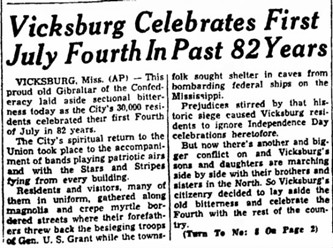
As a side note, the city of Vicksburg surrendered on July 4th, 1863, but they did not embrace the Union or celebrate Independence Day for 82 years. As the paper clipping alludes, the people of Vicksburg didn’t lay aside their bitterness and celebrate July 4th until the end of World War 2 in 1945.
While Grant received accolades from Washington, General Lee’s troops were embarking upon one of the most grueling retreats in the annals of war. It was not as disastrous as Napoleon’s retreat from Moscow, but it was deadly and fraught with peril nonetheless.

During the night of July 4th, the battered Confederate army began its retreat from Gettysburg, moving southwest toward Hagerstown and Williamsport in pouring rain. Cavalry screened their movements. The following day, the Federals realized Lee had slipped away and organized themselves to set out after him. As you may recall from earlier episodes, General Imboden’s cavalry had a 24-hour head start having set out the night before via a westward route. As fate would have it, the Confederate retreat was plagued by a driving rainstorm and under constant attack from Union cavalry and partisan bands along the way. In the words of General Imboden, the wailing of the wounded was agonizing, but we could not stop for anything. Lee had instructed General Imboden to press on with his 25-mile wagon train no matter what. He had to get that wagon train to safety in Virginia.
Broken wagons were simply abandoned. The column pushed on through the rainstorm towards the Williamsport pontoon bridge crossings. Many were asleep in the saddle, and many wounded soldiers died along the way.
Initially, General Meade thought the Confederates were simply regrouping behind the South Mountain passes until his cavalry detachments brought news of Lee’s full-scale retreat. Union cavalry harassed and attacked the retreating Confederates in a half dozen locations as both sides marched south. General Buford’s cavalry outran the Confederates and began destroying their pontoon bridges in Williamsport, MD. This was General Lee’s escape route. By destroying the bridges, the Union Army could halt Lee’s withdrawal at the river while General Meade and the rest of the Army of the Potomac closed the distance. Essentially, the army could trap Lee with his back to the Potomac and press the matter to a historic conclusion now.
By July 7th, General Imboden’s cavalry arrived in Williamsport and chased away General Buford’s cavalry. Unfortunately for the Rebels, the damage was done. When Lee’s infantry reached the rain-swollen river crossing sites – the bridges were down, and the current was too fast to repair them. Lee was trapped. This was it.

The war department in Washington was elated, and dozens of curriers were sent flying to find General Meade and impress upon him – the need for speed. If the Federals could mount a sustained attack against Lee’s army – with Lee’s back to the Potomac River, he would have no place to go with dwindling supplies. The war could be over this week!
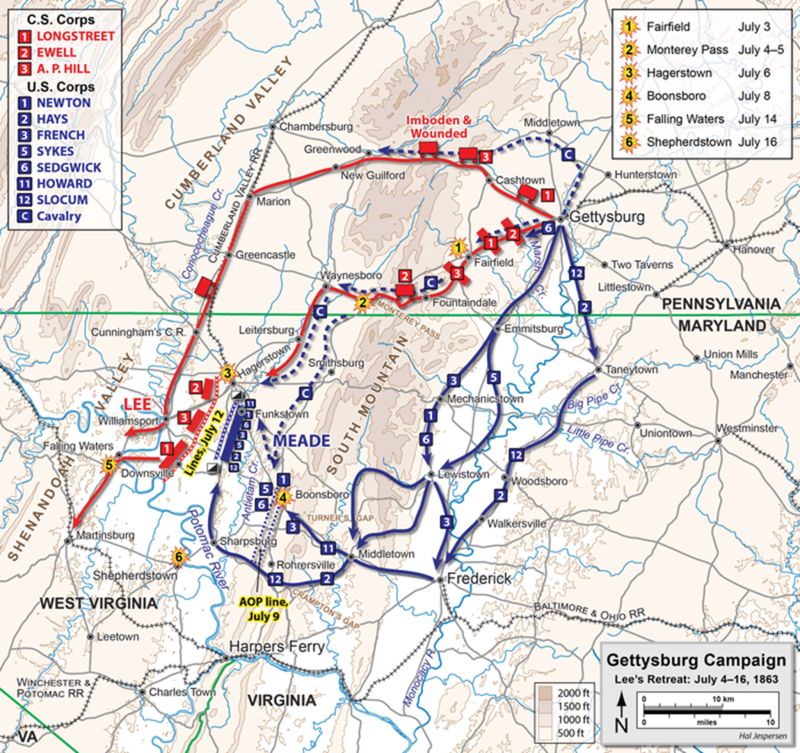
But this is where the persona of ‘Lee’ and his cowering effect on the Union Army prevailed. General Meade interpreted his orders differently. He was successfully blocking Lee from points east while driving him from Northern soil. Meade’s forces were beaten up, too, and organizing them in a driving rain was difficult. The army was way short on food. Many of those Federal wagon supply trains that General Hancock had previously ordered off the roads to clear the way for infantry had not arrived in town yet. Many of the Federal Corps was badly mauled from the 3-day fight, and many were assembled ‘In Frankenstein’ style and intermingled with units from other commands. Battalions had been moved around the battle lines in emergencies to plug gaps in the line and were detached from their parent brigades. This made coordination quite difficult throughout the 7 Corps.
Unable to cross the Potomac, Lee understood the gravity of the situation. On July 11, Lee set up defensive entrenchments with interlocking fields of fire protecting the river crossings at Williamsport and waited on passable river conditions and for General Meade’s arrival. On July 11th through the 13th, skirmishing was heavy along the lines as Meade probed Lee’s lines while waiting for the preponderance of his forces to arrive. In the meantime, the river fell enough to allow the construction of new bridges. The Confederates worked around the clock creating pontoon bridges across the river while the rest of the army exchanged volleys with the Federals to their front. Meanwhile, General Meade’s headquarters was inundated with messages from Washington ordering an attack. The War Department wrote, “You must not let Lee escape into Virginia. Press the fight.”
On the night of the 13th, Confederate General Heath’s men kept up a steady fire from their defensive positions and made enough noise to conceal rebel river crossings to their rear. Lee’s army secretly began crossing the river after dark that night.

Intense fighting occurred the following morning when Meade’s cavalry attacked Confederate rearguard divisions of General Heath as they were preparing to cross. General Heath’s North Carolinians had successfully staved off the Federals long enough for Lee to escape, but it was a deadly affair. When Heath’s Confederates ran out of ammunition, the Federals took more than 500 Confederate prisoners. In the deadly fight, Confederate Brigadier General Johnston Pettigrew was mortally wounded. Meanwhile, Lee’s main body had escaped over the bridges to the relative safety of Virginia. A portion of General Meade’s army crossed the Potomac further east and raced to cut Lee off one last time at Manassas Gap. The Rebels won the engagement, and Lee’s forces filed on through Front Royal the following day and waved farewell to the town as they regrouped further south.
With the Confederates gone again, the ladies in Bel-Air watched as the blue coats moved back in. The citizens of Front Royal were forced to walk beneath the ole familiar stars and stripes again. The Confederate flag was lowered, and the U.S. flag was hoisted high. The following year the town would be under the black flag as total war ushered in the ‘Burnings’ and the many evils of the summer and fall of 1864. But for now, all was rather quiet in the aftermath of Gettysburg.
Despite General Meade’s victory at Gettysburg, the Lincoln administration considered it a hollow victory in light of Lee’s escape. The slaughter would go on for almost two more years. Lincoln famously said, “We had him [Lee] in our grasps. All we had to do was reach out our arms, and he was ours.” The President realized he needed new stewardship of the Army of the Potomac. The eastern generals were too accustomed to defeat and were always wondering what Lee was going to do to them instead of what they were going to do to him. Even when they did win a battle, they didn’t possess the killer instinct to follow up. With that, Lincoln sent word to have General Ulysses Grant come east and take over the show.




Mayor Lori Athey Cockrell Looks to Water, Economic Development and Rail Trail in Another Term

WCHS vs. Brentsville HS – Girls Volleyball – October 6, 2026

BMI Is Only One Piece of the Health Picture

The Eye Surgery Factory That Could Not Expand

Ancient Ownership of Israel

VDOT: Warren County Traffic Alert for October 5 – 9, 2026

Reaching Out Now Expands Programs and Opportunities for Warren County Youth

Dance and Arts VA Finds New Home, New Opportunities on Water Street

Ann L. Shuman (1933 – 2026)

Wendy Lee Whitacre-Stout (1966 – 2026)

Spanberger’s Energy Plan Keys in on Clean Energy to Meet Growing Demand and VCEA Goals

Jean Elizabeth Grubbs Fogle (1939 – 2026)

Feds Provide Guidance on New Federal K-12 Scholarship Tax Credit Program

Why Wait Till November? Mid-Term Election Early Voting Processes in Place Now

US Senate Leaves Nation’s Capital in Advance of Midterms With Much Still Undone

Business Growth Series: If You Don’t Control Your Day, It Controls Your Business

The End of a 20-Year Monopoly on the Credit Score
Voltron and Immigration

States OK Solar Panels for Balconies. Safety Guidelines Haven’t Caught Up

Trump TV Ads Paid for with $20M in Homeland Security Funds, Dems Find

Blue Ridge Wildlife Center Patient of the Week: Gray Treefrog

Birthday Twins: See Which Famous Face Shares Your Big Day

Meet-and-Greet Set Sunday for Republican-Endorsed Front Royal Candidates

Barbara Ann Mathews Smelser (1943 – 2026)
