
State News
Spanberger Weighs Legislation to Allow Class Action Lawsuits in Virginia Courts
Gov. Abigail Spanberger is weighing whether to sign or veto legislation that would, for the first time, allow Virginians to file class action lawsuits in state courts — a shift advocates say would expand access to justice, but one that has drawn pushback over how far the change should go.
Virginia is one of only two states, along with Mississippi, that does not provide a formal class action procedure in its state court system. As a result, groups of plaintiffs cannot currently band together to bring a single case on behalf of many people, even when the claims are similar.
Senate Bill 229, sponsored by Sen. Scott Surovell, D-Fairfax, and its companion, House Bill 449 by Del. Marcus Simon, D-Fairfax, would establish that framework.
Both measures passed the legislature earlier this year, but Spanberger sent them back to lawmakers with a substitute that narrows key provisions, which lawmakers rejected when they reconvened in Richmond last month.

At its core, the legislation would allow one or more individuals to represent a larger group in court if certain conditions are met, including that the class is so large that individual lawsuits would be impractical, that claims share common legal or factual questions, and that the named plaintiff can actually represent the group’s interests.
The bill also lays out how courts would certify class actions, sets standards for attorneys handling those cases, and details procedures for managing litigation, including settlements and dismissals. It would also extend provisions of the Virginia Consumer Protection Act to class actions, allowing damages to be awarded to members of a class if violations are proven.
“I’ve been trying to fix this for six years, and it’s probably decades overdue,” Surovell said in a phone interview, noting that both federal courts and nearly every other state have allowed class actions. “There are a lot of people who don’t understand what the bill does, and they are trying to scare people about what it isn’t.”
Under federal law, large class actions — generally those involving more than $5 million in damages — can be moved to federal court. That means the Virginia proposal would primarily affect smaller-dollar cases that often struggle to find a path forward.

“That’s important, because class actions are often the only way for citizens, especially lower-income citizens, to have access to courts when they are hurt by corporations on both a massive scale and in small-dollar amounts,” Surovell said.
For tenants and consumers, small fees can add up
For advocates working with low-income Virginians, the issue is a real-life concern. Victoria Horrock, a senior supervising attorney with the Legal Aid Justice Center, said the lack of class action mechanism often leaves clients without a realistic way to enforce the law and seek damages.
She pointed to a common example of her work, where tenants are charged small, recurring fees that courts have already deemed unlawful.
“My biggest reason for wanting this bill is actually just an example of my work,” Horrock said.

“I represent tenants, and they’re often charged these $5 pest control fees. Many Virginia courts have ruled these fees to be unlawful, but there’s no incentive for bad actor landlords not to keep charging them because the tenants have to come and sue one by one, over and over again.”
The economics of such cases make individual lawsuits impractical, she said.
“No tenant has an incentive to sue over a $5 monthly fee, no judge wants to hear a case about a $5 monthly fee,” Horrock said. “As a class action, you could actually get these bad actors to adhere to the law and stop charging this fee, but we can’t file those kinds of claims in state court.”
Currently, Virginians can only pursue class actions if they meet federal jurisdiction requirements — an avenue that has narrowed in recent years. Federal courts have increasingly dismissed certain consumer cases following the U.S. Supreme Court’s decision in TransUnion LLC v. Ramirez, which tightened standing requirements.

The Virginia legislation is intended, in part, to close that gap — but Spanberger’s substitute would reshape how the system operates.
Her proposal preserves the overall framework for class actions while imposing new limits, most notably on where cases can be filed. Instead of allowing suits to be brought across the state, the substitute would restrict venues to a handful of jurisdictions, including Richmond, Fairfax County, Norfolk, and Roanoke.
The changes would also give courts additional tools to dismiss cases earlier, including expanded use of summary judgment and certain dispositions during discovery.
“Obviously, the substitute would allow some kinds of class actions, but there are some pretty significant ways that it would still have a lot of access-to-justice barriers,” Horrock said.

Limiting venues to a few cities, she said, would make it harder for people in other parts of Virginia to participate in cases.
“That would leave out chunks of Southwest Virginia and Southside Virginia,” she said. “Those people would still have to be driving to these far-away courthouses to follow their cases, or to do depositions.”
Horrock also raised concerns about how the substitute handles damages under the Virginia Consumer Protection Act. She said the governor’s changes would effectively eliminate statutory damages in class actions, reducing the financial incentive for companies to comply with the law.
“The reason that the General Assembly wrote that is to incentivize corporations to follow the law,” she said. “But she took away that ability to get statutory damages, limiting what consumers who are harmed could actually get back in these lawsuits.”
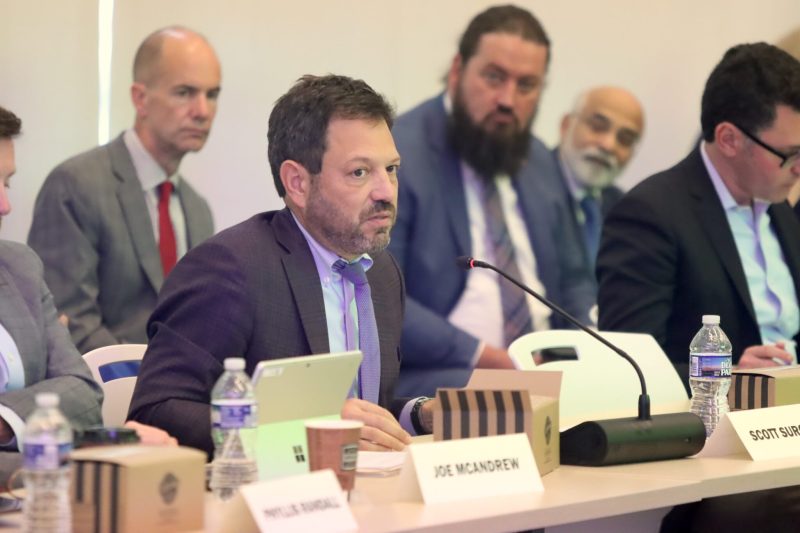
Sen. Scott Surovell, D-Fairfax. (Photo by Nathaniel Cline/Virginia Mercury)
Surovell echoed those concerns, saying the proposal includes provisions he had not seen in years of debate on the issue.
“The governor’s amendments contained a couple of proposals that were debated and discussed over the last six years, but it also had some proposals that I’d never seen before,” he said, including a prohibition on statutory or punitive damages.
“That basically would make a class action remedy completely useless in any context,” he added, because proving individual damages across large groups can be difficult without standardized amounts.
The debate over class actions in Virginia is not new. In 2024, then-Gov. Glenn Youngkin vetoed similar legislation, also sponsored by Surovell, arguing it would expose businesses to excessive liability and pressure defendants into settlements.
“The possible statutory damages resulting from these consumer class actions will coerce defendants into settlements to avoid potentially ruinous financial consequences,” Youngkin wrote in his veto statement at the time. He also warned of strain on the Court of Appeals and broader economic impacts.
The current proposal attempts to address some of those concerns while still creating a system that does not exist in Virginia today.
Budget impact modest but ongoing, analysis shows
Beyond policy questions, the legislation carries a measurable fiscal impact.
According to the state’s fiscal analysis, the legislation would cost about $622,729 annually starting in fiscal year 2027, largely due to increased workload for the Office of the Attorney General. Class action cases tend to involve large volumes of documents and data, requiring additional staff and specialized software.
To manage that workload, the attorney general’s office anticipates hiring five new employees — three assistant attorneys general and two paralegals.
The Virginia Court of Appeals said its costs are indeterminate, while the Workers’ Compensation Commission expects no financial impact.
Overall, the analysis suggests the state would need a general fund budget amendment to cover the expenses, which are expected to remain steady in future years.
For advocates like Horrock, the issue goes beyond budgets and legal frameworks.
“I think just the biggest thing is there’s kind of a narrative around this bill that it’s going to just line the pockets of class action lawyers,” she said. “This is really about the lower-dollar claims of average Virginians that can’t get into state court.”
Horrock said those small fees — like the $5 to $50 pest control charge many tenants are facing — add up, especially for families already struggling with rising costs of living.
“People are being nickel-and-dimed constantly across the commonwealth with these unlawful fees, and it’s really making life unaffordable,” she said.
Surovell said the legislation is about bringing Virginia in line with the rest of the country and giving residents a practical way to seek relief.
“I think this is a critical bill for access to the courts for some of the most economically vulnerable populations,” he said. “And in a time when affordability is important, this is one of the best tools consumers can use to push back when corporations break the law.”
Spanberger has until May 23 to act on this legislation.
by Markus Schmidt, Virginia Mercury
Virginia Mercury is part of States Newsroom, a nonprofit news network supported by grants and a coalition of donors as a 501c(3) public charity. Virginia Mercury maintains editorial independence. Contact Editor Samantha Willis for questions: info@virginiamercury.com.




Blue Ridge Wildlife Center Patient of the Week: Gray Treefrog

Birthday Twins: See Which Famous Face Shares Your Big Day

Meet-and-Greet Set Sunday for Republican-Endorsed Front Royal Candidates

Barbara Ann Mathews Smelser (1943 – 2026)

Kathleen Frances Elar (1956 – 2026)

Happy Creek Crossing to Hold Vendor Interest Meeting Oct. 8 in Front Royal

If the Car Name Fits, Drive It

Front Royal Begins Smoke Testing Sewer System; Residents May See Smoke Around Homes

Trump Orders Federal Agencies to Replace ‘Artificial Intelligence’ With ‘Super Intelligence’

Town-Wide Weed Spraying Underway in Front Royal Through Oct. 6

Southbound I-81 Lane Closure Near Strasburg Expected to Cause Significant Weekend Delays

Virginia Democrats Warn More Healthcare Strains Loom After November Election

Legislation to Force Virginia Traffic Camera Fine Payments Will Make ‘Nightmarish’ Court Workloads

CDC’s Latest Youth Behavior Report Offers a Narrower Look at Teen Health

News Organizations Banned from White House Accuse Trump of First Amendment Violation

Virginia Education Board Approves New Rules for Local Student Assessments

FCC Halts Automatic Approval of Verizon Plan to End Legacy Landline Service in Virginia

Women in Agriculture Continue to Face Barriers as Their Role Grows

This Week’s Showtimes at Royal Cinemas as of October 1st

Surveillance, Outdoor Dining, and Other Community Concerns at Town Council Meeting

When Elected Officials Cross the Line

Trump Administration Revokes $810M Approved by Congress for Refugee Aid and More

The Signs Offer Quick Cash for Homes. But States Want More Oversight

This Drone Hunts Mosquitoes
