
Local News
Heartsong Hill Goats hungry and ready to clear land of unwanted vegetation
Targeted grazing (TG) is the careful use of livestock to produce specific vegetation management objectives. Unlike conventional grazing management, goats are used as a tool for improving land health by performing weed control, reducing wildland fire hazards by forming a fire break, and aiding in restoration projects. By manipulating the time, extent, and duration of grazing, invasive plants can be eliminated so that native habitat can be restored.
TG is a long-term approach and may require multiple years to improve ecological restoration and reduce the weed seeds. The goats may need to return to a site, depending on the life cycle of the weeds. By using a grazing plan, weeds can be eliminated at different times of the year to reduce the seed bank on the land. It can take one to five years to eliminate most of the weeds, but results will be appreciated soon after the goats finish grazing.
Deborah Phillips is a retired microbiologist/medical editor and an extreme animal lover. Phillips resides on five acres outside of Stephens City and bought the goats to clear her woods. First, they cleared the area that she had fenced for them, then they cleared the extended area that she enclosed with electric fencing! After experiencing how efficient her goats were in clearing her own woods, she said, “it was time for the goats to earn their keep. I began thinking more seriously about starting a business with them.”
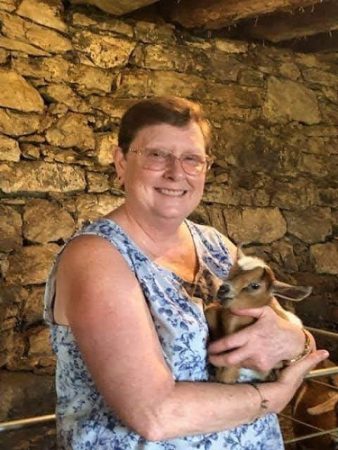
Deborah Phillips in her barn with 2-day-old blued eyed Asher. Photo courtesy Jacquetta Owen.

Around that time Blandy Experimental Farm put a post on Facebook about needing to rent some goats to clear an acre of land where they wanted to plant trees. Blandy had scrub trees cut down and chipped everything up, but they knew the weeds would return. Phillips contacted them, worked out a contract, and delivered the goats last September where the site was cleared in one month. Ideally, the goats should return to the site in late Spring to eat any new growth before weeds are reestablished.
Phillips bought her property in 1997 and named it Heartsong Hill because she thought the name sounded romantic. In 2017, the mini-farm was started with seven chickens. “My son and his wife helped me convert a small shed to a chicken coop and added a small run in 2017. As I added more chickens, I needed a bigger coop and run,” said Phillips. I tore down the shed and had a barn built in 2019. I do sell eggs when the older chickens are laying in the spring (at least 2 dozen a day). Right now, I’m getting 4-6 eggs a day, all from my first-year chickens, just enough to keep my parents favorably supplied. Many of my chickens prefer to roost in the secure, outdoor run instead of the coop, although when we had the ultra-cold temperatures recently, I had to put the outside chickens into the coop and closed the door so they would retain their heat. Chickens tolerate cold better than heat, but they can get frostbite on their comb, wattles, and feet.
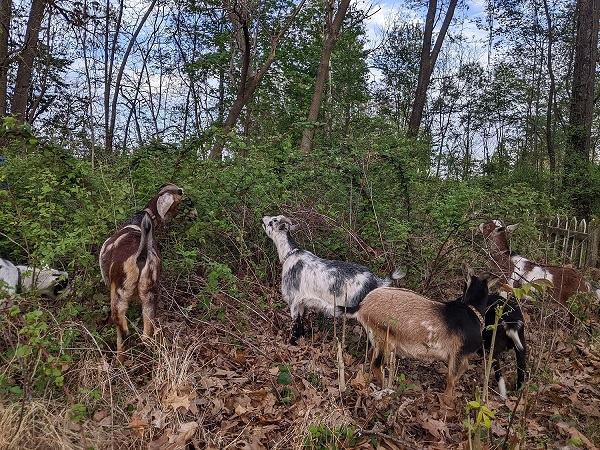
The herd of goats munching on a fallen tree that fell down during a summer wind storm. Photos courtesy Deborah Phillips.
Phillips continues, “When I built the barn, I decided to make the area big enough for goats. The goats were born in 2019 and arrived at the farm in August of that same year. So now I have the goats on one end and the coop on the other end, with a storage room in the middle. I made the run four times larger at the same time and fenced a large part of the woods for the goats. There are currently more than thirty chickens, seven goats, and six dogs coexisting on the property. All my dogs are rescues and either failed fosters or were surrendered by owners. Some of the failed fosters were special to me, including my deaf dog, Gator. I adopted my blind dog Larkyn from another rescue facility when she was about 9 months old. The other dogs just fit into the pack.” Phillips used to foster dogs and kittens, probably fostering over one hundred of each. She managed a guinea pig rescue from 2002-2012.

The Heartsong Hill goat herd comprises six Nigerian Dwarf (ND) and one Mini-Nubian. Nigerian Dwarfs were originally bred for show and as a companion animal. Nubian Dwarf goats, or Mini-Nubians, are a cross between Nubian dairy goats and Nigerian Dwarf dairy goats. Auris is Mini-Nubian; Cinder, Dice, Domino, and Peanut are ND’s; Asher is 75% ND and 25% Nubian; and Comet probably has some Pygmy mixed with ND.
Auris weighs about 100 lbs. and is about 36 inches at his withers and has horns. The youngest and most adventurous/mischievous/friendliest goat is Cinder. He’s about 40 lbs. and 23 inches tall. Peanut came from the same farm and is a little bigger, plus he has horns. He learned to jump the (non-electric) fence, so Phillips had to make adjustments to the fence to keep him in. Comet is the smallest goat and the only one with a beard! Asher came from the same farm as Comet but is bigger. He and Cinder look a lot alike and both have blue eyes. Asher is also very friendly and always looking for food. Dice is best friends with Auris. He’s about 60 lbs. and 28 inches tall. Domino has horns and is about the same size as Dice.
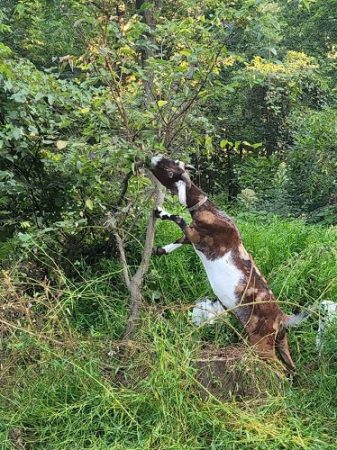
Auris, the 100 pound Mini-Nubian reaches up high in the tree to pull down branches.
The biggest goat, Auris, eats the tallest brush and will sometimes pull-down branches or small trees for the smaller goats to eat. They are all good eaters and work well together. They generally stay in a herd as they work the land.

All the goats are 3-year-old wethers (castrated males) and love to eat,” said Phillips. “Goats are natural brush control agents, and these animals are fed organically, so it is only common sense that I offer a more natural, chemical-free way to clear land.”
Herbicides can be dangerous for the environment and people, and they are not effective in the long term. Goats, however, eat the weeds and seed heads, keeping the weeds from coming back. The goats churn the soil with their hooves, aerating it, and fertilize the land with their manure. By eating the noxious weeds, they enhance the soil for native plants and increase ecological variety.
I asked Phillips why people would rent goats for grazing. “Goats reduce the need for mowing while providing an environmentally friendly alternative to herbicides”, she responded. “They save on fuel costs and can control weeds in poor terrains that cannot be reached by machines. Using mechanical equipment to eliminate brush is not always possible in steep and inaccessible terrain, but goats are agile and can easily access these areas. They do not compact the soil or cause erosion, nor do they compete with the native ecosystem because their grazing is managed and short-term.”
The goat digestive system can aid as an herbicide when trying to prevent the spread of weeds. When a goat eats seeds from a weed, its saliva contains an enzyme that neutralizes several seed types. After the material passes through the goat and is excreted, the seeds are no longer viable and unable to grow back. As a general rule, goats prefer eating woody plants rather than grass, making them complementary to cow herds that prefer grass. To avoid potential injuries and protect the health of the goats, the land needs to be clear of glass, plastic, rusted metals, hunting traps, and barbed wire.

One of the drawbacks to grazing goats is they are known for their climbing ability and curiosity, making them a fencing challenge. Portable fencing is needed to allow rotational grazing. Fence types include electric netting and poly-wire electric fences. Phillips explains, “I will set up a temporary electric netting fence that is powered by a solar battery. Any areas of property where the customer does not want the vegetation eaten will be blocked off.”

The goat herd hard at work inside the temporary electric fence installation.
Customers should know that Phillips will check the goats on site twice a day, morning and evening. The goats will stay in their trailer overnight, so she will let them out in the morning and put them in in the evening. “They will have hay and water available at all times,” she said. Grazing set up can be as little as one-half acre or as much as twenty acres, however acreage greater than one acre will need to be subdivided as the goats finish each acre.
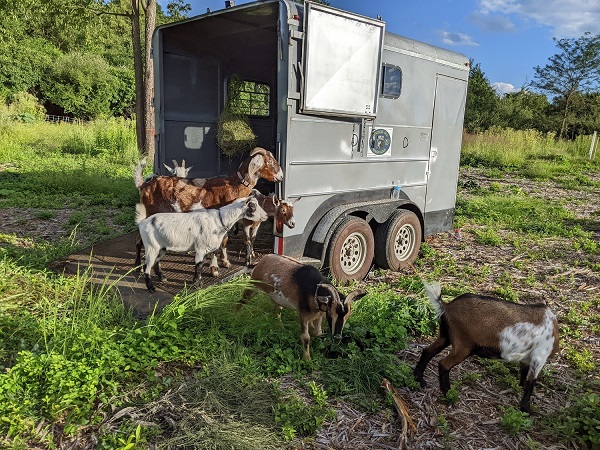
The goats leave their overnight trailer and begin the work day.

Phillips informed me that goats eat most invasive weeds, including poison ivy, kudzu, knotweed, wisteria, oriental bittersweet, multiflora rose, Japanese honeysuckle, phragmites, and reed grass. They generally eat from upper to lower down to six inches above the ground. They will eat grass if nothing else is available, but much prefer undergrowth. “Goats will also eat Christmas trees and other evergreens, including cedars and white pines,” she added.
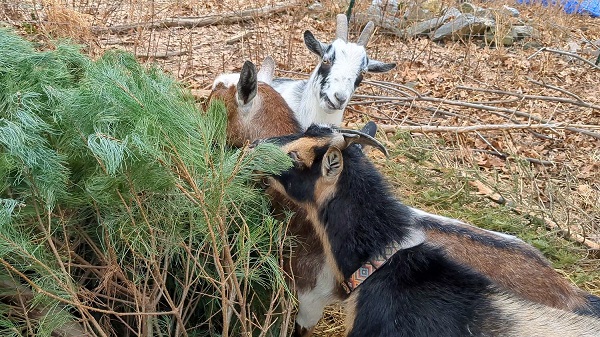
Front to back; Peanut, Asher, and Domino delight in eating a Christmas tree.
Some plants are toxic to goats, and the goats usually will not eat them. But Phillips will still try to eliminate anything dangerous in their area. This includes mountain laurel, azalea, nightshade leaves (tomato, foxglove, etc.), pokeweed, wild black cherry, rhododendron, black locust, horse nettle, and Indian poke, and others. Most are only toxic in large amounts. “I usually try to fence around any poisonous plants or pull them out before I bring the goats to the property,” said Phillips.
Heartsong Hill Hungry Goats LLC is licensed and insured. It is a formal business, which makes it more desirable to corporations wanting to clear land. Homeowners are usually surprised at the cost, but there is more to setting up the goats than just letting them loose on the property. The electric fence is essential and takes time to set up and take down. Goats don’t eat everything at once, the herd are “browsers,” seeking the soft shoots of new growth on flowers, shrubs, and vines. Goats slowly look and test various foods to see what they like most. So, it can take some time for them to clear an area, especially if the brush is very thick. Plus, they are ruminants, so they need to take breaks to “chew their cud” just like cows.
The business is seasonal, usually from late Spring until late Autumn. The goats eat fallen leaves from October through December and from about January to March they will eat Christmas trees. And they always need hay! Goats need minerals in their diet, so Phillips adds free-choice goat minerals and baking soda (they eat it when they need to adjust their stomach acidity) in their diet. Wethers don’t really need grain, but she gives them a mixture of equal parts goat pellets, black-oil sunflower seeds, and whole oats in the evening as part of the bedtime routine.
Phillips believes the effort is worth the investment. “Goats are sustainable,” she says. “You can’t saturate the ground with chemicals for years to kill the weeds and think it’s sustainable. Goats, if properly managed, leave the earth better than they found it, and can help save people’s homes and, sometimes, people’s lives.” Goats have been given credit for helping slow the spread of wildfires. The vegetative areas where goats graze are shorter in length and have more space between plants. If a wildfire breaks out, the increased distance between the plants provides more time for the fire to extinguish before spreading on to another plant.
Goats love treats, but they should be given in moderation. Animal crackers, tortillas, apples, pears, mangoes, pumpkins, ripe bananas (peel included), cantaloupe, and watermelon are some of their favorites. Phillips instructs her customers. “Please do not go into the fence or call the goats over to the fence unless under supervision. Feeding and petting them could introduce a potential sickness and distract the goats from doing their job. When I am there, I will turn off the electric fence so you can feed them treats.”
Phillips serves the Northern Shenandoah Valley of Virginia that is within 25 miles of Stephens City. Areas 25-50 miles away will have a mileage charge added. Areas included within the 25 miles include Gore, Clear Brook, Shawneeland, Gainsboro, Albin, Stephenson, Kernstown, Berryville, Boyce, Millwood, White Post, Middletown, Strasburg, Front Royal, Toms Brook, Woodstock, and Bentonville.
Renting the grazing goats is not cost prohibitive. The price will vary according to the number of acres, steepness of the slope, vegetation type and density, access to water, and the time of year. The setup will usually take about 4 hours and is $500 if within 25 miles of Stephens City. Phillips will be glad to discuss total costs with any potential customer. She can be reached at 7hungrygoats@gmail.com or visit heartsonghillgoats.com.




Grandparents’ Day Celebrates the Bonds That Connect Generations

Update: Two Killed in Fiery I-81 Crash Near Exit 310 in Frederick County

Front Royal Hosts 5th Annual NAACP ‘Hope & Holiness Gospel Fest’

Mediterranean Diet Offers Variety With a Focus on Healthy Choices

The Woman Who Helped Save a Forest — and Its Species

Invested Retirees Need an Emergency Fund, Too

Patricia Ann “Patty” Vaught Brown (1961 – 2026)

Warren County Fire and Rescue to Kick Off Fire Prevention Week Oct. 4

Literacy Volunteers Students Earn Publication in Statewide Magazine

Virginia Transportation Board Schedules Fall Meetings, Including Stops in Weyers Cave and Culpeper

VDOT: Warren County Traffic Alert for September 14 – 18, 2026

Shenandoah River State Park Packs September With Fishing, Night Hikes, Pawpaws and More

How 9/11 Changed the Way America Surveils Its Citizens

Virginia General Fund Revenues Up 5.4% Through August

Virginia State Police Report More Than $580,000 in Drug Seizures During Weeklong Operations

The Night British-Held New York Burned

Spanberger Marks 25th Anniversary of 9/11 at Arlington Fire Station

Frustrations, Remorse and Pain Surface on 25th Anniversary of Sept. 11 Attacks

Twenty-Five Years After the Towers Fell
9/11: Honoring Our First Responders and Remembering the Role of Our Teachers

How the US House Could Overturn the Midterm Election Results

Front Royal Marks 25 Years Since 9/11 With Remembrance at the Gazebo

Beth Macy Discusses Sixth District Campaign, Health Care, Farming and Data Centers

Neurofeedback Specialist to Offer Free Community Program at Samuels Public Library
