
Local Government
UPDATED: Town Planning Commission Hears Concerns About Private Schooling Impacts on Public Property; Recommends 5-Acre Minimum PND District Size
(Writer’s note: the list of churches mentioned by Public Comments speaker Kate Heneberry has been corrected to exclude the Lutheran Church originally cited. The churches she cited in her remarks were Front Royal Presbyterian, St. John the Baptist Catholic, Front Royal United Methodist, and First Baptist. The Royal Examiner regrets any confusion the error caused.)
The Front Royal Town Planning Commission met on Wednesday, November 15, and in the absence of the regular Clerk Connie Potter, immediately voted unanimously to appoint Zoning Administrator John Ware as Clerk Pro Tempore.
Kate Heneberry, who lives on Luray Avenue, was the only speaker during the Citizen Comments portion of the meeting. She addressed the commission to express her concern about increased organizational uses in that area, which includes schools, churches, and, in particular, private schools located in single-family structures or churches, leading to on-street parking shortages and an “appreciable reduction in traffic flow.” One cause of this is an increase in traffic volume at student pick-up and drop-off peaks. In the case of St. John the Baptist Catholic Church, Ms. Heneberry asserted that the church, unlike the Neighboring Presbyterian, Methodist and Baptist churches, “apparently does not have enough parking for its parishioners and students.” However, it wasn’t clear from satellite imagery that the Catholic Church’s off-street parking is any smaller than the other churches.
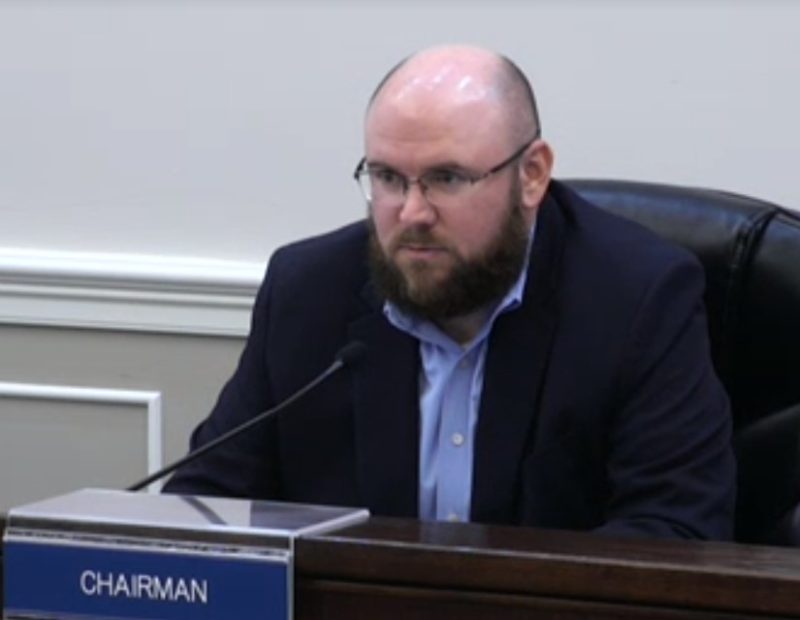
Town Planning Commission Chair Daniel Wells listens to citizen comments during Wednesday’s regular commission meeting. Below, During Public Comments, Kate Heneberry addressed the commission to make it and the Town Planning Department aware of parking and traffic problems on Luray Avenue as a result of “organizational uses” – mainly private church or home schools – at properties in that neighborhood.

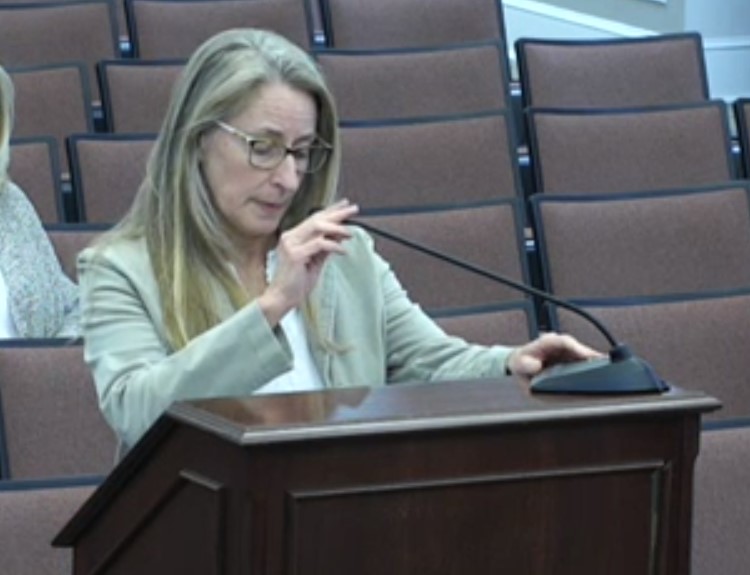
Ms. Heneberry was also concerned that some of these organizational uses might not meet health and safety standards, as single-family residences may not have the public safety infrastructure to accommodate a student body. She also cited problems with students using Bowman Park for recess, lunch, and sometimes outside learning. She said that the damage to the grounds has led to a loss of grass and trees. She urged the Town to address these impacts during the review and approval of applications related to organizational uses in residential districts.
There were three items on the Consent Agenda for approval to advertise for coming public hearings:
The Warren Coalition has made a request for a Special Use Permit for a lodging house located at 501 S. Royal Avenue in the Community Business District. It is zoned Community Business District (C-1) and is also located in the Entrance Corridor.
Skyline Realty Investments, LLC has submitted a Rezoning Application for a request to rezone 29 W. Duck Street from C-1, Community Business District to R-3, Residential District.

Cook Realty, LLC has submitted a Rezoning Application for a request to rezone 1121, 1125 and 1135 John Marshall Highway, from R-1, Residential District to C-1, Community Business District.
On a motion by Vice-Chair Connie Marshner, seconded by Commissioner Wood, the Commission voted unanimously to approve the consent agenda items, allowing coming public hearings to be advertised. Those hearings should be held at the next scheduled Commission meeting.
The Commission then turned its attention to the two items scheduled for public hearings.
Magdalen Capital, LLLP, has submitted a request to amend the current Zoning Ordinance Sections 175-37.3.C, 175-37.4.A & 175-37.17.As the Royal Examiner previously reported, the minimum acreage requirement for the Planned Neighborhood Development District (PND) from the existing 20 and 50-acre minimum lot requirements to a 2-acre minimum lot requirement. This is the minimum total development size, not the individual lot size. Under the Town’s zoning ordinance, the maximum allowable residential density is six dwelling units per acre – and only at the discretion of the Town Council, making a theoretical planned development of 2 acres under the revised ordinance only capable of 12 dwelling units. Otherwise, the parcel is still subject to the density restrictions of the parcel prior to rezoning.

Planning Director Lauren Kopishke told the Commission that Planning Department staff had consulted with its contractor assisting with the rewrite of the Zoning Ordinance and concluded that a 2-acre minimum would not work with the current open space requirements but that staff would recommend a 5-acre minimum instead.
Commissioner Glenn Wood asked how long this ordinance had been in effect. Answer: Since 2011. Commissioner Brian Matthiae asked if this proposed change is in accordance with the new Comprehensive Plan that the Town Council just approved. Planning Director Kopishke: “The Comprehensive Plan lays out goals for increased mixed-use and provisions for affordable housing, so I believe this opens the door for that.” However, she went on to say: “The staff supports the change to reduce the minimum acreage, but I do think that 5 acres is the right minimum.”
Vice-Chair Marshner asked about the process for approval of a PND if a property owner has such a parcel. Planning Director Kopishke responded: “They would need to submit a rezoning application, and we would review it to see if it is in conformance with the Comprehensive Plan. If it is, typically at that point, it would come before the Planning Commission to determine if it was appropriate, and if so, the Commission would forward it to the Town Council with a recommendation for approval.”
At the public hearing, there were two speakers. Neighboring resident Linda Turner, whose property adjoins that under consideration for rezoning for a PND, opposed the ordinance change. She asserted that the current zoning ordinance’s 20 to 50-acre minimums are a safeguard for the community, and allowing a 2 or 5-acre minimum would open the door to “pop-up areas of Development,” potentially turning Front Royal into a “mini-Manassas.” The current zoning of the property would allow the construction of 22-27 homes, and that number alone will add significantly to the increasingly heavy traffic along the Happy Creek corridor, Turner told the commission.

The second speaker, Megan Marazzo, related her experience in new construction and urban infill to illustrate the point that a 2-acre minimum for PNDs is “unheard of” and cited the experiences of places like Leesburg and Ashburn, which have experienced drastic changes due to similar development proposals. She urged the town to identify all the potential parcels that could conceivably be “ripe for the picking” if such a zoning change were approved.

Linda Turner was the first of two public hearing speakers urging caution on reduced Planned Neighborhood Developmental (PND) District minimum lot sizes – from 20 to 50 acres to 2 acres. Below, Magdalen Capital Partner Alex Stieb explained the reasoning for PND zoning size reductions and for the development of a parcel off Happy Creek Road, ranging from up to 27 tract houses to a mixed-use development of single and multi-family homes and small commercial uses. The Commission voted to recommend approval for the Ordinance change at a 5-acre minimum and the requested rezoning.
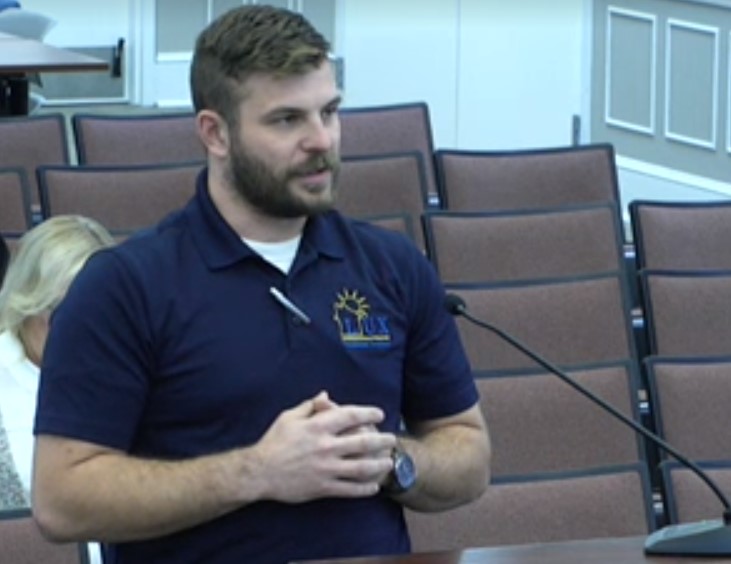
Representing Magdalen Capital LLLP, Alex Stieb addressed the Commission and said that a 20 or 50-acre minimum inhibits smaller builders from doing developments. The proposed 2 or 5-acre developments would allow quality local builders to develop smaller pockets. He pointed out that large developments of 20-50 acres also have a heavy regulatory and environmental burden that small local developers cannot handle.
After a motion by Vice-Chairman Marshner, seconded by Commissioner Michael Williams, to recommend approval of a 5-acre minimum, the Commission discussed the proposed change. Commissioner Wood asked Zoning Administrator-cum-clerk pro tempore John Ware if an inventory of available parcels in the town of 20 acres or more was done. Answer: 16 parcels in town meet the 20-acre threshold of the current ordinance, but Planning Department staff has not done an inventory of how many parcels there would be if the 2 or 5-acre change were made.

The Commission then voted unanimously to recommend a 5-acre minimum, rather than the requested 2 acres, in the ordinance. The text-amended ordinance will go to the Town Council for a final decision.
Magdalen Capital, LLLP also has submitted a request to rezone a parcel at 311 Leach Street, identified by tax map number 20A9-1-3, from R-S, Suburban Residential District to PND (Planned Neighborhood Development District), and adjoining properties from R-1, Residential District to PND as well. This rezoning would only be possible if the Zoning Ordinance text amendment is approved.
In the applicant’s presentation, Magdalen Capital partner Stieb told the commission that a by-right development on that parcel (requiring no rezoning) would essentially be a tract housing site with 26 to 27 single-family homes with no commercial infrastructure. “There’s not a lot of add-value to the town. Nationwide studies show that single-family developments are a net negative,” Stieb told the commission. A mixed-use PND could attract a traditional “corner store” as part of the commercial component. Stieb reasoned that the commercial component would generate tax revenue to offset the public infrastructure costs. So far, the applicant has developed only conceptual versions of the PND that would allow higher-density multi-family units and site plans would have to be provided before actual development could be approved to begin.
At this public hearing, local resident Tanya Jones reiterated the previous speakers’ opposition to the Zoning Ordinance change and told the Commission that she prefers that the developer pursue the by-right option rather than the PND because of the impact on the land and the traffic on Happy Creek Road.
At the end of the public hearing, the Commission discussed the points raised at the Public Hearing. Planning Director Kopishke reminded the commission that no matter what option was eventually followed by the applicant, the Planning Department and the Commission would have to issue and approve a site plan, which would also require Town, County, and State approval before permitting and construction could begin. After some further discussion, on a motion by Commissioner Williams, seconded by Commissioner Wood, the Commission voted unanimously to recommend approval of the rezoning under the new zoning ordinance changes, which have, again, not yet been implemented by the Town. The application will now go to the Town Council for final action. The council will announce when the rezoning will be on its agenda.
Planning Director Kopishke announced that the department had issued 28 zoning permits in October, 18 new zoning enforcement cases, making a total of 320 cases for the year, four new land use applications, eight sign permit applications, and 12 business licenses. The department has met with their consultant and expects a draft zoning and subdivision ordinance in January or February for the Planning Commission to review.
Click here to watch the Front Royal Planning Commission Meeting of November 15, 2023.




Front Royal Community Marks Juneteenth Celebration

Water Main Break Floods Front Royal Neighborhood

The Baby Who Changed Medicine

Front Royal Cardinals Host Purcellville Cannons Sunday, June 21 at Bing Crosby Stadium

America 250: The Smithsonian Comes to You

Regular Maintenance Keeps Electric Fences Working Properly

Virginia House, Senate to Meet Monday as Budget Deadline Inches Closer

Louise Elizabeth Mills (1937 – 2026)

Suspected Drug Trafficker Arrested After Interstate Chase Through Warren and Shenandoah Counties

Business Growth Series: Why Customers Choose Businesses That Show Energy and Confidence

Small Reactors, Big Ambitions

Virginia Unveils East Coast’s Deepest Shipping Channel at Port of Virginia

Warren County Election Staff Earn Federal Election Administration Certification

Weeding Through the True Cost of Building a Cannabis Market to Balance the Budget

Commentary: Four Virginia Counties Will Pump Almost 20 Million Gallons of Water a Day to Amazon… Cause for Concern?

What Parents and Grandparents Need to Know About Child Tax Credits in 2026

Choosing the Right Garden Swing Starts with Space, Style and Material
Front Royal Cardinals Return Home Friday, June 19 to Face Strasburg Express

Town Planning Commissioners Recommend Denial of Proposed Junkyard

Lawmakers Demand Interior Department Explain Use of Park Visitor Fees

What Not to Say in Your First Weeks on the Job

Some Former Felons, Eligible to Vote This Summer, are in Registration Limbo

State Code Allows Front Royal and Warren County to Ban Data Centers

Shelby Gene Bailey (1941 – 2026)
