
National News
No Due Process Guarantee in Fast-Track Removal Proceedings, Trump Administration Argues
WASHINGTON — The Trump administration on Tuesday defended the merits of its fast-track deportation policy before a panel of judges in the U.S. Court of Appeals for the D.C. Circuit, saying immigrants who have been in the country for less than two years without legal authorization are not guaranteed due process.
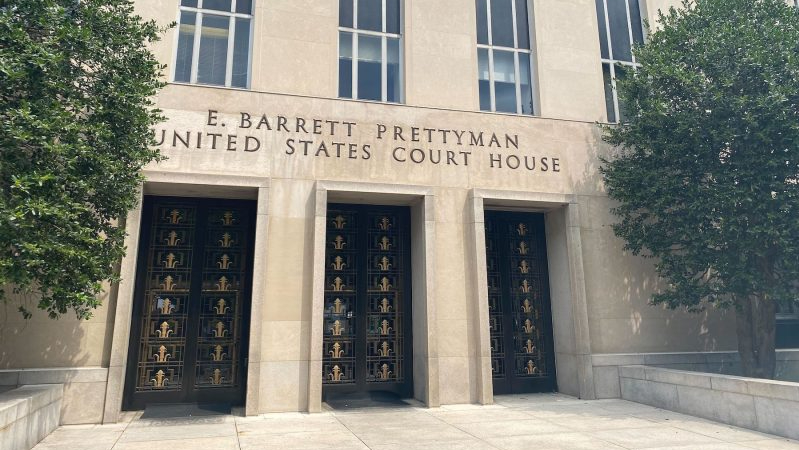
The front entrance of the E. Barrett Prettyman U.S. Courthouse in Washington, D.C., which houses the U.S. Court of Appeals for the D.C. Circuit. (Photo by Jennifer Shutt/States Newsroom)
The suit, brought by immigration rights advocacy groups, challenges the Department of Homeland Security’s expanded expedited removal rule’s application to immigrants in the interior of the United States who cannot prove they have remained in the country for more than two years.
The expanded policy, which allows the removal of immigrants without an appearance before an immigration judge, is a pillar of the Trump administration’s mass deportation campaign.

Arguing on behalf of the Trump administration, Drew Ensign from the U.S. Department of Justice said that immigrants cannot rely on due process rights granted in the Constitution because those rights are reserved for U.S. citizens. Congress and Supreme Court precedents restrict immigrants’ rights to due process, he said.
Additionally, Ensign argued that because Congress authorized the DHS secretary to use expedited removal, the courts have no jurisdiction on the matter.
Anand Balakrishnan, legal counsel for Make the Road New York, the immigrant rights advocacy group that brought the challenge, said the policy skirts a fair legal process for immigrants.
Democratic state attorneys general also submitted a brief in support of the immigrant rights groups, arguing that the expanded use of expedited removal is unconstitutional. Those states include California, Arizona, Colorado, Connecticut, Delaware, Hawai’i, Illinois, Maine, Maryland, Massachusetts, Michigan, Minnesota, Nevada, New Jersey, New Mexico, New York, Oregon, Vermont, and Washington state.

Policy expanded to interior
For decades, expedited removal has been applied to migrants apprehended at the U.S. border and quickly deported without appearing before an immigration judge. In January, the Trump administration expanded its scope to the interior of the country and applied it to any immigrant apprehended who cannot prove they have remained in the country for more than two years.
An appeals court in late November declined the Trump administration’s request to pause a district court’s block of the policy while the appeal was pending.
Tuesday’s hearing was part of the Trump administration’s appeal on the merits of its policy before a different appeals panel, Judges Justin R. Walker, Neomi Rao, and Robert L. Wilkins. President Donald Trump nominated Walker and Rao, and former President Barack Obama nominated Wilkins.
The panel appeared skeptical of the administration’s argument that due process rights do not apply to immigrants who entered the U.S. without legal authorization.

Duty to notify
The judges seemed split, though, about if the government should be expected to explain the expedited removal statute to a person it is attempting to remove and what that person’s rights are to challenge their removal, or if the person should have to ask for their own due process rights.
“Even if we accept your portrayal of how the due process works, … under that framing, there still has to be adequate notice (of removal),” Wilkins said to Ensign.
Ensign argued that immigrants subject to expedited removal have sufficient notice that they are being removed and can’t rely on the due process clause of the Constitution’s Fifth Amendment to challenge it. The executive branch has the authority to decide how to apply the clause to immigrants, he said.
Wilkins pushed back on that argument, saying notices must meet minimum standards.

“The notice (of removal) has to be sufficient,” he said to Ensign. “(It) has to inform you of at least what the procedures are or what you’re facing.”
Balakrishnan said a mere notice of removal is “inadequate.” An immigrant subject to expedited removal can be deported within hours, and without having time to challenge their removal or even speak to an attorney, he said.
Walker seemed skeptical that the burden of notifying an immigrant that they were subject to the policy fell to the government.
“For someone who has chosen to be here illegally, in violation of our laws….from a due process perspective, it’s not too much to ask that if someone here illegally wants the special non-expedited removal procedures that Congress has graciously afforded them, it’s not too much to ask that they ask for them,” he said.

Balakrishnan argued that it wouldn’t be sufficient due process.
“I think it’s common sense that having even that bare amount of information, ‘if you’ve been here for over two years you’re not subject to expedited removal’ would certainly decrease the risk of error,” Balakrishnan said. “I’m not sure how it would be overly burdensome for the government to do that.”
by Ariana Figueroa, Virginia Mercury
Virginia Mercury is part of States Newsroom, a nonprofit news network supported by grants and a coalition of donors as a 501c(3) public charity. Virginia Mercury maintains editorial independence. Contact Editor Samantha Willis for questions: info@virginiamercury.com.




The Eye Surgery Factory That Could Not Expand

Ancient Ownership of Israel

VDOT: Warren County Traffic Alert for October 5 – 9, 2026

Reaching Out Now Expands Programs and Opportunities for Warren County Youth

Dance and Arts VA Finds New Home, New Opportunities on Water Street

Ann L. Shuman (1933 – 2026)

Wendy Lee Whitacre-Stout (1966 – 2026)

Spanberger’s Energy Plan Keys in on Clean Energy to Meet Growing Demand and VCEA Goals

Jean Elizabeth Grubbs Fogle (1939 – 2026)

Feds Provide Guidance on New Federal K-12 Scholarship Tax Credit Program

Why Wait Till November? Mid-Term Election Early Voting Processes in Place Now

US Senate Leaves Nation’s Capital in Advance of Midterms With Much Still Undone

Business Growth Series: If You Don’t Control Your Day, It Controls Your Business

The End of a 20-Year Monopoly on the Credit Score
Voltron and Immigration

States OK Solar Panels for Balconies. Safety Guidelines Haven’t Caught Up

Trump TV Ads Paid for with $20M in Homeland Security Funds, Dems Find

Blue Ridge Wildlife Center Patient of the Week: Gray Treefrog

Birthday Twins: See Which Famous Face Shares Your Big Day

Meet-and-Greet Set Sunday for Republican-Endorsed Front Royal Candidates

Barbara Ann Mathews Smelser (1943 – 2026)

Kathleen Frances Elar (1956 – 2026)

Happy Creek Crossing to Hold Vendor Interest Meeting Oct. 8 in Front Royal

If the Car Name Fits, Drive It
