
State News
Trees Take Root as Virginia’s Frontline Defense Against Urban Heat
As temperatures climb, some parts of the commonwealth are heating up faster than others — a result of too few trees and too little shade. Neighborhoods without tree canopy can be up to 15 degrees hotter than those with tree cover, and often those areas are home to communities of color and lower-income households.
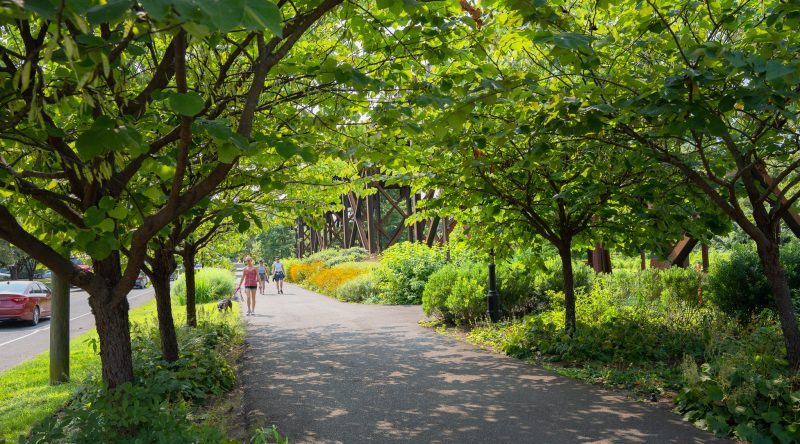
Example of urban tree canopy in Richmond, VA. (Photo courtesy Virginia Department of Forestry)
To address the legacy of redlining and underinvestment in these parts of Virginia localities, state and local groups are working to lower temperatures naturally by planting trees.
Across Richmond, hundreds of tree wells sit empty. Through a $6 million grant from the U.S. Department of Agriculture, the city and community-based groups are working to plant more trees and bring shade to neighborhoods that need it most.

“The neighborhood organizations and these nonprofits are kind of stepping in to assist the city in this effort because we do realize that there are a lot of needs and priorities that the city has to take care of,” said Amy Wentz, co-founder of Southside ReLeaf.
The Cool the City initiative was created as part of Richmond’s RVAgreen plan to increase tree coverage across the city. Local officials also hired an urban forester for the first time to develop a comprehensive plan identifying where more green space is needed most.
In 2010, Richmond was reported to have 42% tree canopy coverage, while 36% of its surface was impervious, meaning water cannot infiltrate it. Most areas lacking tree canopy were post-industrial zones and historically redlined neighborhoods that faced years of underdevelopment. High levels of impervious surfaces can lead to runoff into waterways, localized flooding, and a lack of shade to cool roads, sidewalks, and parking lots.
Cool the City has entered its second year under the federal grant, with a renewed focus on public engagement. Organizers are planning to plant hundreds of trees during Earth Month while also working to educate the public about maintaining green spaces and the cooling benefits of tree canopies.

Beyond providing shade and lowering temperatures, trees also play a critical role in managing stormwater and reducing flooding.
According to the Chesapeake Bay Foundation, a one-inch rainfall on a one-acre parking lot can generate more than 27,000 gallons of runoff flowing into low-lying areas and streams.
By contrast, the same amount of rain falling in a forest produces only 750 gallons of runoff — a major difference that can be crucial during flash flooding events in Virginia cities.
Virginia is home to roughly 16 million acres of forest that serve as natural air purifiers, flood mitigation systems, and cooling mechanisms. However, much of that tree canopy is located on the outskirts of urban areas, where development continues to expand.

Jeremy Hoffman with GroundworkUSA has been involved in research starting in 2017 that revealed that temperatures in urban areas that lack tree canopy face higher temperatures and increased health risks, particularly for often impacting the most vulnerable populations in a community.
“It’s an important perspective to see that trees are infrastructure,” Hoffman said. “When we invest in trees, we’re also investing in the safety and reliability of our transportation networks and the cohesiveness of our neighborhoods and our public health all at the same time.”
Areas with shade — whether from trees or built infrastructure — were found to be significantly cooler than paved spaces exposed to direct sunlight, a difference that can be crucial during extreme heat.
Hoffman said neighborhoods such as Southside Richmond, including the historically industrial Manchester area, routinely experience pronounced heat island effects on hot days.

“It can be really challenging to plant and maintain an urban tree canopy in those places,” Hoffman said. “We also need to be thinking about if we don’t have the space for these trees to provide durable shade for the next 50 years, what are some other immediate sorts of things we can be doing to improve the thermal experience of these areas?”
A bill passed by the General Assembly and now awaiting action from Gov. Abigail Spanberger would give localities new authority to require tree planting as part of development plans, setting long-term canopy targets based on zoning density.
Under the proposal, site plans and new developments could be required to include planting or replacing trees to meet canopy benchmarks within 20 years.
The targets would range from 10% canopy coverage in business, commercial, and industrial zones to as much as 30% in lower-density residential areas. Higher-density housing, such as developments with 20 or more units per acre, would also be required to meet at least 10% canopy, while mid-range residential zoning would fall between 15 and 20%, depending on density.

The legislation also calls for the creation of a study group bringing together state agencies and nonprofit organizations to develop recommendations for future policies governing urban tree canopy management.
At the same time, some existing efforts face uncertainty.
The Virginia Department of Forestry’s Trees for Clean Water grant program, which supported community-based tree planting projects that resulted in more than 75,000 trees planted last year, was not funded in this year’s budget.
Lara Johnson, the department’s urban and community forestry manager, said the agency will continue deploying remaining funds while helping local governments sustain their own initiatives. One ongoing statewide effort, known as “Throwing Shade”, partners with nurseries to offer discounts on native shrubs and trees.
“We’re going to work as much as possible with our sister agencies, just to be technical support, if the funding’s there or not,” Johnson said. “There will always be trees growing on the ground, and there will always be a need for that kind of support, right? And we’ll be there to provide it.”
Johnson said a comprehensive report examining heat impacts across the commonwealth is expected to be completed this fall and submitted to the General Assembly, potentially shaping future legislation on tree canopy and other cooling methods.
“I think it’ll be really nice to have that data to kind of reiterate that messaging of, yes, our cities are hotter,” Johnson said. “Let’s think about some of these solutions, and trees can be a solution to this problem.”
The General Assembly is scheduled to return to Richmond on April 23 to finalize and pass a budget.
by Shannon Heckt, Virginia Mercury
Virginia Mercury is part of States Newsroom, a nonprofit news network supported by grants and a coalition of donors as a 501c(3) public charity. Virginia Mercury maintains editorial independence. Contact Editor Samantha Willis for questions: info@virginiamercury.com.




The Eye Surgery Factory That Could Not Expand

Ancient Ownership of Israel

VDOT: Warren County Traffic Alert for October 5 – 9, 2026

Reaching Out Now Expands Programs and Opportunities for Warren County Youth

Dance and Arts VA Finds New Home, New Opportunities on Water Street

Ann L. Shuman (1933 – 2026)

Wendy Lee Whitacre-Stout (1966 – 2026)

Spanberger’s Energy Plan Keys in on Clean Energy to Meet Growing Demand and VCEA Goals

Jean Elizabeth Grubbs Fogle (1939 – 2026)

Feds Provide Guidance on New Federal K-12 Scholarship Tax Credit Program

Why Wait Till November? Mid-Term Election Early Voting Processes in Place Now

US Senate Leaves Nation’s Capital in Advance of Midterms With Much Still Undone

Business Growth Series: If You Don’t Control Your Day, It Controls Your Business

The End of a 20-Year Monopoly on the Credit Score
Voltron and Immigration

States OK Solar Panels for Balconies. Safety Guidelines Haven’t Caught Up

Trump TV Ads Paid for with $20M in Homeland Security Funds, Dems Find

Blue Ridge Wildlife Center Patient of the Week: Gray Treefrog

Birthday Twins: See Which Famous Face Shares Your Big Day

Meet-and-Greet Set Sunday for Republican-Endorsed Front Royal Candidates

Barbara Ann Mathews Smelser (1943 – 2026)

Kathleen Frances Elar (1956 – 2026)

Happy Creek Crossing to Hold Vendor Interest Meeting Oct. 8 in Front Royal

If the Car Name Fits, Drive It
