
Local News
Maryland, Virginia, D.C. join forces to challenge EPA inaction on Bay cleanup
The non-partisan Environmental Integrity Project (EIP) citizen watchdog group is lauding a joint action by the Attorney General’s Offices of Virginia, Maryland and Washington, D.C. regarding a failure by the Environmental Protection Agency (EPA) to hold two northern states accountable for their roles in pollution of the Chesapeake Bay. That pollution is seen as a major threat to the Bay’s billion-dollar commercial fishing industry.
Warren County and other Northern Valley counties are also part of the Chesapeake Bay watershed impacted by past mandates on preventing regional pollution from floating downstream to the Bay. Targeted by the trio of AG Offices are EPA failures to hold Pennsylvania and New York to standards mandated as part of the long-term cleanup plan to preserve the Chesapeake Bay’s ability to sustain the aquatic life at the heart of a major source of the U.S. seafood supply.
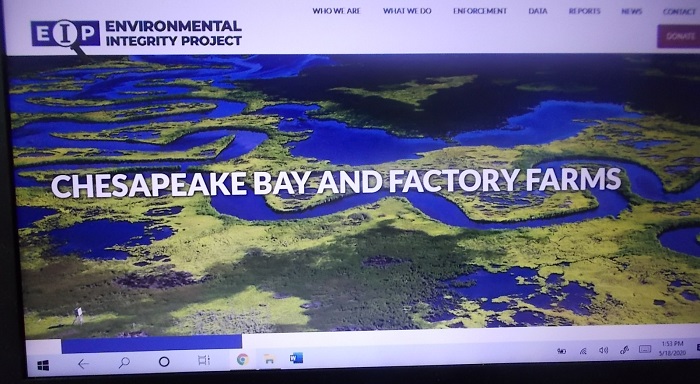
Threats to the Chesapeake Bay and its fishing industry come from many directions. A new tri-jurisdiction legal action says all should be held equally accountable. Graphics from the EIP website.
Below is the full text of the Environmental Integrity Project release on the action, followed by the press release of Maryland Attorney General Brian Frosh’s office elaborating on why the suit is being brought forward:

Praise for Legal Action Against Trump EPA over its Failure to Enforce Chesapeake Bay Cleanup
Attorneys General for MD, VA and DC File Notice of Intent to Sue EPA for Failing to Force PA and NY to Reduce Pollution
Washington, D.C. – The Attorneys General of Maryland, Virginia and the District of Columbia today filed a notice of intent to sue the Trump Administration EPA over its failure to force Pennsylvania and New York State to meet their Chesapeake Bay cleanup obligations under a 2010 regional agreement with a deadline of 2025.
Eric Schaeffer, former Director of Civil Enforcement at EPA and Executive Director of the Environmental Integrity Project, issued the following statement in support of the legal action.
“This is a welcome development and long overdue, because the Trump Administration’s EPA has really fallen down on its job to enforce the Chesapeake Bay cleanup plan,” said Schaeffer. “This lack of accountability has been especially troublesome in the case of the state adding the largest share of pollution in the Bay, Pennsylvania. The Commonwealth has been slashing the budget and staffing of its Department of Environmental Protection and doing little to reduce agricultural pollution and even sewage overflows from the state capital, Harrisburg, during the same decade when it had promised to step up its efforts. Enough is enough.”


Three State Attorney Generals are calling Trump Administration softening of EPA regulatory mandates to account in court.
A copy of the notice is attached. The notice says in part: “The Bay TMDL (cleanup agreement, or Total Maximum Daily Load) requires Pennsylvania to reduce its nitrogen pollution by about 33.8 million pounds per year. Pennsylvania’s (most recent cleanup plan, called the ‘Phase III Watershed Implementation Plan’) however, reflecting significant deficiencies in funding, shows anticipated reductions of only 24.8 million pounds per year. Thus, Pennsylvania’s Phase III WIP leaves the Bay with an excess of approximately 9 million pounds of nitrogen per year.”
Below is the press release from Maryland Attorney General Brian Frosh’s Office:
Attorneys General Frosh, Herring, Racine File Notice of Intent to Sue EPA
Agency Failed to Hold Pennsylvania and New York Accountable for Bay Pollution

BALTIMORE, MD (May 18, 2020) – Maryland Attorney General Brian E. Frosh, joined by the Attorneys General of Virginia and the District of Columbia, today filed a Notice of Intent (NOI) to sue the Environmental Protection Agency (EPA) over its failure to require Pennsylvania and New York to develop and implement plans to achieve 2025 Chesapeake Bay restoration goals. Under the Clean Water Act, EPA has a nondiscretionary duty to “ensure that management plans are developed and implementation is begun by signatories to the Chesapeake Bay Agreement to achieve and maintain” the Bay Total Maximum Daily Load (TMDL). The TMDL is a comprehensive “pollution diet” aimed at restoring clean water in the Bay States that sets limits for nitrogen and phosphorus pollution, in addition to reductions in sediment.
EPA’s recent evaluation of each Bay state’s Watershed Improvement Plan (WIP) concluded that Maryland, Virginia and the District of Columbia all will attain their respective necessary load reductions by 2025. EPA also concluded that the plans submitted by Pennsylvania and New York were deficient, falling short of nutrient reduction goals and lacking in sufficient funding. EPA has not, however, required Pennsylvania or New York to develop or implement plans that fully meet the pollution reduction goals.

This graphic illustrates the myriad areas of concern that keep the Environmental Integrity Project busy around the nation trying to preserve a standard of environmental protections that cross partisan political lines for a national good in all U.S. citizens’ interest.
“The Chesapeake Bay is one of our country’s most valuable natural resources,” said Attorney General Frosh. “Restoring the health of the Bay will take a coordinated, multistate effort with every state sharing the burden. EPA has abandoned its responsibility to regulate and manage the efforts of the Bay states. Together, we fully intend to hold EPA accountable and require it to perform its regulatory duty.”

“Protecting and restoring the Chesapeake Bay requires a comprehensive effort by each of the watershed states as well as the EPA,” said Attorney General Mark R. Herring. “As the administrator of the Chesapeake Bay Agreement, EPA must treat each of the partners equally and make sure every state is pulling its weight and upholding its portion of the agreement, but instead, the Trump EPA simply rubberstamped plans that are plainly inadequate. I hope we are able to come to an understanding that is beneficial for all parties, while keeping the health of the Bay at the forefront.”
“Our coalition of State Attorneys General will not allow the EPA to walk away from its enforcement obligations and undermine decades of work to reduce pollution across the Chesapeake Bay watershed,” said D.C. Attorney General Karl A. Racine. “The District is committed to reaching our pollution reduction goals, but if other states are not doing their part, and the EPA is not keeping watch, we will fail to restore the Bay and our local waters, including the Potomac River.”
“Maryland will continue to work with all of our partners to meet Bay restoration goals, as this important lawsuit moves forward,” said Maryland Environment Secretary Ben Grumbles. “EPA must be held accountable to enforce the clean water commitments made by our upstream partners.”
In 2007, the Bay States and EPA agreed that EPA would establish a TMDL for the entire Bay Watershed. Pursuant to that agreement, in 2010, EPA established the Bay TMDL, a comprehensive “pollution diet” aimed at restoring clean water in the Bay States. The Bay TMDL sets limits for pollution that equate to a 25 percent reduction in nitrogen, a 24 percent reduction in phosphorus, and a 20 percent reduction in sediment. The Bay TMDL further allocates these pollution reductions to the respective Bay States, including Pennsylvania and New York, with a 2025 deadline to achieve the reductions.

To ensure they met the Bay TMDL’s goals, EPA required each Bay State to submit a series of WIPs detailing how it would achieve its allocated pollution reductions over the course of the Bay TMDL’s term. EPA received the third and final WIP for each Bay State on August 23, 2019.EPA concluded that the Phase III WIPs (Watershed Implementation Plan) submitted by Maryland, Virginia, and the District of Columbia showed they would attain the necessary load reductions by 2025. EPA similarly concluded that Delaware and West Virginia had submitted Phase III WIPs that met their respective numeric planning targets and would attain the necessary load reductions by 2025. Pennsylvania and New York, however, submitted Phase III WIPs that failed to meet their planning targets. Pennsylvania’s plan, as approved by EPA, would only achieve approximately 75 percent of its target for nitrogen reduction and reflected significant deficiencies in funding. New York’s plan would only achieve a 64 percent nitrogen reduction – falling short of the planning target by nearly 1 million pounds per year.
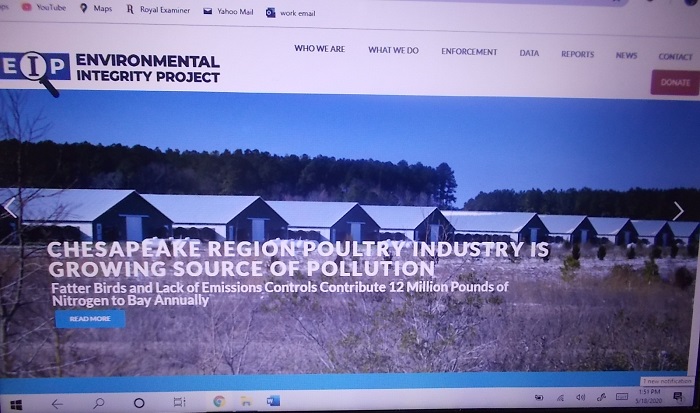
That is 12 MILLION pounds of poultry wastes alone threatening the health of the Chesapeake Bay’s aquatic life – where did that last seafood dinner you had come from?
EPA has not required Pennsylvania or New York to prepare a Phase III WIP that remedies these deficiencies. The obligations of Pennsylvania and New York in the Bay Agreement and Bay TMDL are critical to restoring clean water in the Chesapeake Bay and its streams, creeks, and rivers. Yet EPA has allowed these jurisdictions to send approximately 10 million excess pounds of nitrogen into the Chesapeake Bay and its watershed every year, and threaten the success of efforts to restore the Bay.




July 1 Marked Statewide Start of a Ban on the Use of Certain Plastic Foam Foodware Containers

Technology Business Versus Data Center: Town Planning Commission Deep Dives into Definitions

Celebrate Independence Day Close to Home

Middletown Announces Grand Marshals for America 250 Independence Day Parade

Virginia Braces for Dangerous Heat Wave Ahead of Fourth of July Weekend

Cardinals Host Woodstock River Bandits Friday, July 3 at Bing Crosby Stadium

Medicaid Again to Cover Non-Abortion Care at Planned Parenthood as GOP Ban Ends

Justice Department Sues Virginia Over New Semi-Automatic Rifle Ban

Warren County Sheriff’s Foundation Working to Strengthen Community Connections

Dr. Arthur Gaillard Gower III (1933 – 2026)

The $4 Frame That Held a Treasure

Mary A. Shaw (1958 – 2026)

Come On Down to the Great American State Fair — There’s Plenty of Room

Man Accused of Threatening Former Delegate Kim Taylor Enters Plea Agreement

Mark Allen Kisner (1957 – 2026)

Peggy Ann Franklin Thompson (1940 – 2026)

Spanberger, Assembly Ignore Dominion Sale, Focus on Scapegoating Data Centers

The Declaration of Independence First Received in the Churches

What Frederick Douglass Asked of America

Here Are 10 Notable New Virginia Laws That Will Take Effect July 1

Virginia to Fund Cancer Screening Program for Firefighters

How a Texas Metal Shop Became Igloo

Warren County Officials Urge Safe, Legal Fireworks Use During July Fourth Holiday

Virginia Colleges Face Global Competition as More Students Consider Studying Abroad
