
Local Government
Front Royal’s Economic Development Authority has inaugural meeting
The newly formed Front Royal Economic Development Authority (FREDA) met for the first time, at 11 a.m. Thursday morning, January 20, 2022, in the second-floor Town Hall meeting room. Royal Examiner was notified that what was primarily an orientation meeting and the first gathering meet and greet of the town council-appointed FREDA Board of Directors would not be livestreamed or videotaped by the Town, leading to the presence of the Royal Examiner camera to visually document the occasion.
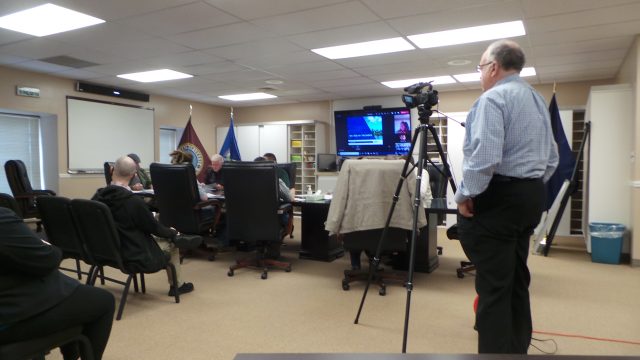
Told the Jan. 20th FREDA meeting would not be livestreamed or videotaped by the Town, the Royal Examiner camera was present to record the inaugural FREDA gathering. Royal Examiner Photos by Roger Bianchini
The meeting was chaired by Town Manager Steven Hicks, who has been tasked by the Town Council to also serve as FREDA’s executive director. The meeting began two of seven board members short, with Nick Bass and Rick Novak both arriving a few minutes after the 11 a.m. starting time. Final arrivee, Royal Cinemas owner Novak, explained a concession stand equipment malfunction had delayed his arrival.
The now fully manned board took on a four action-item agenda, including presentation of draft bylaws for review; setting dates for a FREDA retreat (March 8), as well as its next meeting (Feb. 17, indicating a third Thursday rotation of regular monthly meetings); and Virginia Economic Development Partnership (VEDP) General Counsel Sandy McNish’s remotely presented PowerPoint overview of EDA functions and state legal parameters for EDA operations, including financial lending utilizing public funds to stimulate economic development for a public good.

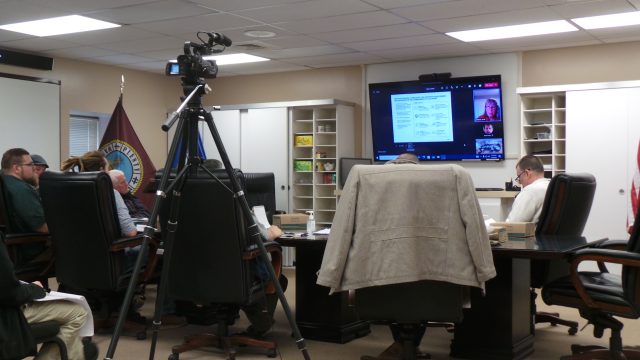
The full FREDA Board of Directors, executive director/town manager, and other Town support staff listen to VEDP General Counsel Sandy McNish virtually summarize an overview of EDA functions and legal parameters.
McNish noted Virginia as a Dillon Rule state in which localities and political subdivisions like EDA’s cannot exceed authorities “expressly granted by the General Assembly”. She also noted that municipally created EDA’s are independent entities from the municipalities that create them and utilize their services in economic development initiatives and assistance in financing economic development projects.
In prefacing the FREDA board for the VDEP presentation, Town Manager/FREDA Executive Director Hicks said, “Today is obviously our first overall meeting. We’ve got a pretty decent agenda, more of just an intro of what we’re going to do. We’re going to talk about EDA 101 … and also I would kind of like to go around the table and have everyone introduce (themselves) with a brief bio of who you are, as well. And then I’m going to introduce the staff that will be supporting the EDA as we go forward.”

The full FREDA board meets and greets as Executive Director/Town Manager Steven Hicks presides at far head of the table.

Those FREDA Board of Director introductions included (in the order listed in the agenda packet summary of their backgrounds):
Isaac Rushing (1-year term), owner of Honey and Hops Brew Works at 212 E. Main St., also cited as “a former supervisor with the Town of Front Royal” though no department was included in his profile;
David Gedney (1-year term), owner of Element Restaurant (317 E. Main St.), also a current member of the Town Board of Zoning Appeals (BZA), who has past experience “in planning/growing a recycling effort for VCU” (Virginia Commonwealth University in Richmond);
Mark Tapsak (2-year term), owner of Mountain Music (217 E. Main St.), also cited as “a medical device research scientist and consultant with Diabetic Health Inc., as well as a university (unspecified) teacher of biochemistry and chemistry courses.”

Rick Novak (2-year term), as previously noted owner of Royal Cinemas (117 E. Main St.) and Royal Family Bowling Center (430 Remount Rd.), also cited as a former owner of the Blue Ridge Motel and Royal Family Amusement Arcade;
Frank Stankiewicz (3-year term), owner/manager of Green to Ground Electrical LLC (316 Warren Ave.), also cited as “President of local (unspecified) networking organization”;
James Crowell (3-year term), owner of Quecon, Inc. IT Engineering Co. (134 Peyton St.) “that specializes in cybersecurity, software engineering and telecommunications” who is also cited as “Graduated from Goldman Sachs 10,000 small business program (10KSB), Veteran’s Institute of Procurement (VIP), VA Scaling for Growth (S4G), Small Business Administration (SBA) business development.”
Nick Bass (4-year term), cited as “Geotechnical and construction consultant; experience reviewing construction contracts and subcontractor agreements to identify risky language; marketing experience and communications skills.”

In her presentation to the newly created FREDA Board of Directors, VEDP General Counsel McNish, who noted a 14-plus year tenure at VEDP, said, “So, what’s an EDA? You’re enabling legislation is the Industrial Development and Revenue Bond Act. You’re a political subdivision of the Commonwealth, much as the VEDP is; you are a separate legal entity, as the VEDP is. You’re not the town that created you, the town that created you is not you. You have a separate subdivision, you are a different thing.”
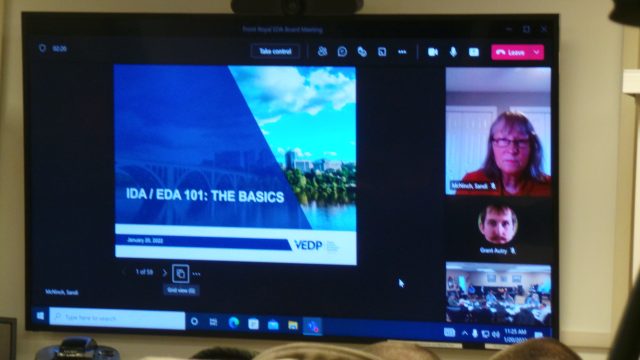
As their executive director phrased it, the FREDA board is briefed in detail on ‘EDA 101’ by 14-year veteran VEDP General Counsel Sandy McNich.
She continued to note that EDAs “are usually created by one locality but they can … be created by two or more, as you know. And authorities, even if they’re from separate localities, can, indeed, work together in a cooperative way on projects.”
One might hope that as an evolving independent subdivision of the Town of Front Royal, that type of inter-EDA cooperation will develop, as has been offered by the WC EDA Board, despite the total cut off of all communications, other than civil litigation, example that has been set in recent months by the Front Royal Town Council and its town management staff.

“You have very broad powers under the Industrial Development and Revenue Bond Act. And you can do most anything, so long as you do it under your animating purpose, which is to promote industry and develop trade by inducing manufacturing, industrial, governmental, etc. facilities to locate in or remain in the Commonwealth.
“Now if you’re providing a branch or something to somebody or helping with a developmental plan, that’s certainly going to benefit a private company. But that’s okay because that’s not why you are doing it. You’re doing it for a public purpose,” McNish pointed out of attracting business or industry to an area as a general economic benefit to the community in which the EDA operates.




July 1 Marked Statewide Start of a Ban on the Use of Certain Plastic Foam Foodware Containers

Technology Business Versus Data Center: Town Planning Commission Deep Dives into Definitions

Celebrate Independence Day Close to Home

Middletown Announces Grand Marshals for America 250 Independence Day Parade

Virginia Braces for Dangerous Heat Wave Ahead of Fourth of July Weekend

Cardinals Host Woodstock River Bandits Friday, July 3 at Bing Crosby Stadium

Medicaid Again to Cover Non-Abortion Care at Planned Parenthood as GOP Ban Ends

Justice Department Sues Virginia Over New Semi-Automatic Rifle Ban

Warren County Sheriff’s Foundation Working to Strengthen Community Connections

Dr. Arthur Gaillard Gower III (1933 – 2026)

The $4 Frame That Held a Treasure

Mary A. Shaw (1958 – 2026)

Come On Down to the Great American State Fair — There’s Plenty of Room

Man Accused of Threatening Former Delegate Kim Taylor Enters Plea Agreement

Mark Allen Kisner (1957 – 2026)

Peggy Ann Franklin Thompson (1940 – 2026)

Spanberger, Assembly Ignore Dominion Sale, Focus on Scapegoating Data Centers

The Declaration of Independence First Received in the Churches

What Frederick Douglass Asked of America

Here Are 10 Notable New Virginia Laws That Will Take Effect July 1

Virginia to Fund Cancer Screening Program for Firefighters

How a Texas Metal Shop Became Igloo

Warren County Officials Urge Safe, Legal Fireworks Use During July Fourth Holiday

Virginia Colleges Face Global Competition as More Students Consider Studying Abroad
