
Local Government
Council interviewing to fill vacancy; undecided on early special election
With its Fiscal Year 2018 Budget in place, the Front Royal Town Council is proceeding with plans to appoint a successor to fill the vacancy created by the July 1 departure of Bébhinn Egger. After marrying in late June, Egger left the town and state to live at her husband’s Maryland residence.
When council appoints Egger’s replacement it will have two appointed members. Chris Morrison was appointed on January 23 to fill the vacancy left when Hollis Tharpe became mayor in an off-year for his council seat’s election at the start of 2017.
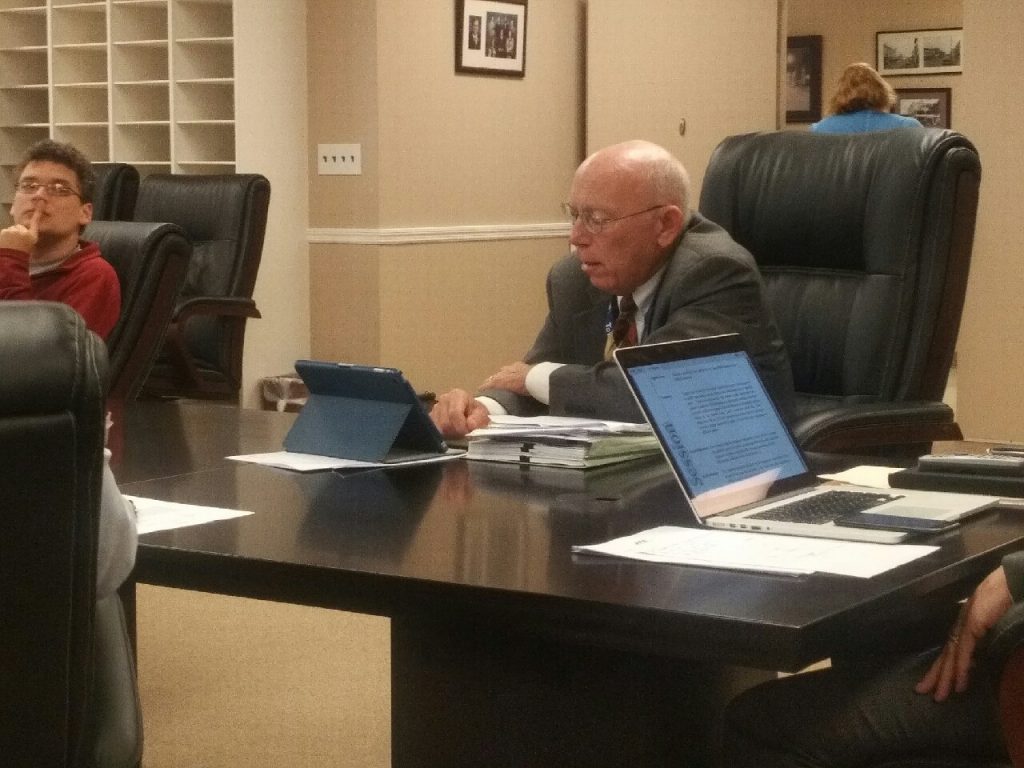
Front Royal Attorney Doug Napier is advising council on its options regarding appointed versus elected councilmen. To Napier’s right, Councilman John Connolly ponders what he’s hearing. Photo/Royal Examiner
The discussion of appointment versus special election to fill Egger’s seat arose because there are mixed messages in State Codes, the Virginia Constitution and the Town Charter about the legal rights of appointed members to vote on budgets, real estate sales and certain other large-ticket items. However, according to the town attorney the supermajority – five of six members under normal circumstances – required to approve high-dollar items may only require a supermajority of “the elected” members.

Contacted on Friday, July 7, Town Attorney Doug Napier confirmed council was proceeding with plans to appoint Egger’s successor, but was yet undecided on whether to convene a special election to fill the seat for the remaining year of her term. Egger’s seat will come up for election November 2018. However, there are county and state elections this coming November when the town government could piggyback a special election.
Cost of a special election is one variable being considered in council’s decision on when to give its appointed members a chance to become elected, ending any question on their voting rights. County Voter Registrar Carol Tobin is on vacation this week though we have sought an e-mail reply on relative costs of stand-alone versus special elections piggybacking on already-scheduled – ALONG with a VERY DEEP apology for interrupting her vacation.
Council had interviews scheduled for a 6 p.m. closed session prior to its 7 p.m. meeting of July 10 (see coming related story). It plans to have interviews from the pool of eight applicants for Egger’s seat completed within the next two weeks.

Unknown variables – how long to fill an empty council seat with an appointed versus elected member remained unresolved following July 10 closed session discussion. Photo/Roger Bianchini

And while we know the number of applicants for the vacant council seat, Town policy has been not to release the identity of applicants or information on their backgrounds or qualifications before the announcement of the appointment. Interviews with council applicants for appointment have been conducted in closed session for years.
We asked Town Attorney Doug Napier and Mayor Hollis Tharpe what the rationale behind that policy is; and if perhaps appointees to fill elected seats shouldn’t be treated along the lines of the public information available on candidates for public office?
Napier explained that the policy pre-dated his arrival and cited State Codes related to FOIA exemptions on such actions as municipal appointments to fill vacant elected-body seats.
On Monday, July 10, council adjourned to closed session at the conclusion of its regular meeting to discuss the council vacancy. While Mayor Tharpe said there might be a vote following the closed session, none occurred after the regular meeting reconvened. It was anticipated on press row that had there been a vote, it would have been on whether or not to hold a special election this November to make the seat an elected one for the final year of Egger’s term.





More Than a Futbol Rivalry

Scott’s Turn: A Conversation About Building Stronger Communities

The Power of Words: A Lesson From Calvin Coolidge

Excel to Perform July 23 at Gazebo Gatherings

Michael Ray Santmyers (1971 -2026)

Oatmeal: Why Some Swear by It and Some Swear at It

This Week’s Showtimes at Royal Cinemas as of July 24th

Marcelene Fay “Marci” Pinion (1958 – 2026)

Buford “Bo” Lynn Kibler (1942 – 2026)

A Path to Fiscal Responsibility and Public Wellness

Moving Data Center Regulations and Permitting Forward a Dominant Topic of Conversation for County’s Elected Officials

Screen Rules That Actually Work

Blue Ridge Wildlife Center Patient of the Week: American Barn Owl

After Taking Off in Charlottesville, Feds Plan National Electric Aircraft Charging Network Rollout

POLICE: 7 Day FRPD Arrest Report 7/20/2026

FDA: Taylor Farms iceberg lettuce sample produced a false positive for cyclospora

Data Centers Want to Build Their Own Gas Turbines. Would That Skirt State Renewable Energy Laws?

Legal Notice: Virginia Alcoholic Beverage Control (ABC) Authority
Removing a Senator
The Dillon Rule Doesn’t Say What Mr. Cuddeback Implies

Test Your Balance Before the Job Tests It for You
Legal Notice: Virginia Alcoholic Beverage Control (ABC) Authority

Late On Rent? New Virginia Law Gives Tenants More Time and Protection From Eviction

Virginia Schools Gain Spending Flexibility Under Federal Program
