
Interesting Things to Know
Recalling the Events of Our Lives: Half a Century Since the Vietnam War
If you think back a little more than 50 years, the images from April 1975 may still linger: helicopters lifting desperate evacuees from rooftops in Saigon, crowds pressing toward the U.S. embassy gates, and the final collapse of South Vietnam that marked the end of one of the most divisive conflicts in American history.
For many Americans, the Vietnam War was not something seen only on television. It touched families and communities across the country. Some remember friends or relatives who quietly disappeared to avoid the draft. Others remember soldiers who returned home from combat to little recognition, or the names of those who never returned at all — more than 58,000 Americans who lost their lives in the war.
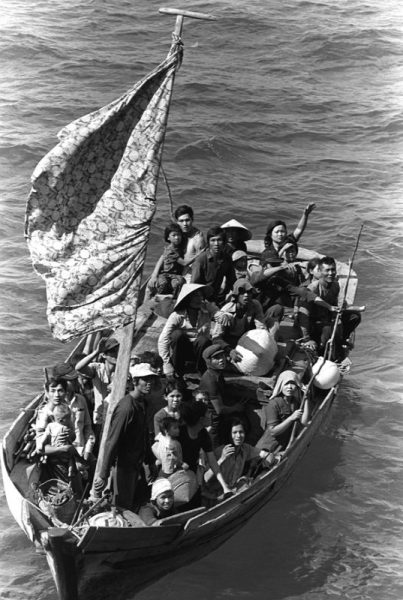
Vietnamese refugees wait to be taken aboard the amphibious command ship USS BLUE RIDGE (LCC-19). They are being rescued from a 35-foot fishing boat 350 miles northeast of Cam Ranh Bay, Vietnam, after spending eight days at sea.
Now, 51 years later, the world that emerged after the conflict looks very different from what many expected at the time.

When the war ended in 1975, Vietnam was unified under the Communist Party of Vietnam. The new government implemented a strict socialist economic system that included collectivized farms, nationalized industries, price controls, and central planning.
In the years that followed, particularly in the former South Vietnam, the transition was harsh. Many people were detained in “re-education camps,” where political prisoners were held for years. Others were forced to relocate to remote rural settlements known as “New Economic Zones.” Private property was seized, and economic freedoms were sharply restricted.
The economic results were grim. Food shortages became common, malnutrition spread, and inflation soared to more than 700 percent. Economic growth stalled, and poverty deepened throughout the country.
Faced with mounting crisis and declining support from the Soviet Union, Vietnam’s leadership eventually changed course. In 1986, the government launched a sweeping reform program known as Đổi Mới, often translated as “Renovation.”
The reforms loosened government control over the economy. Farmers were allowed to operate household farms, price controls were eased, private businesses were permitted, and foreign investment was welcomed.

The shift produced dramatic results.
Over the past four decades, Vietnam has transformed into one of the world’s fastest-growing economies. While the country remains under one-party rule, its economy now blends market-driven enterprise with state oversight, and it has become a major manufacturing and export center in Southeast Asia.
In the United States, time also reshaped the understanding of the war’s global consequences.

During the conflict, many American leaders believed in the “domino theory,” the idea that if Vietnam became communist, neighboring countries across Southeast Asia would soon follow. In reality, the outcome was more complicated.
While Laos and Cambodia did fall under communist control — Cambodia’s Khmer Rouge regime carried out one of the most brutal genocides of the 20th century — other nations such as Thailand, Malaysia, and Indonesia remained independent of communist rule.
Perhaps the most unexpected development is the relationship between the United States and Vietnam today.
Former wartime enemies have become important trading partners and regional security collaborators, working together on economic development and stability in the Indo-Pacific region.
For those who lived through the era, the anniversary of the war’s end is a reminder of how deeply those years shaped a generation. It is also a reminder that history rarely unfolds the way anyone expects.



Autumn Delights: Spotlight On Pumpkins!

Lord Fairfax Health District Receives $5,000 Grant To Support Local EMS Crews

Why an AI Bubble Could Reach Your Savings

The Platypus: A Truly Amazing Animal!

A Thing of the Heart: Two-Fold Outreach to Children and Award Presentation Brings Hike Kidz to Stone Branch Arts Center

Virginia State Police Seize Drugs Valued at More Than $830,000, Recover 13 Firearms

Commentary: We Hate Technology. Please Like and Share

One Medicare Open Enrollment Decision That Can Be Hard to Undo

Constitution 101: The Postal Clause

VDOT: Warren County Traffic Alert for October 12 – 16, 2026

UVA Poison Expert Warns of Emerging Synthetic Opioids That Fentanyl Tests May Miss

Pumpkins Will Take to the Skies at Front Royal Warren County Airport Oct. 24

Front Royal Remains Under Mandatory Water Conservation As Shenandoah River Flow Drops

Front Royal Women’s Resource Center Opens 2027 Dare to Dream Grant Applications

Warner, Mizusawa Outline Competing Approaches to Disability Policy

Fable Greenhouse and Gardens Breathes New Life into Former Horton’s Nursery

Louise Virginia “Mom” Messer (1936 – 2026)

Business Growth Series: Doing Everything Yourself Is Slowing You Down

The Mystery of the Purple Seal

Front Royal Outdoors Founder Don Roberts Named 2026 Protector of the Shenandoah

Front Royal Man Held Without Bond Following Child Sexual Abuse Material Investigation

Performing Arts Center Pointing to 2027 Opening as Local Entertainment, Business, and Educational Partner

Town Planning Commission Continues to Prepare for the Arrival of Cannabis on the Local Market

Warren County Schools Improve, But Federal Rules Lower Seven Ratings
