
Interesting Things to Know
Guy Fawkes and the failed Gunpowder Plot
“Remember, remember, the fifth of November, gunpowder, treason, and plot,” the 19th-century English folk verse begins as it launches into the tale of Guy Fawkes and the notorious Gunpowder Plot of 1605. The verse, which exists in many variations, tells the story of a group of Catholic rebels who sought to blow up Parliament, assassinate King James I, a Protestant, and restore a Catholic monarchy to England.
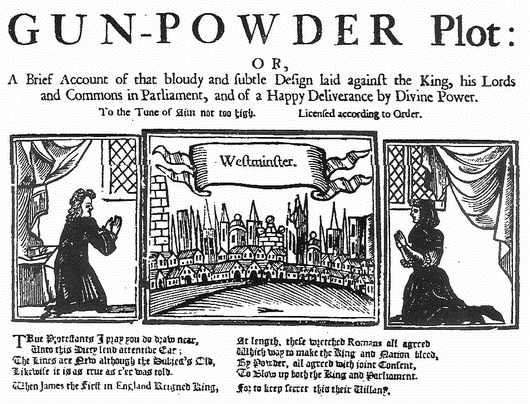
Unknown (printed for P. Brooksby, I. Deacon, I. Blare, I. Back.), Public domain, via Wikimedia Commons
The conspirators smuggled 36 barrels of gunpowder — nearly three tons — into a rented vault directly underneath the House of Lords, where the King and much of England’s political elite would assemble on November 5, 1605, for the State Opening of Parliament. But someone betrayed the conspirators in an anonymous letter that sent agents of the King directly to the door of the vault in the early hours of November 5, only hours before the planned slaughter. When the door opened, Guy Fawkes was caught, and a catastrophe was averted.
On that very day, Londoners lit bonfires to celebrate the King’s narrow escape, and a subsequent Act of Parliament ordered that every year, November 5 would be marked as a day to give thanks for the King’s deliverance. The celebration, often called Guy Fawkes Day or Bonfire Night, grew over the years to include fireworks and burning effigies.

The Act remained in effect until 1859, but more than 150 years after the last state celebration of Bonfire Night, Guy Fawkes has transformed from a reviled traitor into a pop culture creation that represents dissent and resistance. But even though Fawkes was rehabilitated as his co-conspirators faded into the background, the celebration itself lives on in the modern U.K., where a Protestant monarch still sits on the throne.



Walking Malls Don’t Solve Problems

Festival of Leaves 2026 Wraps Up a Successful Day in Downtown Front Royal

Autumn Delights: Spotlight On Pumpkins!

Lord Fairfax Health District Receives $5,000 Grant To Support Local EMS Crews

Why an AI Bubble Could Reach Your Savings

The Platypus: A Truly Amazing Animal!

A Thing of the Heart: Two-Fold Outreach to Children and Award Presentation Brings Hike Kidz to Stone Branch Arts Center

Virginia State Police Seize Drugs Valued at More Than $830,000, Recover 13 Firearms

Commentary: We Hate Technology. Please Like and Share

One Medicare Open Enrollment Decision That Can Be Hard to Undo

Constitution 101: The Postal Clause

VDOT: Warren County Traffic Alert for October 12 – 16, 2026

UVA Poison Expert Warns of Emerging Synthetic Opioids That Fentanyl Tests May Miss

Pumpkins Will Take to the Skies at Front Royal Warren County Airport Oct. 24

Front Royal Remains Under Mandatory Water Conservation As Shenandoah River Flow Drops

Front Royal Women’s Resource Center Opens 2027 Dare to Dream Grant Applications

Warner, Mizusawa Outline Competing Approaches to Disability Policy

Fable Greenhouse and Gardens Breathes New Life into Former Horton’s Nursery

Louise Virginia “Mom” Messer (1936 – 2026)

Business Growth Series: Doing Everything Yourself Is Slowing You Down

The Mystery of the Purple Seal

Front Royal Outdoors Founder Don Roberts Named 2026 Protector of the Shenandoah

Front Royal Man Held Without Bond Following Child Sexual Abuse Material Investigation

Performing Arts Center Pointing to 2027 Opening as Local Entertainment, Business, and Educational Partner
