
National News
Never mind the honeybee: Maryland researchers want more buzz over saving native bee species
WASHINGTON – Although honeybees have captured national attention in an effort to “save the bees,” some Maryland entomologists want to shift the focus toward native bee species that are in graver danger.
Bees are the most important pollinators on Earth, critical to populating native plants and fundamental to ensuring the abundance and variety of agricultural crops.
Misguided information on which bee species to save has created a media frenzy over protecting the honeybee despite research pointing to steady honeybee populations, experts say.
“The honeybee is not the bee we need to save because it’s not endangered,” said Dr. Nathalie Steinhauer, science coordinator for the Bee Informed Partnership Inc. and a postdoctoral researcher at the University of Maryland’s Department of Entomology.

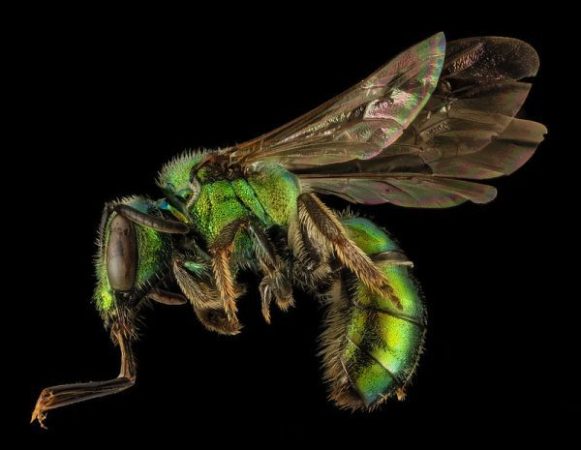
The sweat bee, often found in a metallic green color, nests in soil. The bee is one of the Maryland native species scientists say needs more study. (Courtesy of Phillip Moore/U.S. Geological Survey’s Native Bee Inventory and Monitoring Lab)
The honeybee is native to Europe, Africa, and Asia. Early colonists brought these insects to the United States, where they now dominate research and a general understanding of bees.
Beekeepers have managed to keep the overall number of honeybee colonies in North America stable over the last two decades, according to the Bee Informed Partnership, a coalition of researchers and labs established to improve the health and survival of honeybee colonies.
To be sure, pesticides, stress, and diseases still hinder the health of honeybees nationwide.

But some native bee species, such as the rusty patched bumblebee, are truly endangered and often compete with honeybees to pollinate natural environments.
Part of the reason honeybees gets so much attention stems from constant societal reinforcement of their importance.
“Culturally, other bees don’t exist,” said Sam Droege, wildlife biologist for the U.S. Geological Survey’s Eastern Ecological Science Center in Laurel, Maryland.
“That’s why we don’t know anything about (native bee species), and then when someone puts out a media report, a lot of it’s really short,” he said.

The Eastern Ecological Science Center houses the Native Bee Inventory and Monitoring Lab, which develops tools and surveys to identify native bee species.
Roughly 4,000 native bee species reside in North America and approximately 430 of those species inhabit Maryland, including at least 80 kinds of ground-dwelling mining bees, 20 species of leaf-cutting bees, 10 types of bumblebees, plus carpenter bees, mason bees (they make mud nests) and squash bees (which live in the ground near pumpkins or squash plants).
But researching native bee species can be a daunting task, according to Jennifer Selfridge, the invertebrate ecologist for the Wildlife Heritage Program of the Maryland Department of Natural Resources.
Many native bee species are tiny and solitary, and bee sampling is a relatively new development in entomology.

“The desire is to want to lump them into one big study so you can understand them all, but they’re very different,” Selfridge said.
Selfridge said the Native Bee Inventory and Monitoring Lab’s location in Maryland has led to more data and research on native bee species compared to other states.
Even so, research on Maryland’s native bee species lags behind research on other insects and invertebrates due to the limited funding and lack of long-term datasets.
“The funding that we have available to us is generally more geared toward rare, threatened, and endangered things, so things that are really in trouble,” Selfridge said.
Droege said researchers often have to make crude inferences about native bee species in Maryland.

“‘You can’t find them anymore’ is not a great, very nuanced survey program,” Droege said.
“That’s where we are. But worse is, things that are not bumblebees are so tiny, so obscure, we don’t even know if they were there, to begin with, because we are describing entirely new species that weren’t described before,” he said.
Efforts to “save the bees” grew out of human actions, including urbanization that destroys natural insect habitats, including harming bee populations.
“I really want to emphasize: we do know that nature is changing,” Droege said. “You don’t put houses on the ground and have positive benefits to nature.”
Maryland plays a role in endangering native bee species as urbanization also decreases flower populations, which bees need for pollination and survival.
“And the fact that we’re losing landscape to urbanization is something that’s going to actually increase the impacts of climate change,” Steinhauer said.
Droege said increasing the diversity and number of flowers on Maryland’s landscape could help native bee species survive.
“The state…is a big property owner, manager, and a regulator, so you have regulations that surround a lot of things that would impact the number of flowers in the area, essentially,” he said.
At the individual level, people can also make a positive impact on the future of bees.
As consumers, people can choose to support companies that make the effort to reduce the environmental impacts affecting bee populations, Steinhauer said.
Although commercial beekeeping helps with pollination and honey production, personal beekeeping can drive down the population of native bee species that compete with honeybees for pollination.
“If you’re getting into honeybees because you want to save the environment, you’re not –– you’re doing the opposite,” Droege said.
“Your hives are…not saving honeybees because honeybees have disease problems and your hive is probably a disease vector if anything,” he said.
The decline in populations of native bee species points to a larger biodiversity crisis facing the United States and the world, according to scientists.
“We are losing species at a rate that is faster than we’ve ever recorded in history,” Steinhauer said. “Bees are not an exception.”
By SHAUNEEN MIRANDA
Capital News Service




Mayor Lori Athey Cockrell Looks to Water, Economic Development and Rail Trail in Another Term

WCHS vs. Brentsville HS – Girls Volleyball – October 6, 2026

BMI Is Only One Piece of the Health Picture

The Eye Surgery Factory That Could Not Expand

Ancient Ownership of Israel

VDOT: Warren County Traffic Alert for October 5 – 9, 2026

Reaching Out Now Expands Programs and Opportunities for Warren County Youth

Dance and Arts VA Finds New Home, New Opportunities on Water Street

Ann L. Shuman (1933 – 2026)

Wendy Lee Whitacre-Stout (1966 – 2026)

Spanberger’s Energy Plan Keys in on Clean Energy to Meet Growing Demand and VCEA Goals

Jean Elizabeth Grubbs Fogle (1939 – 2026)

Feds Provide Guidance on New Federal K-12 Scholarship Tax Credit Program

Why Wait Till November? Mid-Term Election Early Voting Processes in Place Now

US Senate Leaves Nation’s Capital in Advance of Midterms With Much Still Undone

Business Growth Series: If You Don’t Control Your Day, It Controls Your Business

The End of a 20-Year Monopoly on the Credit Score
Voltron and Immigration

States OK Solar Panels for Balconies. Safety Guidelines Haven’t Caught Up

Trump TV Ads Paid for with $20M in Homeland Security Funds, Dems Find

Blue Ridge Wildlife Center Patient of the Week: Gray Treefrog

Birthday Twins: See Which Famous Face Shares Your Big Day

Meet-and-Greet Set Sunday for Republican-Endorsed Front Royal Candidates

Barbara Ann Mathews Smelser (1943 – 2026)
