
Interesting Things to Know
Stephens City’s most distinguished citizen lived a life worthy of all imitation
It is my humble opinion that too little attention has been given by local historians to the distinguished career of Dr. John Bell Tilden. Tilden spent the last 45 years of his life as a resident of Frederick County, leaving a lasting impression on the local church and civil government professions.
Dr. John Bell Tilden, son of Captain Richard and Anna (Meyer) Tilden, was born in Philadelphia, Pennsylvania, December 9, 1761 (gravestone reads 1762) and baptized in the Episcopal Church. He died July 31, 1838, in Stephensburg, now Stephen City, Virginia. He was a student at Princeton College studying medicine at the time of the Revolutionary war. He left college to join the Continental army, receiving a commission as ensign, May 28, 1779, in the Second Regiment Pennsylvania line, commanded by Colonel Walter Stewart. He was subsequently promoted to second lieutenant, his commission to date from July 25, 1780. His regiment left York, Pennsylvania, for the southern campaign in the spring of 1781 and he was present at the siege of Yorktown and surrender of General Cornwallis (was an officer appointed to receive the surrendered arms). At the close of the war he was honorably discharged and became a member of the Pennsylvania Society of the Cincinnati. During his entire service he kept a diary, which is now in the possession of the Pennsylvania Historical Society, in Philadelphia, Pennsylvania.
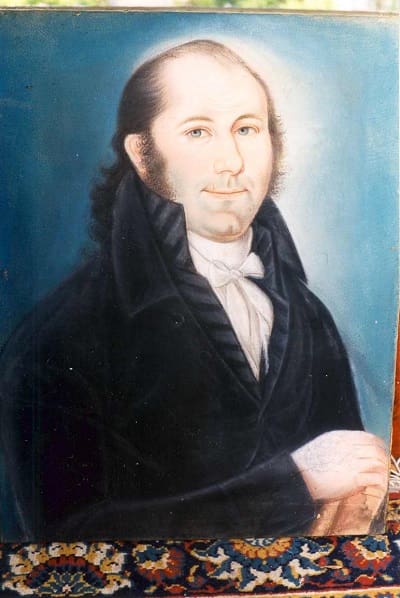
Dr. John Bell Tilden by Frederick Kemmelmeyer, painted in Winchester in 1814. (Eleanor G. Shutter Collection, Stewart Bell Jr Archives, Handley Regional Library, Winchester VA)
Dr. John Bell Tilden married Jane Chambers on August 9, 1784. Jane was daughter of Joseph and Martha Chambers of York, Pennsylvania. Sometime after leaving the army in 1783, Tilden settled in Martinsburg, Berkeley County, Virginia (now West Virginia). During that time, Tilden was converted to Christ in 1787 and united with the Methodist Episcopal Church there and soon became a layman and an active worker in evangelistic efforts.

He later relocated to Stephensburg, Frederick County about 1793, where he apparently studied medicine and secured a large and lucrative practice until the close of his life. Being a man of culture and extensive influence, Tilden was ordained to the ministry of the Methodist Episcopal Church on January 31, 1803 with George Reed and James Chipley as Bondsmen. Tilden was elected a Justice of the Peace and also High Sheriff of Frederick County (1795-1813). He occupied prominent positions in the state as well as the church; and by the exercise of justice and integrity in the discharge of his important duties, reflected credit and honor, both upon his ministerial and magisterial professions. Tilden bought a large two story log home in Stephens City sometime between 1801 and 1815. The house which Tilden named Bell Air, was built by the Lewis Stephens family in 1788 and still stands today.

John Bell Tilden purchased this large two story log home in Stephens City, (built in 1788) and named it Bell Air. Photos courtesy of Mark Gunderman
During the agitation of the question of lay representation, Tilden advocated the equal rights of the laity with the clergy in the legislative department of the church. For exercising these Scriptural and American rights, he and other prominent brethren were expelled from the M. E. Church in Stephensburg, in 1828. At his trial he was refused the privilege of reading his defense, so he informed the large assembly, that he would read it from the door steps after leaving the church. Nearly the entire congregation went with him leaving only his accusers behind. Tilden united with his expelled brethren and in the next year, 1829, assisted in organizing the Virginia Conference of the Methodist Protestant Church. In 1872 the M. E. church admitted its error by adopting lay representation into its polity.
The most complete account of Rev. John Tilden’s preaching ability was published in 1880. That year Sketches of the Founders of the Methodist Protestant Church, and its Bibliography by Thomas H. Colhouer, included this description regarding Tilden:
“As a reformer, Tilden was like Paul and Luther, bold, earnest, and outspoken, laboring with both tongue and pen to defend and advance the cause of the New Testament equality in the ministry. He promoted the indisputable rights of the laity to representation in the free Gospel Church of Christ. Tilden was a contributor and industrious circulator of the Mutual Rights Magazine, the organ of the Reform party in the Methodist Episcopal Church.

Rev John B. Tilden was a fine preacher of noble and dignified bearing, chaste in style, pure in diction, graceful in manner, and a profound and earnest profounder of the Word of God. In his holy life, fervent zeal and spotless character, he set an example that was worthy of all imitation.”
Early Days and Methodism in Stephens City, Virginia, by Inez Virginia Steele, first published in 1906 includes an account of a Methodist Dinner Party. The dinner party was held in Rev. Elisha Phelps house in August 1802 at Stephensburg. There Rev. James Quinn described John Tilden as, “an interesting figure, somewhat robust but not corpulent, a fine, manly face, and smiling countenance.”
As a committed early Methodist he acknowledged the equity of all people before God. These democratic views of social order extended across the racial divide. Long before the abolitionist movement was an organized effort to end the practice of slavery in the United States, Dr. Tilden freed his slaves Lucy and her small child James in April 1806 and sent them to Liberia with one year’s provision.

Dr. Tilden will always be remembered as a veteran of the Revolutionary war, doctor and Methodist Minister. His spouse, Jane Chambers was born in York County, Pennsylvania, December 18, 1766 and died May 26 1827. In 1802, at the age of 35, Jane was described as an interesting lady with white hair as pure wool and eyes beaming with intelligence. They had ten children. Dr. Tilden and Jane are buried in the Tilden family plot at Stephens City UMC Cemetery.

Dr. John Bell Tilden gravestone at Stephens City United Methodist Church cemetery.
Buried in the Tilden family plot are:
- Anna Belle Tilden: Died 1819
- Jane Tilden: Died 1827
- Dr. John B. Tilden: Died 1838
- Lorenzo R. McLeod: Died Unknown
- Lorenzo T. McLeod: Died 1888
- Anna Bell Tilden McLeod: Died 1890




“Can’t We Just Watch the Movie at Home?” A Question About the Future of Movie Theaters

Two Front Royal Churches Plan Joint Oct. 25 Gathering Focused on Faith and Virginia Ballot Issues

Robert Arthur Babineau (1961 – 2026)

Here’s Where Doctors Diverge on Virginia’s Pending Reproductive Rights Constitutional Amendment

Virginia Teachers Balance AI Innovation with Student Creativity Amid Rising Academic Pressure

Donna Kersey Deavers Smith (1945 – 2026)

William Franklin “Rocky” Walker (1959 – 2026)

Measles Cases Reach 4,080 for the Year — the Highest in Decades

Data Center Backlash Set to Sway Midterm Elections

Mary Ann Williams (1942 – 2026)

Winston Richard Summers (1946 – 2026)

With Mother Nature’s Cooperation Festival of Leaves Draws Another Huge Crowd to Greet the Fall Season

Turning Off an Airbag Is Allowed in Limited Circumstances

A Retirement Account for a Grandchild Starts With a Summer Job

Your Photos Survive A Lost Phone, But Not A Wrong Tap

Walking Malls Don’t Solve Problems

Festival of Leaves 2026 Wraps Up a Successful Day in Downtown Front Royal

Autumn Delights: Spotlight On Pumpkins!

Lord Fairfax Health District Receives $5,000 Grant To Support Local EMS Crews

Why an AI Bubble Could Reach Your Savings

The Platypus: A Truly Amazing Animal!

A Thing of the Heart: Two-Fold Outreach to Children and Award Presentation Brings Hike Kidz to Stone Branch Arts Center

Virginia State Police Seize Drugs Valued at More Than $830,000, Recover 13 Firearms

Commentary: We Hate Technology. Please Like and Share
