
Local Government
Supervisors propel Blue Ridge Heritage Project request forward
The Warren County Board of Supervisors other “history lesson” on April 3 came by way of a Consent Agenda request that the Blue Ridge Heritage Project be allowed to use some brick from the Robert McKay house in construction of a memorial to the 32 local families displaced to make way for Shenandoah National Park.
The request was removed from the consent agenda by Fork District Supervisor Archie Fox. After a brief discussion the board voted unanimously, on a motion by Linda Glavis, to approve the request. That approval is contingent on a concurrent approval by the Front Royal Town Council. The Robert McKay house believed constructed in 1731 was destroyed by fire on the county’s north side several years ago.
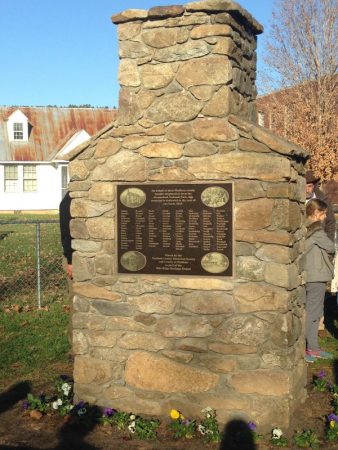
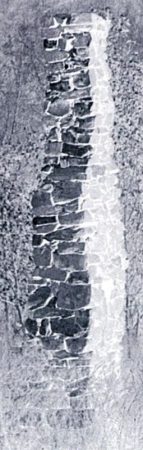
Above, the Madison County monument; below, the basis for the monument design – an actual chimney standing at a park site of one of the displaced homes – Courtesy Photos/Blue Ridge Heritage Project
And if discussion of the request lacked the emotional recounting of Public School Superintendent Greg Drescher’s report on the history of violence aimed at American schools in support of additional school security funding, it does give us an opening to revisit one of our favorite local history projects. See Related Story

As Royal Examiner has reported in tracking the development of the Blue Ridge Heritage Project here, the effort comprises the eight counties where land was acquired for Shenandoah National Park. Those counties are Albermarle, Augusta, Greene, Madison, Page, Rappahannock, Rockingham and Warren, the latter as we know at the northern end – “Mile 0” – of Shenandoah National Park
Town Planning Department staffer Darryl Merchant, whose family was one of those 32 displaced here, has taken the point in organizing the effort in Warren County. The program’s literature notes that each county will establish a similar chimney monument site as a focal point illustrating what was often the last standing vestige of those abandoned homes, their chimney.
“In order to recognize their contributions and their losses, each site will contain a memorial to the people from that county whose land was acquired for the park,” the project’s outline states, adding, “Through educational displays, cultural displays and demonstrations the project hopes to accurately depict the people’s lives and to help preserve their lifestyle, crafts, music, and traditions.”
The ultimate goal, as of the broad study of history itself, is to give visitors to this particular series of memorials “a greater appreciation for the impact the park had on individual lives in general and for that particular community. – Altogether, the eight sites will create an understanding of life in the Blue Ridge Mountains.”

The site chosen for the Warren County memorial is along the Happy Creek Trail near Burrell Brooks Park, close to the Criser Road intersection with Remount Road. Of that site, Merchant had noted that appropriately, nearby Happy Creek runs into town from Harmony Hollow near the Shenandoah National Park boundary. The town council has approved the Criser Road site as a location for the local memorial.
The 32 county families associated with the relocation effort to establish Shenandoah National Park are Aleshire, Bailey, Barnhardt, Beaty (also spelled Beatty by some descendants who left the area), Borden, Carter, Clatterbuck, Compton, Cook, Corbin, Fox, Fristoe, Hartley, Hickerson, Hillidge, Johnson, Jones, Kenner, Manual, Marlowe, Matthews, Merchant (ah hah), Millar, Miller, Overall, Morrison, Pomeroy, Settle, Thompson, Vaught, Walters and Weaver.
Additional detail on the Blue Ridge Heritage Project can be acquired from a Facebook page – Front Royal Warren County Blue Ridge Heritage Project. Merchant also notes that at the Great Meadows Park visitor site at Milepost 51 on the Skyline Drive, a display on the project is in place. Two communities, Albermarle and Madison Counties, have already erected their Blue Ridge Heritage memorials.




WCHS vs. Brentsville HS – Girls Volleyball – October 6, 2026

BMI Is Only One Piece of the Health Picture

The Eye Surgery Factory That Could Not Expand

Ancient Ownership of Israel

VDOT: Warren County Traffic Alert for October 5 – 9, 2026

Reaching Out Now Expands Programs and Opportunities for Warren County Youth

Dance and Arts VA Finds New Home, New Opportunities on Water Street

Ann L. Shuman (1933 – 2026)

Wendy Lee Whitacre-Stout (1966 – 2026)

Spanberger’s Energy Plan Keys in on Clean Energy to Meet Growing Demand and VCEA Goals

Jean Elizabeth Grubbs Fogle (1939 – 2026)

Feds Provide Guidance on New Federal K-12 Scholarship Tax Credit Program

Why Wait Till November? Mid-Term Election Early Voting Processes in Place Now

US Senate Leaves Nation’s Capital in Advance of Midterms With Much Still Undone

Business Growth Series: If You Don’t Control Your Day, It Controls Your Business

The End of a 20-Year Monopoly on the Credit Score
Voltron and Immigration

States OK Solar Panels for Balconies. Safety Guidelines Haven’t Caught Up

Trump TV Ads Paid for with $20M in Homeland Security Funds, Dems Find

Blue Ridge Wildlife Center Patient of the Week: Gray Treefrog

Birthday Twins: See Which Famous Face Shares Your Big Day

Meet-and-Greet Set Sunday for Republican-Endorsed Front Royal Candidates

Barbara Ann Mathews Smelser (1943 – 2026)

Kathleen Frances Elar (1956 – 2026)
