
State News
The 21st century’s canary in the coal mine is a robotic dog named Spot
GLEN ALLEN — Coal miners had their canaries sniff out deadly carbon monoxide before the gas could overcome them.
Now, with coal on its way out, nuclear plants are turning to a 21st-century warning system to shield workers from radiation: a robotic dog named Spot.
“You can’t see radiation,” said Joshua Bell, a Dominion Energy nuclear technology and innovation consultant. “It is there, and you can only detect it, so Spot’s a really good way to understand stuff you can’t see before people have to go and experience it themselves.”
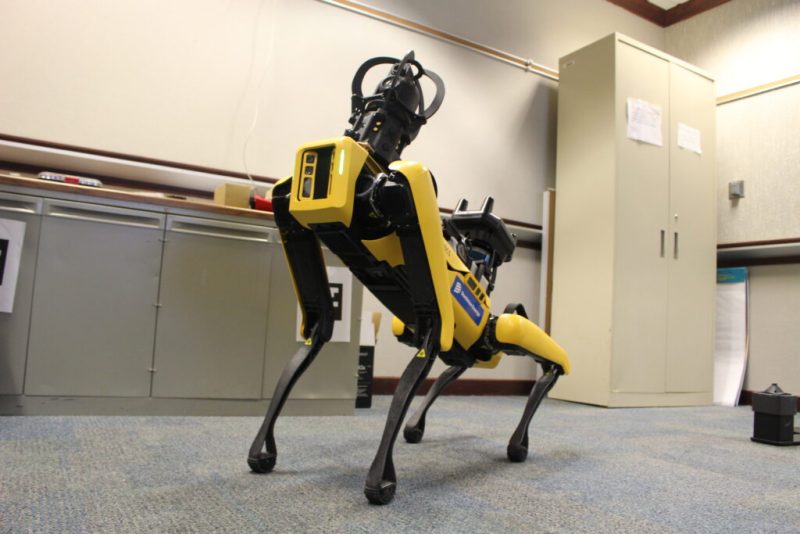
Spot, a robotic dog, designed by Boston Dynamics, is being used by Dominion Energy in its nuclear plants to reduce workers’ exposure to radiation. (Sarah Vogelsong / Virginia Mercury)

A 70-pound contraption designed by Boston Dynamics and powered by a lithium-ion battery, the four-legged robot can be controlled remotely, equipped with up to 30 pounds of sensors, cameras, and other tools, and programmed to carry out tasks. Since the engineering and robotics company introduced the technology in 2019, electric utilities like Dominion have increasingly been eyeing it as a way to reduce radiation exposure for workers at nuclear plants.
“There are a few dozen utilities actively using Spot today, and we’re seeing more and more interest all the time,” said Nikolas Noel, Boston Dynamics’ marketing and communications director, in an email.
Spot wasn’t designed specifically for use at nuclear plants, Noel said. Instead, “the idea was to create a general purpose industrial robot that was highly mobile and could perform useful work in a variety of areas, especially in places that might be dangerous or difficult for people to access.”
“Certainly nuclear facilities fit that criteria,” he said.

Dominion acquired its own Spot in fall 2021. The company, which operates the North Anna and Surry nuclear plants in Virginia, each of which employs over 780 people, currently sources about a third of its electricity for state customers from nuclear and intends to keep the plants running for at least the next few decades as Virginia phases out fossil fuels.
The allure of the robot was straightforward: “If I have a walking device that can use stairs and go around corners, I can reduce the amount of exposure I give to people,” said Joseph Rigatti, Dominion’s manager of nuclear technology programs.
Since then, the electric utility has been running pilots with the robotic Rover to see how it (Dominion employees agree Spot is an “it,” although “he” tends to slip into conversations after a while) can be integrated into the North Anna and Surry plants.
Bell and Rigatti, who are experimenting with Spot from the utility’s Innsbrook facility outside Richmond, describe a range of uses for the technology. It can be programmed to walk through a plant to monitor and map radiation or heat, detect leaks, and verify test results. It can carry cameras for remote technicians to watch. It can take instrument readings. It can help move used nuclear fuel to onsite storage facilities, as it did in a recent pilot at Surry.

“Spot’s just a wagon that can move itself,” said Bell. “We can use it with so many different instruments.”
The robot may also allow utilities to collect data they otherwise wouldn’t from high-radiation areas of plants where workers are barred except for occasional necessary checks to ensure equipment is operating properly.
“Current practice is unlock the door, a guy runs in, does checks as fast as reasonable to get the information and comes out,” said Bell. “But with Spot, we can go in, we can take the time to do thermography on the whole space. We can take the time to get up-close visuals of individual components, do a real in-depth survey, and gather data that (is) valuable, but not valuable enough to risk someone being in that space that long.”
But despite its utility, worker reactions to Spot have been mixed.

Unlike other robots, the technology isn’t intended to replace employees. But also, unlike other robots, Spot doesn’t seem quite robotic enough. At times, it seems downright doglike, capable of rolling on its side, trotting up hillsides, and stretching.
“There are just some that just the sight of it makes them nervous, and they walk away,” said Rigatti. “And there’s others that want to get right up and pet it like you would a dog.”
Bell, who has spent hours with Spot, said that even though the contraption isn’t voice-controlled, he still finds himself talking aloud to it, encouraging it around corners and up stairs with a cheerful, “Come on, Spot, we’re going to go here.”
Noel of Boston Dynamics said the robot’s canine design was no accident but a product of how the company intended Spot to function.

“Our robots end up moving like humans and animals not because we designed them to look like humans and animals but because we made them balance,” he said. “Balance and dynamic motion are characteristics we have previously only seen in animals,” and people tend to associate them “with lifelike movement.”
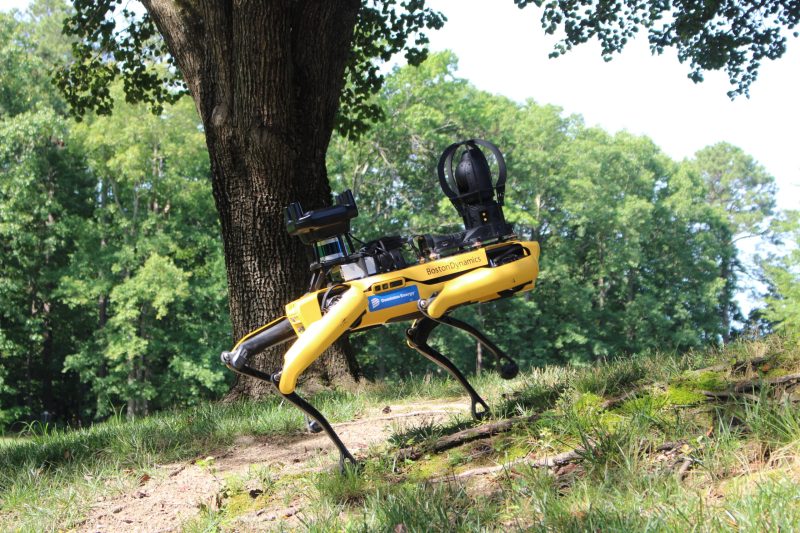
Spot trots up a hillside at Dominion Energy’s Innsbrook campus. (Sarah Vogelsong / Virginia Mercury)
It’s precisely that functionality that lets Spot carry out tasks earlier-generation drones or other robots have been unable to undertake because of their inability to climb stairs or navigate tight spaces.
Even Spot is evolving, however. During an early trial at Surry, Rigatti recounted, he ran into a spot of trouble negotiating a tight turn on a stairwell and fell down the flight of stairs. Boston Dynamics has since rewritten his code specifically to improve his navigational abilities.
“Any place a person can go, they want Spot to be able to go,” said Rigatti.
The robot’s operational range at Dominion’s Virginia plants also is expanding. At the recent Surry pilot where Spot was used to move spent nuclear fuel, Bell said he realized that he was operating the robot from roughly 100 feet away for the first time.
“Really, that’s what we’re going for,” he said, “is being able to sit back, stay away and let the robot do the job as much as it can.”
by Sarah Vogelsong, Virginia Mercury
Virginia Mercury is part of States Newsroom, a network of news bureaus supported by grants and a coalition of donors as a 501c(3) public charity. Virginia Mercury maintains editorial independence. Contact Editor Sarah Vogelsong for questions: info@virginiamercury.com. Follow Virginia Mercury on Facebook and Twitter.




The Eye Surgery Factory That Could Not Expand

Ancient Ownership of Israel

VDOT: Warren County Traffic Alert for October 5 – 9, 2026

Reaching Out Now Expands Programs and Opportunities for Warren County Youth

Dance and Arts VA Finds New Home, New Opportunities on Water Street

Ann L. Shuman (1933 – 2026)

Wendy Lee Whitacre-Stout (1966 – 2026)

Spanberger’s Energy Plan Keys in on Clean Energy to Meet Growing Demand and VCEA Goals

Jean Elizabeth Grubbs Fogle (1939 – 2026)

Feds Provide Guidance on New Federal K-12 Scholarship Tax Credit Program

Why Wait Till November? Mid-Term Election Early Voting Processes in Place Now

US Senate Leaves Nation’s Capital in Advance of Midterms With Much Still Undone

Business Growth Series: If You Don’t Control Your Day, It Controls Your Business

The End of a 20-Year Monopoly on the Credit Score
Voltron and Immigration

States OK Solar Panels for Balconies. Safety Guidelines Haven’t Caught Up

Trump TV Ads Paid for with $20M in Homeland Security Funds, Dems Find

Blue Ridge Wildlife Center Patient of the Week: Gray Treefrog

Birthday Twins: See Which Famous Face Shares Your Big Day

Meet-and-Greet Set Sunday for Republican-Endorsed Front Royal Candidates

Barbara Ann Mathews Smelser (1943 – 2026)

Kathleen Frances Elar (1956 – 2026)

Happy Creek Crossing to Hold Vendor Interest Meeting Oct. 8 in Front Royal

If the Car Name Fits, Drive It
