
Interesting Things to Know
Why the Code Talkers Baffled the Enemy—and Helped Win the War
On the battlefields of the Pacific during World War II, American military forces were outnumbered, outgunned, and facing an enemy that had cracked nearly every military code. Then came a breakthrough—the Navajo Code Talkers. Using one of the most complex and unwritten languages in the world, these young Marines sent and received unbreakable messages in real time. Their contributions were so vital to victory that the program remained top secret for 26 years after the war.
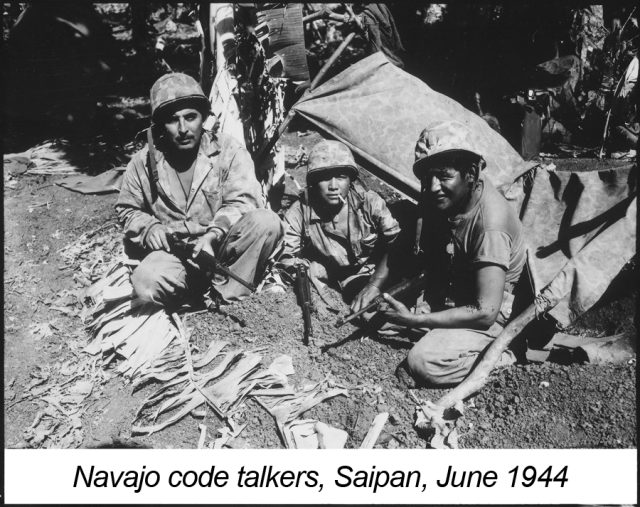
Navajo Code Talkers
Each year on August 14—Navajo Code Talkers Day—we remember how a small platoon of Navajo-speaking Marines helped change the course of history, not with weapons, but with words no enemy could understand.
The code itself wasn’t just based on the Navajo language—it was the language. This made it nearly impossible to decipher, even if intercepted. The Japanese military, known for its skilled cryptographers, never cracked it.

Why was it so secure? Because Navajo is exceptionally complex—and rare.
It belongs to the Athabascan language family, which includes about 44 Native languages spoken by Indigenous peoples across Alaska, Canada, and parts of the U.S. Southwest. Even today, most people have never heard Navajo spoken, let alone understood it. In the 1940s, the number of non-Navajos who could understand the language was estimated at fewer than 30.
Philip Johnston, a non-Navajo civil engineer and World War I veteran, proposed the idea to the U.S. Marine Corps in 1942. He was raised on Navajo land by missionary parents and had attended Navajo schools. Though perhaps the most fluent non-Navajo speaker alive at the time, Code Talker Chester Nez later recalled that even Johnston’s grasp of the language wasn’t perfect. Its grammar, pitch, and structure made fluency nearly impossible for outsiders.
Navajo’s structure is vastly different from English or any European language. It includes four distinct tones, meaning that changing pitch alters a word’s meaning. Words are often made from complex combinations of verb stems, prefixes, and suffixes, and a single verb can convey a sentence’s worth of information.

For example, one verb can express the repeated action of picking up small objects. Other verbs change based on the shape of the object—“carry a flat object” versus “carry a round object”—and change further depending on the speaker and the grammatical mood. This made the language both rich in nuance and nearly impossible to predict or decode.
The first 29 Navajo Code Talkers trained in secret and developed the original code. They assigned Navajo words to represent military terms—for example, “besh-lo” (iron fish) meant submarine. The code grew to include hundreds of terms, all memorized, never written down.
Over the course of the war, more than 400 Navajo men served as Code Talkers, transmitting thousands of secure messages, often under fire. Their speed and accuracy helped win key battles like Iwo Jima, where it’s reported that they delivered messages in minutes that would have taken hours using traditional methods.
By war’s end, the Code Talkers had played a vital role—but no one knew. Their work remained classified until 1968, and only then did they begin to receive recognition. In the decades that followed, they were honored with Congressional medals, movies, books, and the official designation of Navajo Code Talkers Day.

Today, the Navajo language remains one of the strongest surviving Native languages. The 2010 U.S. Census counted about 170,000 speakers, up from an estimated 50,000 in the 1950s.
The legacy of the Code Talkers isn’t just a story of war—it’s a story of language, culture, and resilience. Their unbreakable code, built on an ancient tongue, baffled the enemy and helped save thousands of lives. And it reminded a nation of the power of its Indigenous people and the languages they have fought to preserve.
Native Code Talkers: A Legacy That Spans Tribes and Wars
Most Americans know the story of the Navajo Code Talkers, whose legendary role in World War II helped secure victory in the Pacific. But the Navajo weren’t the only Native Americans who used their languages to safeguard military messages. In both World War I and World War II, soldiers from more than 30 tribes served as code talkers—using their unwritten, complex languages to confuse enemy forces and protect Allied communications.
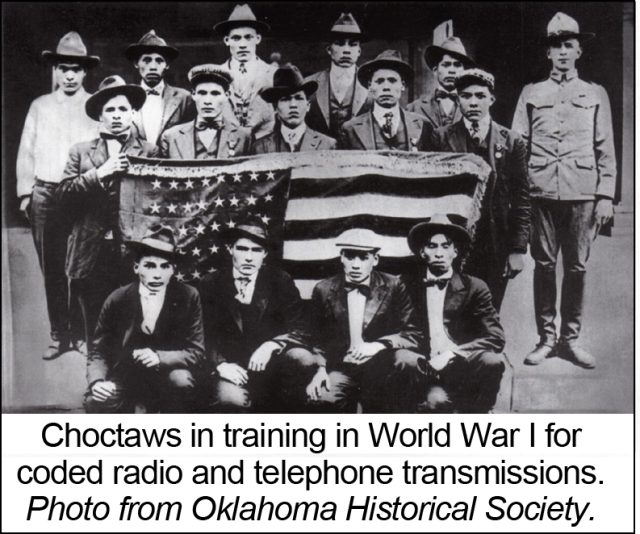
Their work was so successful that German and Japanese intelligence were never able to break these codes. Here are just a few of the lesser-known, but equally vital, contributions of Native American code talkers:

The Choctaw – World War I
The first documented use of Native code talkers came in 1918. During the Meuse-Argonne Offensive, German forces had cracked U.S. codes and tapped phone lines, jeopardizing critical battlefield communication. That’s when eight Choctaw soldiers of Company E, 142nd Infantry began transmitting messages in their native language.
The results were immediate. The Germans had no idea what they were hearing, and the tide of the offensive turned. Their success laid the groundwork for future Native language use in military operations. Decades later, the French government awarded the Choctaw Nation the Chevalier de l’Ordre National du Mérite in 1989. In 2013, U.S. Congress awarded Congressional Gold Medals to code talkers from 33 different tribes, including the Choctaw.
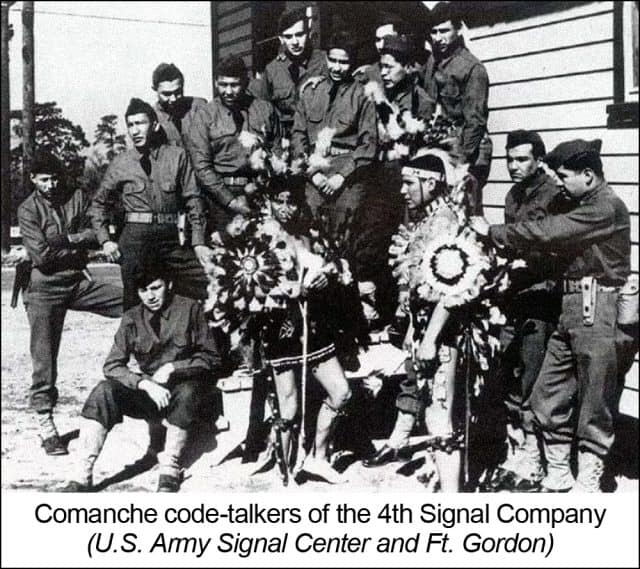
The Comanche – World War II
In 1941, Comanche men were recruited to serve as code talkers for the U.S. Army’s 4th Infantry Division. They created a code using their own language, combining traditional words with newly coined terms. Their codebook had about 250 terms.
Some examples:

- “Tukomoo” (black) was used to mean “tank”
- “Wakaree” (turtle) meant “tank destroyer”
Comanche Code Talkers saw action on D-Day and throughout the European theater.
The Hopi – World War II
About 11 Hopi code talkers served in the Pacific, the Philippines, and New Guinea. Though small in number, they had an outsized impact. The Hopi language, with its complex grammar and sounds, was so unfamiliar to outsiders that it baffled anyone listening.
The Hopi code talker program was never widely expanded, likely because of the limited number of fluent speakers—but it proved, once again, how effective Indigenous languages could be in secure communication.
The Meskwaki – World War II
From the Iowa Sac and Fox Nation, eight Meskwaki soldiers joined the war effort and became code talkers. That number may seem small, but it represented 7% of the tribe’s entire male population. These soldiers were deployed to North Africa, where their language became a key part of Allied communications during the campaign.
Other Tribes – Quiet Contributions
Not all Native American code talkers received as much documentation or recognition, but history records that the following tribes also contributed to secure military communication in WWII:
- Cherokee
- Lakota and Dakota (Sioux)
- Creek (Muscogee)
- Chippewa (Ojibwe)
- Kiowa
- Pawnee
- Seminole
In many cases, the lack of written records—and the secret nature of their work—meant that these contributions were not formally acknowledged until decades later.
The Language Advantage
Why were Native languages so effective for military code? Most were unwritten, known only to a few thousand people, and completely unfamiliar to the enemy. Some, like Navajo and Hopi, had such complex grammar, tonal shifts, and verb structures that they were nearly impossible to learn for outsiders.
This linguistic uniqueness, combined with cultural fluency and patriotism, made Native code talkers an irreplaceable part of American military history.




Commentary: A Pesticide-Free Farm Can Have Worse Soil Than One Sprayed With Roundup

Warren County Sheriff’s Office Foundation Expands Community Programs, Plans Fall Events

New Proposal from Grid Operator PJM Would Require Data Centers to Gring Their Own Power

Apple Wallet Adds Driver’s Licenses and IDs for Virginia Residents

Samuels Library Sets September Lineup With SamiCon, Community Programs and Family Activities

Virginia to Receive $353 Million in Landmark Meta Child-Safety Settlement

Trump’s Second-Term Immigration Agenda Extends Beyond Border Enforcement

Reverend Michael Duesterhaus (1965 – 2026)

Groovy for a Good Cause: Vintage Fashion Show Supports Bridge of Hope

Why More Robots Can Mean More Workplace Injuries

American Legion Post 53 Builds New Pavilion for Veterans and Community

Missing Bricks Led to Discovery of Structural Concerns at E. Wilson Morrison

Spanberger Orders State Agencies to Prepare for Medicaid, SNAP Changes

Amazon Changes Course on Water Use for King George Data Center Campus

Tree Stewards Prepare for 30th Anniversary While Offering Community Tree Care Class

Challenges and Future Uncertainties

Our Young People Are a Reflection of Our Community

America 250: The Battle of Long Island

Pasta e Ceci: An Ancient Roman Comfort Dish Made Simple
How Soon Until We Have A Chinese-Style Surveillance State?

Cline Accepts Three Debate Invitations in Sixth District Race

Lloyd, Silek Spar Over WCRC Membership Payment Methods as August 27 Meeting & Officer Appointments Loom

Warren County Sheriff’s Office Joins Saturation Saturday Ahead of Labor Day Weekend

A More Permanent Closure of a Portion of Church Street Denied at Town Council Meeting
