
Local Government
Town Council Discusses Speed Cameras and Questionable Lease and License Agreement at Work Session
On Monday, October 2, at 7 p.m. at Town Hall, the Front Royal Town Council met at a work session to discuss an assortment of issues they will be facing at their October 23 meeting, when they will hold public hearings and are expected to vote on these matters.
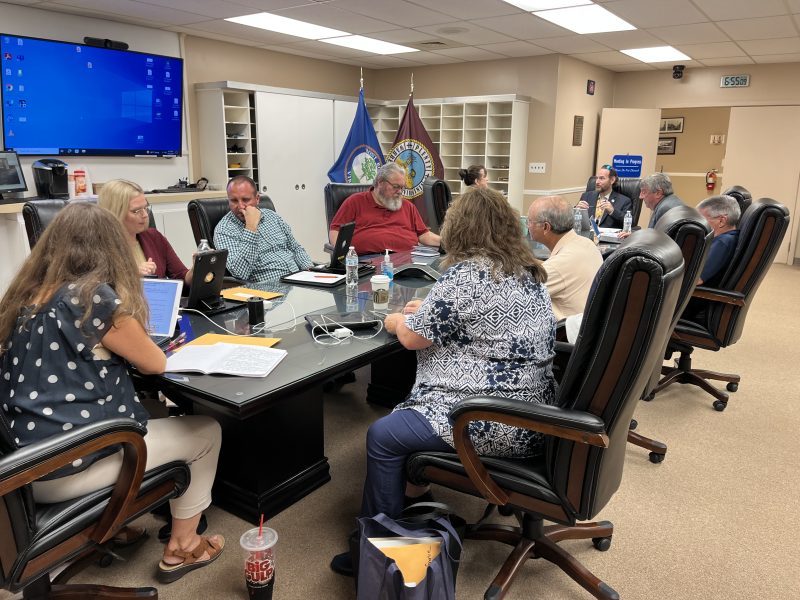
Several items were briefly addressed, like budget reallocations, appointments to ESAC, and maintaining the authenticity of the Downtown Historic District. However, the most discussed items on the work session agenda were the Public School zone speed cameras that Blue Line Solutions will provide for Front Royal if council votes in favor of the public safety initiative brought forward by the Town Police Department, as well as an issue of vacating a public right-of-way in an area where council previously made a decision to grant a lease and license agreement over a parcel that in the eyes of Town Attorney George Sonnett was not the Town’s legal right to grant.
Council member Wayne Sealock feels that the speed cameras have been a long time in coming. “Nitpicking” over the details of the contract with Blue Line Solutions has delayed what he considers a pressing issue. “If they were going to try to mess us over with something,” he said about Blue Line, “all these other jurisdictions wouldn’t be doing it.” He went on to say, “I’m not going to be able to go home and lay my head down if a child gets hit on Criser Road trying to cross the road by a speeding vehicle, and God forbid gets put in a wheelchair, or even worse gets put on Prospect Hill Cemetery.”
Most of the discussion about the speed cameras focused on defining the Town’s role in making them effective, such as that the Town makes “reasonable” efforts to collect the civil fines, which has some built-in ambiguity in terms of the language being used. However, Town Attorney Sonnett said, “Reasonable is what we think’s reasonable, which means in good faith, that we make good faith efforts to collect.” Mayor Lori Cockrell tried to get as much clarity on this point as possible. Will it become the Town’s responsibility to collect fines after the second notice? And at that point, will it be the Town’s prerogative to determine whether a good faith effort has been made?

Again, the Town exercises the power to apply the law to the needs of the community. The cameras covering school zones will be active when school zones are active. “The law says: when it’s an active school zone,” Sonnett explained, “and we’re going to determine when that is.” Furthermore, if there is an issue with the equipment, it will be Blue Line’s responsibility to address the problem, except in an extreme case, like a fallen tree. The police department will play a key role in using this resource to keep Front Royal and especially its school-age children safe.
In the closing moments of the discussion about cameras, council member Duane “Skip” Rogers said, “This is important, and it will be, overall, good for our community.” This matter is expected to come to a vote at the Council’s meeting on October 23.
In discussing the potential vacation of a portion of North Royal Avenue and an alley between North Royal Avenue and Virginia Avenue, Sonnett explained to the council his interpretation of the law pertaining to lease and license agreements, where an agreement was granted in May 2021 by the Town to an individual who subsequently laid down gravel for parking in that vicinity. In Sonnett’s eyes, because the Town does not hold exclusive right-of-way over that access, where a public right-of-way exists, that agreement was misplaced.
“It reports to grant a lease and a license to an area of land within the town right-of-way,” Sonnett explained, observing, “This is a public right-of-way. The Town doesn’t have exclusive use of this parcel. The Town’s use is in conjunction with the public use. So, the Town doesn’t have exclusive use to convey to anybody. That’s the problem. It purports to convey something the Town doesn’t have.” The agreement could be terminated on sixty days’ short notice, he told the council.

“That doesn’t mean I’m correct; it’s just my opinion, but I stand by my opinion,” the town attorney said. He qualified another agreement, under which a fence has been built in one of the areas affecting the proposed vacation, as an encroachment that is legal.
It is important to think separately about the proposed vacation and the agreements over parcels being scrutinized, Sonnett said. As Lori Cockrell pointed out, one must confront A and B before proceeding to C. In other words, the problem would be solved if these parcels, abutting certain property owners, were sold to those property owners, but because of the pre-existing public right-of-way, the public access must be vacated before the parcel that features the gravel parking can be sold.
The council concluded that the issue of vacation can be addressed with a public hearing and voted upon at the October 23 meeting, while the sixty-day notice can be passed in the consent agenda without a public hearing. Then, with the public right-of-way being vacated, interested parties would have the opportunity to purchase the parcels in question.
Council also discussed its upcoming Town-County Liaison Committee Meeting on October 19 to be held at the Warren County Government Center, then moved to go into closed session to discuss issues pertaining to personnel, McKay Springs, HEPTAD v. Town Council, and the proposed agreement on resurrection of the old Youth Center building with Reaching Out Now, Inc.





After Financing Discussions the Supervisors Censure an Apologetic Hugh Henry for Last Meeting Citizen Confrontation

Missing Texas Giraffe Found Safe After Nearly Two Weeks

Profile of a Candidate: Chairman of the Planning Commission Allen Neel Runs for Town Council

Youth Center Goes Forward as Strategic Hub, Supported by Key Community Players Like Honey & Hops

Minnesota Township Keeps Electing Four-Legged Mayors

Data Shows 94,000 Virginians Have Dropped Their ACA Insurance Since Last Year

After FAA Certification, Washington Manassas Airport to Offer Commercial Flights

New Virginia Law Bans Live Streaming While Driving, With Exceptions for Emergencies

Federal Judge Blocks New Virginia Limits on Existing Local ICE Agreements

Judge Calls Trump Mail Ballot Rule ‘Substantively Unconstitutional’ as Court Battle Extends

US House Clears Spending Stopgap Backed by Trump That Averts Government Shutdown

Apple Lawsuit Puts Employee Offboarding and Digital Access in the Spotlight

Virginia Education Board Updates Graduation Requirements, Expands Course Options for Students

Commentary: The Day Virginia Took Down Confederate Statues, a Black Church Remembered a Lynching Victim

Inside Virginia’s City Halls, Concerns, Confusion Rise with Flock Surveillance Protests

A Summer of Recalls Exposes Holes in the Nation’s Food Safety Net

Stewart E. Burke Sr. (1934 – 2026

DLC Acquires Royal Plaza Shopping Center in Front Royal

Food Scares Can Hurt Restaurants That Had Nothing to Do With an Outbreak

Virginia State Police Rap Back Program Tops 55,000 Enrollments in First Year

Warren County Volleyball Set to Host Kettle Run Tuesday Night – September 1

Economic Growth Is Not the Same Thing as Economic Health

Virginia Health Leaders, Lawmakers Share Enhanced Healthcare Resources for Rural Communities

Commentary: Public Utilities Shouldn’t Be Funding the Campaigns of the People Who Govern Them
