
Local Government
Town Council Reviews Easement, Rezoning, and Zoning Ordinance Ahead of County Liaison Meeting
The Town Council work session on Monday, July 7, was packed with issues affecting everything from infrastructure to housing development, zoning clarity, and regional cooperation. Key agenda items included a deed of easement to support utility service expansion, a rezoning proposal, an update on the zoning ordinance rewrite, and preparation for the upcoming liaison meeting with Warren County officials.
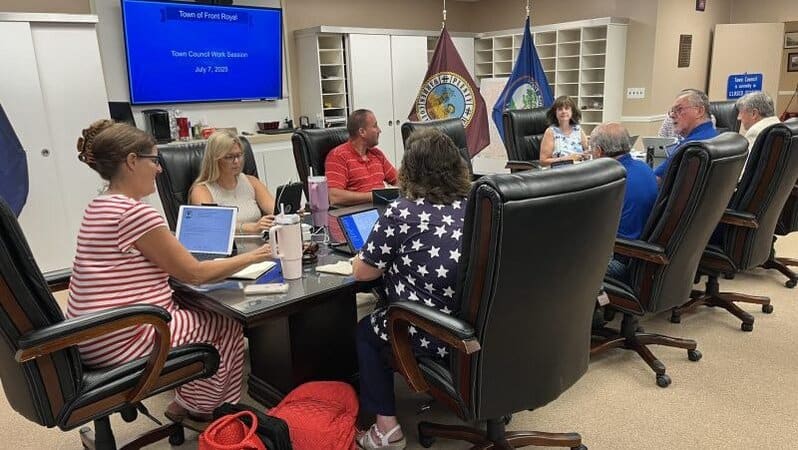
The Town Council convenes for a work session on the evening of Monday, July 7. Royal Examiner Photo Credits: Brenden McHugh.
Easement Clears Way for Utility Access in 522 Corridor
Town Attorney George Sonnett opened the session with a review of a deed of easement allowing the Town to extend water and sewer services to a commercial property in the Route 522 Corridor, outside of town limits. The property, owned by Green Pearl Hospitality, LLC, will have its utility infrastructure constructed privately but will be maintained by the Town. The easement grants the Town access to water lines, meters, hydrants, valves, and sewer infrastructure necessary for long-term service.
This agreement complies with a 1999 voluntary settlement between the Town and Warren County, which requires the Town to provide utility services to commercial users within the designated corridor. Sonnett offered no additional commentary beyond the summary, and the council appeared generally supportive of fulfilling the Town’s obligations under the longstanding agreement.

Rezoning Elsia Drive Parcels Sparks Discussion on Outdated Planning Tools
Planning Director Lauren Kopishke then presented a rezoning application that would reclassify two adjacent parcels on Elsia Drive from commercial to residential zoning. Due to the challenging topography, including steep slopes and limited road frontage, the land is considered unlikely to support commercial development.
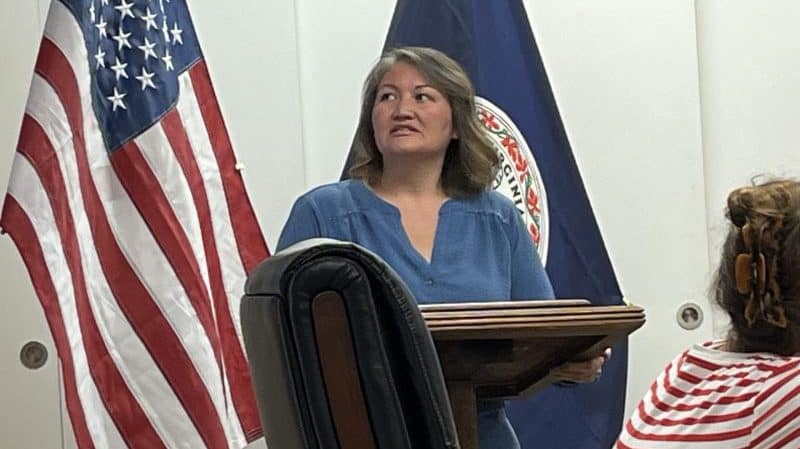
Planning Director Lauren Kopishke presents a proposed rezoning to the council as well as an update on a draft zoning ordinance that has long been in progress through a review by the Town Planning Commission.
Kopishke explained that the application includes no current development plan or proffers and would likely be sold for residential use if rezoned. This lack of specificity complicates fiscal impact assessments, especially with the Town and County continuing to rely on an outdated model for predicting infrastructure burdens.
Councilwoman Amber Veitenthal emphasized the need for a better planning model, stating, “One hundred thousand dollars is a drop in the bucket when the construction of million-dollar schools is at stake.”

The rezoning has already drawn concern from nearby residents. Thomas Ladd, who owns a neighboring property, voiced worries about the possibility of a new road being constructed too close to existing homes. Planning and Zoning staff have begun fielding calls from residents, indicating that a public hearing will be a critical next step.
Zoning Ordinance Draft Nears Completion, Sparks Dialogue on Data Centers
Kopishke also updated council members on the draft zoning ordinance rewrite, which is being refined for clarity and consistency across all land uses and definitions. She encouraged council input as the process continues through the Planning Commission and staff review.
In a noteworthy exchange, Mayor Lori Cockrell raised the topic of data centers, a controversial issue in several Virginia communities. Kopishke recommended that the Town take a proactive stance. While some fear that naming data centers in the zoning code could act as an invitation, omitting any reference could result in such a facility being built with no clear restrictions in place.
“This is the first time we’ve heard of it,” said Councilwoman Veitenthal, emphasizing that the Council has had no formal or informal discussions with any data center developers and that the issue had not yet reached their desks.

Also under consideration was parking equality, especially for short-term rentals, which currently face the same parking requirements as long-term tenants. Council members pointed out the imbalance, noting that long-term rentals often bring more vehicles while short-term visitors are more likely to dine out and contribute to local business revenue.
Kopishke and her team were encouraged to factor this into the revised ordinance as they aim to modernize outdated or unbalanced provisions.
Preparing for County Collaboration
In preparation for the upcoming July 17 liaison meeting with Warren County, the council briefly reviewed strategy and focus areas. Officials expect to discuss issues that require cooperation, including development standards and shared services.
The open session concluded with the council entering a closed meeting to address personnel matters related to the Planning Commission and to receive legal guidance regarding an easement agreement for Peyton Street Parking as well as the insolvency and asset disposition of the Economic Development Authority (EDA).




July 1 Marked Statewide Start of a Ban on the Use of Certain Plastic Foam Foodware Containers

Technology Business Versus Data Center: Town Planning Commission Deep Dives into Definitions

Celebrate Independence Day Close to Home

Middletown Announces Grand Marshals for America 250 Independence Day Parade

Virginia Braces for Dangerous Heat Wave Ahead of Fourth of July Weekend

Cardinals Host Woodstock River Bandits Friday, July 3 at Bing Crosby Stadium

Medicaid Again to Cover Non-Abortion Care at Planned Parenthood as GOP Ban Ends

Justice Department Sues Virginia Over New Semi-Automatic Rifle Ban

Warren County Sheriff’s Foundation Working to Strengthen Community Connections

Dr. Arthur Gaillard Gower III (1933 – 2026)

The $4 Frame That Held a Treasure

Mary A. Shaw (1958 – 2026)

Come On Down to the Great American State Fair — There’s Plenty of Room

Man Accused of Threatening Former Delegate Kim Taylor Enters Plea Agreement

Mark Allen Kisner (1957 – 2026)

Peggy Ann Franklin Thompson (1940 – 2026)

Spanberger, Assembly Ignore Dominion Sale, Focus on Scapegoating Data Centers

The Declaration of Independence First Received in the Churches

What Frederick Douglass Asked of America

Here Are 10 Notable New Virginia Laws That Will Take Effect July 1

Virginia to Fund Cancer Screening Program for Firefighters

How a Texas Metal Shop Became Igloo

Warren County Officials Urge Safe, Legal Fireworks Use During July Fourth Holiday

Virginia Colleges Face Global Competition as More Students Consider Studying Abroad
