
State News
Pending Bill Could Clarify Visitation Standards for Virginia Correctional Facilities
Incarcerated people in Virginia can contact their friends and family by phone call or a special email service for prisons, but those who previously served time say in-person visits helped them keep morale high and incentivized good behavior.
Former and current inmates and criminal justice advocates are calling for clearer visitation standards in Virginia facilities, a challenge a new legislative measure is designed to address.
House Bill 173 by Del. Bonita Anthony, D-Norfolk, would require that the Virginia Department of Corrections provide extended visitation access for long-distance travelers who live at least 150 miles outside of the correctional facility, minors under 18 years old, and infrequent visitors who have not been to see their loved one in more than 90 days. Each visit for these types of guests would be at least two hours, unless the visitor or inmate requests to shorten it.
Before the standards are applied broadly to VADOC, the bill stipulates that the department conduct pilot programs of the revised visitation rules at three or more prisons with different security levels to evaluate the staffing and safety impacts. This will help the department sort through how to best implement the new visitation standards.

The bill also outlines how visitation privileges could only be suspended for conduct occurring during the visitation that “presents a direct and substantial threat to the physical safety of participants or the security of the correctional facility.”
Finally, it would create an appeal process for suspension of visitation rights and would require VADOC to collect and publish related data in an annual report to state lawmakers.
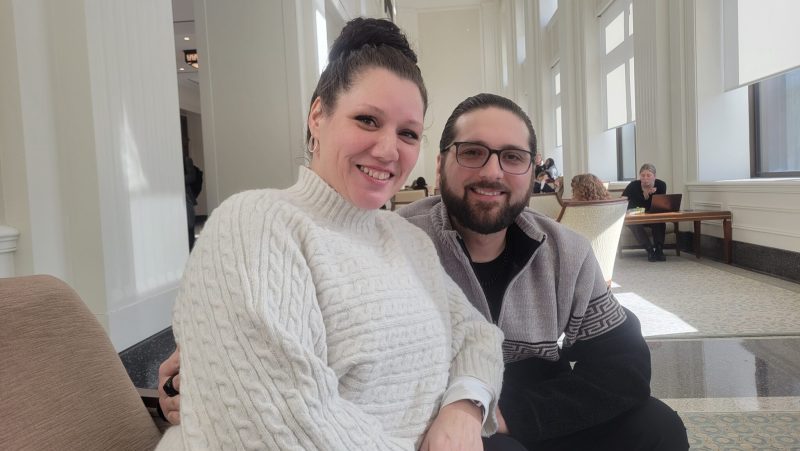
Christine and Blake Via sit in a lobby in the Virginia General Assembly building before attending a Courts of Justice committee meeting to advocate for bills in January 2026. (Photo by Charlotte Rene Woods/ Virginia Mercury)
Christine Via, whose husband Blake was previously incarcerated at Dilwyn Correctional Center, said she has been turned away when trying to visit him due to her attire, despite her attempts to follow the visitation rules and clothing policy.

VADOC policy outlines that clothing must cover people from neck to knee, must not contain “inappropriate language or graphics,” watches and other wearable technology are prohibited, and that administrative duty officers “will make the final decision” on whether or not someone is allowed into the visitor room.
No matter what she wore, Christine said, occasionally, authorities at the center told her she needed to change for security reasons.
So, she’d “run to the nearest store and get something because I don’t want to skip my visit,” she said.
After several such interactions, she said she didn’t always bring the couple’s young son along to the facility, an hour and a half from their home, concerned that he would “get his hopes up,” only to not see his father.

Another time, Blake said his visitation privileges were at risk of being revoked because, apparently, he and Christine shared too long a kiss.
“It’s inconsistent with treatment between (correctional officers’) shifts,” Blake said, adding that Anthony’s bill could help create consistent standards.
Humanization Project co-founder Taj Mahon-Haft also supports the bill. The organization, spearheaded by formerly incarcerated people like himself, advocates to the state legislature on behalf of bills like Anthony’s.
During Mahon-Haft’s incarceration, his mother and his now-wife were two of the people he was in touch with most, each leaning on the other for emotional support. With his mother living in New Mexico, she saved up money and took time off work to visit at least twice a year. This entailed paying for flights, a hotel, and a rental car.

In late 2021, as COVID-19 pandemic restrictions were easing up, Mahon-Haft said he’d filled out the required documentation to arrange for his mother to visit him. She was told to leave the prison after just an hour, he said, despite the waiting room being empty.
It was the last time she visited him before he was released.
“She couldn’t put herself through that again,” he said. “She’d spent thousands of dollars, come thousands of miles, and wasted five days of her PTO.”
He and the Vias feel that the treatment by prison staff has ‘basically discouraged away visits’ at times.

Anthony’s bill must work its way through various committees before it may clear both chambers of the legislature and ultimately face Gov. Abigail Spanberger’s final approval, amendments or rejection.
by Charlotte Rene Woods, Virginia Mercury
Virginia Mercury is part of States Newsroom, a nonprofit news network supported by grants and a coalition of donors as a 501c(3) public charity. Virginia Mercury maintains editorial independence. Contact Editor Samantha Willis for questions: info@virginiamercury.com.




Spanberger Restores Voting Rights to More Than 60,000 Virginians

Virginia Senators Request Special Session to Act on ’Deeply Alarming’ Groundwater Report

VDOT: Warren County Traffic Alert for August 3 – 7, 2026

Spanberger Administration Seeks Public Input on New Energy Plan

String of Outbreaks Tests US Public Health System Amid Funding Cuts, Vaccine Resistance

A Call for Kindness, Respect, and Community

1856 Election Demonstrates Strengths, Weaknesses of Our Democracy

Court Rulings on Treece Defense Motions Lead to Appeals, Forward Action to Circuit Court
Warren County is Not for Sale: Oppose David Silek’s Vote-Buying Scheme

Scott Lloyd Makes His Case for Warren GOP Chairman Ahead of Aug. 5 Revote

David Silek Makes Case for Warren GOP Chairmanship Ahead of Aug. 5 Vote

Police Seek Video After Cadillac Found Burning in Front Royal Alley
What the Power to Prohibit Actually Requires

Anthony Dale “Tony” Pullen

Coolidge’s Vision of Prosperity Through Free Trade

ORDER OF PUBLICATION: In the Circuit Court for Warren County, Virginia

Business Growth Series: If You’re Burned Out, Your Business Shows It
Support Scott Lloyd in Warren GOP Leadership Vote

Mexican-Style Grilled Corn on the Cob Adds Bold Flavor to Summer Cookouts

This Week’s Showtimes at Royal Cinemas as of July 31st

Definition and Prohibition of Data Centers Recommended Unanimously at Special Town Planning Commission Meeting

Assistant F&R Chief Gerry Maiatico Responds to South Warren Citizen Concerns About Service Reduction

Virginia Launches New Unit Targeting Illegal Vapes and Intoxicants
Charity, Refugees & Our Constitution
