
Local Government
Special Events permitting, parking regulations and Town Comp Plan review move forward
Regulations applying to downtown availability for special events and sometimes decades-old parking regulations that aren’t or cannot be enforced were two of a seven-item work session agenda of the Front Royal Town Council Monday evening, September 13. In the wake of those discussions, it appears council will move a revised version of its Special Events permitting matrix forward for approval at its meeting of September 27; and staff will attempt to “clean up” its parking ordinances, so they are legally supportable, and address issues faced by citizens in the 21st century.
Changes presented in the Special Events permitting process appeared to revolve around the striking of several controversial matrix criteria cited as favoring larger, tourism events that have the potential of generating higher fee and taxing revenues to the Town. Such deletions included: “Community Destination Benefit”, a demonstrated past history of “Success” and Organizational Structure Management “Capability”; “Direct Spending” and “Funding Capacity”; generating “Overnight Stays/(commercial) Room Nights”; and an “Evaluation & Management Plan”.
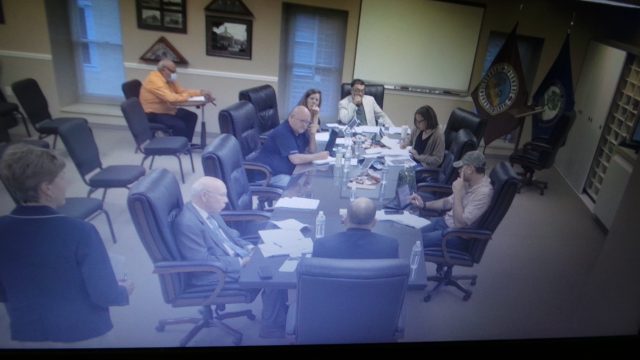
Recently named Assistant Town Manager Kathleen Leidich, bottom left, summarizes changes to the Special Events permitting matrix hoped to appease citizen complaints on the original submissions favoring larger, tourist-targeted events. Royal Examiner Photos by Roger Bianchini
A great deal of discussion was also generated about the advisability or not of refundable fees and the parameters of refunds if events were canceled closer to their scheduled date. Councilman Joe McFadden argued that a reasonable, non-refundable fee would indicate a certain commitment to following through with the necessary planning to see the event occur successfully. While somewhat divided on the issue, a council consensus appeared to be to leave the fees as included in the new draft. However, under “Tourism” in that draft, a number of fees ranging from $50 to $150 attached to the full or partial closure of streets were deleted.

So, after several aborted attempts at establishing a new Special Events policy, council will take another shot on September 27. And we will find out if, in fact, the drafted changes have eased the concerns of some involved citizens that the code changes were too restrictive on smaller community events.
The Parking Maze
As for parking regulations downtown, it appears there is no immediate plan to alter the existing non-enforcement of the posted 2-hour parking limit in the downtown business district, despite some recently added marked parking spaces along Chester Street off its intersection with East Main Street and adjacent to the Town’s Village Commons Parking lot, which carries the same non-enforced 2-hour limit.
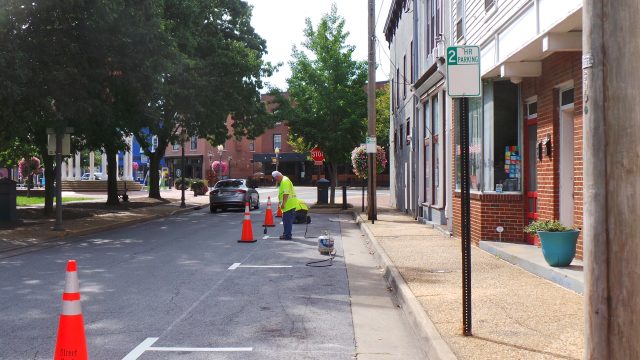
The Town expanded its downtown painted parking spaces onto Chester St. on Sept. 8. However, it appears there are no immediate plans to begin enforcing the posted 2-hour parking time limit with ticketing. – They’re still just a friendly reminder there are businesses seeking customer parking in the area.

More specifically targeted for change were codes defining towing parameters as to after what period of time vehicles can be considered “inoperable” or “abandoned” including improperly licensed or registered vehicles. FRPD Chief Kahle Magalis indicated an absence of specific parameters in the town code. So, time limits on such regulations in neighboring communities were presented. Those ranged from Winchester City’s two-day limit to 10 days in Luray and Leesburg. Luray and Warrenton both had a “4 days without being moved” condition.
A great deal of discussion occurred around the right of people to sleep in their vehicles. The example of someone pulling over to rest while driving some distance to avoid a dangerous situation or just taking a nap in a public park parking area was counterbalanced by a specific instance of a homeless person utilizing their vehicle to repeatedly park and sleep in public parking areas. The dilemma of homelessness and a right to survive as best as possible, with limited publicly or privately offered alternatives available was debated at length.
“So, where are we? Do we look at it or just park it?” Mayor Holloway asked council after a lengthy discussion that included potential state or federal legal parameters that could impact local authority. Letasha Thompson’s “I’d park it” reply appeared to represent council’s consensus for the present.
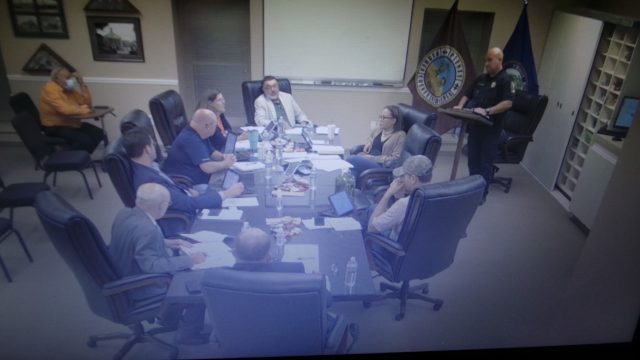
After describing the ‘state of the beast’, Town Police Chief Kahle Magalis, at podium upper right, awaits a council consensus on a path forward in updating what was described at one point as ‘antiquated’ parking codes.

Also discussed were potential time limits on vehicles parked under protective shrouds, perhaps covering whether the vehicle is legally tagged, as well as ticketing of vehicles not parked “right wheels to curb” or against the traffic flow of the travel lane.
The Chapter 158 Code notated with problem areas comprised 43 pages; so, good luck reviewing staff.
A little late on that Comp Plan rewrite
Also on the work session agenda was an update from new Planning and Community Development Director Lauren Kopishke on the Town Comprehensive Plan update now underway. Kopishke noted Phase One was underway seeking input from town citizens on their thoughts on the most desirable future direction for residential and commercial growth within the town limits. The entire process, beginning at the Planning Department/Commission level, followed by council review and approval is anticipated to be completed over the next 18 months.

Kopishke noted that by state code, municipal Comp Plans are supposed to be reviewed and updated every five years. She observed that the Town’s current one was approved in 1998. That made it comparable to, if not quite as aged as some of the parking regulations discussed Monday evening.
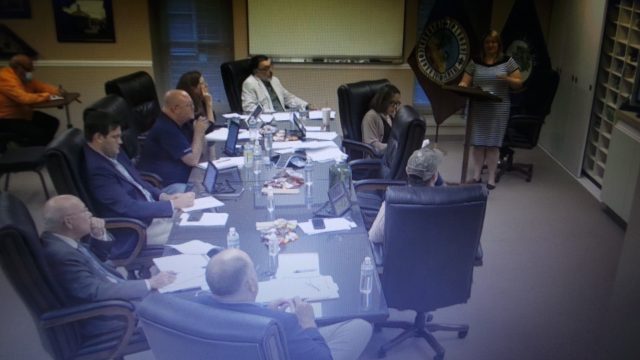
The mayor and council listen as new Planning and Community Development Director Lauren Kopishke, at podium upper right, describes a somewhat overdue Comprehensive Plan update process now seeking citizen input on their vision of the town’s future composition and look.
Vice-Mayor Lori Cockrell suggested a more efficient means than simply relying on social media and Town website notices to alert town residents that council desired their input to develop a plan for future development aligned with that of the majority of people who live in town. Noting that a significant number of citizens probably did not do much, if any social media, the vice mayor suggested hard copy info sent out with Town utility bills, or possibly a mass mailing to citizens, with attached questionnaires that could be either returned with utility payments or dropped in the mail.
Open Discussion

During Open Discussion near the end of the two-hour-and-20-minute work session, as Mayor Holloway edged his seat away from the meeting room table, Town Manager Steven Hicks introduced recently discovered issues related to a scheduled September 27th public hearing. That public hearing is on a requested right-of-way vacation along Carter Street involving Chris Holloway Construction’s plans for the development of a non-conforming six-unit subdivision inside the town limits.
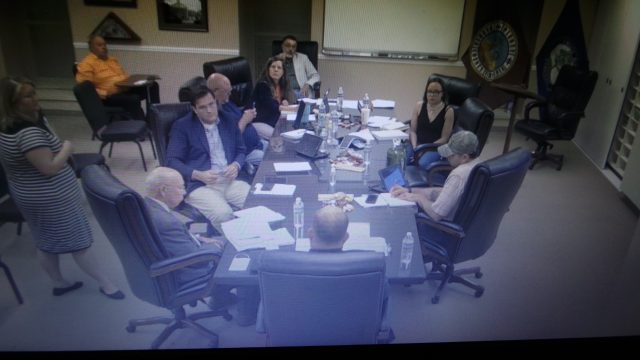
Mayor Holloway has subtly moved his seat away from the head of the work session table as late issues with his construction company’s private-road subdivision’s right-of-way exceptions are discussed. He was available to answer questions.
At issue for the planning commission/department, as the mayor found out when he went to seek a street naming addition to his planned private-road subdivision, are requested road construction rights of ways that do not meet Town codes. Those codes call for a minimum 40-foot street ROW. Staff explained that Holloway’s subdivision lots would each have on-property driveways, with no street parking allowed to facilitate the requested, and previously approved street width of 20 feet. The excepted streets would be private subdivision roads, not part of the town street system, staff explained. Councilman Thompson wondered if guests traveling by car would have to park at distance to be “shuttled in”. Councilman McFadden pointed to council’s past denial of a 30-foot ROW exception request to Front Royal Limited’s planned residential development off Mary’s Shady Lane in town.
“How did we not catch this before?” Vice-Mayor Cockrell asked as the discussion focused on preventing a repeat of any oversight in the approval process. Council and staff committed to bringing the matter to a successful conclusion, with excepted parameters explained and reapproved as necessary.
Also during the Open Discussion on a lighter note, Councilman Scott Lloyd addressed his research into the proper terminology for those people council represents who live inside the town limits. Noting he had once questioned the vice mayor’s use of “citizen” as opposed to “resident” because the Town does not have a “citizenship process” (to incorporate non-natives who move into town). Lloyd, whose pre-council stint as the Trump Administration’s Director of Refugee Resettlement at the southern border may have confused him on the necessity of a citizenship process here, said he had discovered upon consulting Mirriam Webster’s that, indeed, “citizen” was a proper reference, as is “resident”, of a municipality. – “I guess I’ll have to take it up with Mirriam Webster,” Lloyd responded by email to our query on the issue.
So, settle down my fellow Front Royal citizen transplants – we’re not going to have to pass a citizenship quiz on the history and laws of the Town of Front Royal to become legally voting citizens/residents of the town. And neither will the town’s transplanted elected officials to have to resign and pass such a test in order to legally run for municipal office here.
Other business
See the linked Town video for these discussions, as well as ones on Habitat for Humanity’s request for a waiver of water-sewer tap fees on new construction; work toward the Town’s establishment of its own Building Inspections Department and an Environmental Division, prior to adjournment to Closed Session to discuss a number of topics. Those Closed Session topics included consultation with legal counsel on litigation with “the Warren County EDA and Jennifer McDonald”; an unspecified personnel matter; consideration of the acquisition of “privately held real property for a public purpose”, as well as “the disposition of Town-held real property located outside the Town’s corporate limits; and discussion of “contractual and programmatic matters related to a contract the Town is a party to which has become problematic”.




White House Highlights Crime, Economy, Foreign Policy in Weekly Briefing

Heroes on the River: Combat Veterans Skydive at Front Royal Warren County Airport

Declaration of Independence Was Mostly Signed in August, Not July

August Celebrity Birthdays: Do You Share a Birthday?

Helping Students Make a Smooth Transition to High School

Spanberger Restores Voting Rights to More Than 60,000 Virginians

Virginia Senators Request Special Session to Act on ’Deeply Alarming’ Groundwater Report

VDOT: Warren County Traffic Alert for August 3 – 7, 2026

Spanberger Administration Seeks Public Input on New Energy Plan

String of Outbreaks Tests US Public Health System Amid Funding Cuts, Vaccine Resistance

A Call for Kindness, Respect, and Community

1856 Election Demonstrates Strengths, Weaknesses of Our Democracy

Court Rulings on Treece Defense Motions Lead to Appeals, Forward Action to Circuit Court
Warren County is Not for Sale: Oppose David Silek’s Vote-Buying Scheme

Scott Lloyd Makes His Case for Warren GOP Chairman Ahead of Aug. 5 Revote

David Silek Makes Case for Warren GOP Chairmanship Ahead of Aug. 5 Vote

Police Seek Video After Cadillac Found Burning in Front Royal Alley
What the Power to Prohibit Actually Requires

Anthony Dale “Tony” Pullen

Coolidge’s Vision of Prosperity Through Free Trade

ORDER OF PUBLICATION: In the Circuit Court for Warren County, Virginia

Business Growth Series: If You’re Burned Out, Your Business Shows It
Support Scott Lloyd in Warren GOP Leadership Vote

Mexican-Style Grilled Corn on the Cob Adds Bold Flavor to Summer Cookouts
