
State News
With Governor’s Signature, Healthcare Affordability Bills Become Law
Gov. Abigail Spanberger traveled to Northern Virginia on Wednesday to sign a slate of bills aimed at reducing healthcare costs, ranging from insurance claims reform to targeted prescription drug affordability.
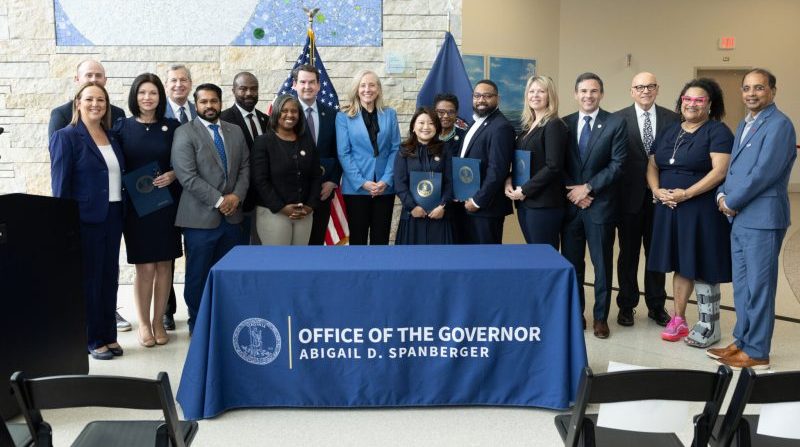
Gov. Abigail Spanberger stands with Virginia healthcare leaders and lawmakers after signing a slate of bills to bring down medical care costs in Fairfax on May 13, 2026. (Photo courtesy of the governor’s office)
Most of the legislation was sponsored by lawmakers representing that part of the state and met success following years of efforts under previous gubernatorial administrations. About a dozen of those legislators joined Spanberger for the signing at the Inova Schar Cancer Institute in Fairfax County.
The measures reflect Spanberger’s focus on affordability, which she called “the cornerstone of my legislative agenda.”

“These bills are a significant step forward to make sure that when your family needs care, you can get it,” Spanberger said in a statement. “When your doctor writes a prescription, you can afford to fill it. And when you get sick, the cost of getting better doesn’t break the bank.”
Details on the new laws
The governor approved Senate Bill 161 and House Bill 625 by Sen. Russet Perry, D-Loudoun, and Del. Rozia Henson, D-Woodbridge. The bills, endorsed by the American Cancer Society Action Network, will allow Virginians to choose insurance plans with flat rates on copays for prescription drugs.
The network’s Virginia government relations director called it a proposal to protect people from “surprise costs” in a statement last month.
SB 164 by Sen. Jeremy McPike, D-Prince William, and HB 484 by Del. Irene Shin, D-Fairfax, will prohibit downcoding insurance claims without a healthcare provider stating why.

Insurance claim downcoding is sometimes triggered or exacerbated by artificial intelligence use, a problem the new law addresses. It requires downcoding dispute decisions to be reviewed and adjudicated by humans.
HB 328 by Del. Rip Sullivan, D-Fairfax, requires the state’s Bureau of Insurance to select a new essential health benefits benchmark plan for 2028 and outlines different treatments and services covered in state-offered plans. The bill came as a recommendation from the Health Insurance Reform Commission.
HB 736 by outgoing Del. Michelle Maldonado, D-Manassas, amends requirements for health carrier contracts that relate to prior authorizations for prescription drugs.
HB 1214 by Del. Karrie Delaney, D-Fairfax, will lower insulin costs and set caps on costs for diabetes equipment, like glucose monitoring devices.

Delaney said she drew from personal experience when championing the legislation. As the parent of a child with diabetes, she’s seen firsthand the benefits of medication and glucose monitoring, but also knows it is a challenge for some families to afford.
She told The Mercury earlier this year that making sure people can continuously take their prescribed insulin management medicine is paramount to their health.
“No Virginian should be rationing insulin because of what it costs at the pharmacy counter,” Spanberger said. “That’s why we’re capping the out-of-pocket cost of a 30-day supply at $35. This is a huge deal for the 800,000 Virginians living with diabetes.”
Still no action on Prescription Drug Affordability Board
A Delaney bill that was not signed Wednesday and one Spanberger has yet to take action on is a proposal to establish a Prescription Drug Affordability Board. If enacted, the advisory panel will examine data to ensure that federal drug pricing caps are applied to state-regulated health insurance plans.

After Youngkin’s veto, lawmakers hope Spanberger will warm to cost-cutting prescription drug board
The legislation’s five year journey includes multiple vetoes by former Gov. Glenn Youngkin, but it evolved this year in ways that garnered stronger bipartisan support. It has also taken on the name “Affordable Medicine Act,” a clearcut signal of its goals.
Spanberger had not signaled support for it on the campaign trail or since becoming governor, but has also not rejected it. She tried to amend the bill by adding a reenactment clause but the legislature rejected her tweak.
The governor has until May 23 to sign it into law sans her amendment or veto it.
Legislation reflects national healthcare worries and state lawmakers’ response
The latest signatures come as healthcare affordability and access remain a top concern for Virginians and people across the country.

A federal spending bill signed by President Donald Trump last summer entails forthcoming changes to Medicaid and hospital funding mechanisms that make thousands of Virginians vulnerable to losing coverage and are expected to further strain hospitals’ budgets.
Meanwhile, Congress’ inability to renew expired Affordable Care Act tax credits has contributed to 33,000 Virginians dropping that form of health insurance this year.
Here’s how Va. lawmakers suggest the next state budget handle federal health care funding fallout
The still-pending state budget includes various proposals to boost funding for free clinics, help social service workers comply with the reconciliation bill, and potentially establish a state-level ACA subsidy program.
With a July 1 deadline for the new budget to take effect and budget negotiations still underway, Virginia Health and Human Resources Secretary Marvin Figueroa noted at Wednesday’s bill signing that they represent shared efforts to address pressing healthcare issues.
“It is a clear signal that regardless of what’s happening in Washington, the governor and these legislators here would not use it as an excuse to do less,” he said.
by Charlotte Rene Woods, Virginia Mercury
Virginia Mercury is part of States Newsroom, a nonprofit news network supported by grants and a coalition of donors as a 501c(3) public charity. Virginia Mercury maintains editorial independence. Contact Editor Samantha Willis for questions: info@virginiamercury.com.




Blue Ridge Wildlife Center Patient of the Week: Gray Treefrog

Birthday Twins: See Which Famous Face Shares Your Big Day

Meet-and-Greet Set Sunday for Republican-Endorsed Front Royal Candidates

Barbara Ann Mathews Smelser (1943 – 2026)

Kathleen Frances Elar (1956 – 2026)

Happy Creek Crossing to Hold Vendor Interest Meeting Oct. 8 in Front Royal

If the Car Name Fits, Drive It

Front Royal Begins Smoke Testing Sewer System; Residents May See Smoke Around Homes

Trump Orders Federal Agencies to Replace ‘Artificial Intelligence’ With ‘Super Intelligence’

Town-Wide Weed Spraying Underway in Front Royal Through Oct. 6

Southbound I-81 Lane Closure Near Strasburg Expected to Cause Significant Weekend Delays

Virginia Democrats Warn More Healthcare Strains Loom After November Election

Legislation to Force Virginia Traffic Camera Fine Payments Will Make ‘Nightmarish’ Court Workloads

CDC’s Latest Youth Behavior Report Offers a Narrower Look at Teen Health

News Organizations Banned from White House Accuse Trump of First Amendment Violation

Virginia Education Board Approves New Rules for Local Student Assessments

FCC Halts Automatic Approval of Verizon Plan to End Legacy Landline Service in Virginia

Women in Agriculture Continue to Face Barriers as Their Role Grows

This Week’s Showtimes at Royal Cinemas as of October 1st

Surveillance, Outdoor Dining, and Other Community Concerns at Town Council Meeting

When Elected Officials Cross the Line

Trump Administration Revokes $810M Approved by Congress for Refugee Aid and More

The Signs Offer Quick Cash for Homes. But States Want More Oversight

This Drone Hunts Mosquitoes
