
State News
Chesapeake Bay leaders resolute even as cleanup targets become more elusive
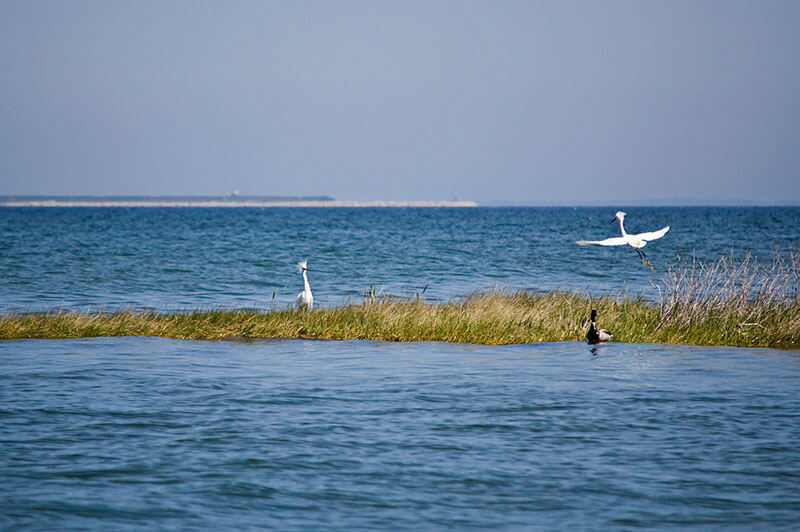
Snowy egrets and mallard on eroding marsh near Poplar Island in Talbot County, Md., on May 20, 2010. (Photo by Alicia Pimental/Chesapeake Bay Program)
As the 2025 federal deadline for states to meet ambitious goals for cleaning up the Chesapeake Bay draws closer, it is starting to dawn on state and U.S. officials and other stakeholders that some states will fall short. Virginia Gov. Glenn Youngkin (R) admitted as much on Tuesday.
“That was a difficult recognition,” he said. “I think we have a clear commitment to meeting those goals. Unfortunately, it won’t be by 2025.”
Youngkin made his remarks at the annual meeting of the Chesapeake Bay Executive Council, which brings the leaders of states in the Bay watershed together with federal officials and other leaders to assess the state of the Bay’s health. Tuesday’s meeting was held at the headquarters of the U.S. Environmental Protection Agency, which has just issued its own mixed though generally sunny assessment.

These meetings are usually a chance for governors, cabinet secretaries, and other officials to boast about the progress cleaning up the Chesapeake Bay — progress that they say is tangible and real.
“It is clear that so many positive developments have been made despite the emerging threats of climate change and with the growing population,” said Kandis Boyd, the new director of EPA’s 39-year-old Chesapeake Bay Program.
But the enthusiasm was dampened by the knowledge that some states won’t meet their targeted goals by 2025. Still, U.S. EPA Administrator Michael Regan, who was chairing the meeting, said that officials from all six Bay states and the District of Columbia are committed to attaining the pollution reduction goals. It’s up to environmental agency officials in each state, he said, to figure out which goals are realistic, how to expedite certain plans of action, and to reconsider how to ensure that the lagging targets are met as quickly as possible.
“I think we’ve all acknowledged that 2025 is fleeting in terms of achieving all of our substantial goals,” Regan said. “We intend to set reasonable achievable goals in a timeline that can help us [eventually] meet our broader, more ambitious goals.”

He added that the bipartisan federal infrastructure bill that became law last year will provide an additional $90 million a year over the next five years earmarked for Chesapeake Bay cleanup. That will go to state and local governments, agricultural groups, watermen, and nonprofits, among others.
In Virginia, the General Assembly dedicated record funding this year to state programs that help farmers pay for pollution reduction practices like streamside fencing. About three-quarters of the pollution reductions Virginia still has to achieve are expected to come from the agricultural sector.
As 2025 deadline for Chesapeake Bay cleanup looms, Virginia zeroes in on agriculture
.
In an interview, Hillary Harp Falk, president of the Chesapeake Bay Foundation, which issued its own report last week on the health of the Bay, complete with warnings about how certain states are falling short, said she was pleased that state and federal leaders publicly recommitted to meeting the cleanup goals.

But she added, “We need strong state leadership and federal accountability to get close to 2025. The devil’s in the details.”
The Choose Clean Water Coalition, which consists of more than 270 nonprofit groups in the Chesapeake watershed, expressed similar sentiments.
“We are focused on the actions that will follow the words shared this afternoon from the members of the Executive Council,” said the coalition’s executive director, Kristin Reilly. “If we are to provide clean water to all 18 million people whose local waterways feed the Bay, we need accountability and sufficient investments to ensure we meet our commitments.”
Youngkin says Northam administration ‘wasn’t completely transparent’ about Bay plans
Without naming him, Youngkin sought to pin some of the blame for Virginia’s shortfall on his predecessor, former Gov. Ralph Northam (D), an Eastern Shore native, saying “the previous administration wasn’t completely transparent about how they went about setting their agenda.” He suggested that the Northam administration did not provide adequate funding for Bay cleanup and also set “artificial expiration dates” for certain programs.

Asked about the transparency concerns and programs that expired early, Youngkin spokesperson Macaulay Porter pointed to other comments made by Youngkin at the meeting.
The governor criticized the state’s “unrealistic” goal of planting 30,000 acres of urban tree canopy by 2025, compared to other Bay states that planned on planting 6,000 acres. “The reality of course, is that our forestry staff has informed me that this goal isn’t feasible,” he said. “In fact, there had been no previous focus on achieving it.”
Youngkin also said the previous administration “in fact had 2030 as the ultimate timeline. As a result, funding streams were insufficient to meet the 2025 goals.”
“I’m a homegrown Virginia boy,” Youngkin asserted. “Not just in Virginia, but in Virginia Beach and the Chesapeake means a whole lot to me personally. I grew up on it. I love the Bay, and I want other folks to have the chance to love it just as much as I do.”

Youngkin brought with him Andrew Wheeler, a former coal company executive who served as EPA administrator during the Trump administration. Wheeler, whose nomination as Virginia’s top environmental official was blocked by Senate Democrats, is now advising the Virginia governor on environmental matters and leading a new Office of Regulatory Management that aims to reduce the state’s regulatory requirements by 25%. Environmentalists have harshly criticized Youngkin’s association with Wheeler.
Maryland Sen. Sarah Elfreth, D-Anne Arundel, noted that Virginia had adopted a revolving loan fund for climate resilience programs, created a flood protection master plan, hired a chief resiliency officer — a program Maryland is emulating — and has begun teaching environmental literacy.
Meanwhile, “in Maryland, we had one of our best sessions yet,” Elfreth said, referencing passage of the Climate Solutions Now Act, a bill to ban the chemical PFAS, and to support oyster restoration programs.
“But there is so much more work ahead,” she said.
Ann Swanson, executive director of the Chesapeake Bay Commission, who is retiring later this fall after more than 30 years on the job, reminded the governors of the unique role they play in ensuring the Bay’s health — not just because of their impact on policy but because of their ability to shape the public conversation.
“You have voices that are incredibly unique,” she said. “When you speak, people jump.”
This story originally appeared in Maryland Matters, a sister publication of The Virginia Mercury within the States Newsroom network. It has been updated with comments from Gov. Glenn Youngkin’s office.
by Josh Kurtz, Virginia Mercury
Virginia Mercury is part of States Newsroom, a network of news bureaus supported by grants and a coalition of donors as a 501c(3) public charity. Virginia Mercury maintains editorial independence. Contact Editor Sarah Vogelsong for questions: info@virginiamercury.com. Follow Virginia Mercury on Facebook and Twitter.




Front Royal Marks 25 Years Since 9/11 With Remembrance at the Gazebo

Beth Macy Discusses Sixth District Campaign, Health Care, Farming and Data Centers

Neurofeedback Specialist to Offer Free Community Program at Samuels Public Library

Warren County Wildcats Host Strasburg Under Friday Night Lights – September 11

Seeing, Listening and Supporting Our Seniors

Virginia’s 6th District Deserves Better Representation

David James “Dave” Lyons (1972 – 2026)

Two Killed in Fiery I-81 Crash Near Exit 310 in Frederick County

Business Growth Series: If You’re Not Listening, You’re Losing Customers

Kaine, Warner Introduce Bill to Reduce Flights and Improve Safety at Reagan National

Virginia Begins Rollout of More Secure Chip-and-Tap EBT Cards
Thinking Independently
Where Was Ben Cline?

What an Air Cleaner Can — and Cannot — Do

Belle Grove to Open Exhibit Exploring the Complex Life of Monday Robinson

Virginia Joins Bipartisan Push for Stronger Rules to Fight Illegal Robocalls

The Well Lies to You

Resumption of Capital Improvement Program Goes Forward at County Planning Commission Meeting

In Rare Move, SCC Orders Three In-Person Hearings for NextEra-Dominion Merger Case

Brenda Louise Morgan (1955 – 2026)

Norma Jean (Markle) Freschi (1933 – 2026)

POLICE: 7 Day FRPD Arrest Report 9/7/2026

Warren County DSS Highlights 5K, Halloween Jubilee and New SNAP Cards

This Week’s Showtimes at Royal Cinemas as of September 10th
