
Local Government
Town vote on dog tethering, anti-cruelty code set for Nov. 13

Vice-Mayor Tewalt, center, and Councilman Meza, right, continue to question the need for added dog protection legislation by the Town – tho Tewalt expressed potential support due to no Town financial or enforcement responsibility. Photos/Roger Bianchini
Despite two members still grousing about it, the Front Royal Town Council appears poised to follow the County’s lead in approving a dog tethering code. The code is designed to increase county animal control’s ability to identify and prosecute canine abuse on BOTH sides of the town-county boundary. Violations of the proposed ordinance could result in seizure of the animal and up to a $500 fine on each count.
The new code was discussed at an October 16 work session. It was council’s first discussion of the topic since the September 19 county board approval of a final draft of the new code. It is a code supported by both animal rights activists and the County Sheriff’s Office Animal Control department. A public hearing and vote on Town passage of a code mirroring the county’s was scheduled for November 13.
At the work session two councilmen re-stated past concerns about Town approval of such a code. However, one of those – Vice-Mayor Eugene Tewalt – said he would “probably vote for it” since the Town will have no financial or enforcement responsibilities. – “The only reason I’ll even consider it is because the County said they would do all the enforcement,” Tewalt observed.

Council’s other critic of the legislation, Jacob Meza, gave no such indication he would support the proposed ordinance. He was again critical of the specificity of treatment standards related to outdoor tethering. Those specifics include a prohibition on outdoor tethering of females in heat; the length and size of chains or tethers related to the size of the dog; the length of time dogs may be tethered outdoors during weather extremes, particular related to temperature; and that “adequate shelter” must be provided for animals tethered outdoors as defined by state code.
Meza called the proposed code “unfortunate”.
“It is very specific on how people treat their animals – I don’t know why we are doing that,” Meza told his colleagues. Indicating he was not a supporter of animal abuse, Meza said he thought the impetus of the code change was “a good cause” but that it was “a bad technique” in support of that cause.
Local animal rights activist Carol Vorous, who brought the proposal forward to the county supervisors in early February, and animal control deputies disagree. Perhaps fortunately for the town’s canine population, it appears a majority of Meza’s colleagues disagree as well. But only William Sealock voiced outright support of the code at Monday night’s work session. Noting past Town ordinance discussions involving “chickens, rabbits and bees”, Sealock said he endorsed the proposed ordinance, observing that it would give equal enforcement authority to county officials on both sides of the town limits.

On September 19 at the County public hearing 13 of 14 speakers added their support of the new code. Some of those speakers involved in animal rescue organizations were brought to tears as they recounted the types of abuse and even canine fatalities they had encountered from the types of neglect and abuse the proposed code is designed to prevent.

At Sept. 19 county public hearing ‘All Dogs Matter’ organizer and canine advocate Carol Vorous presented illustrations of what she has discovered about how some dogs in Warren County have been kept. Council can expect the same briefing on neglectful cruelty on Nov. 13.
Vorous was present at council’s October 16 work session but did not comment.
Asked about the term “adequate shelter” in the proposed code, Town Attorney Doug Napier read from the applicable State statute: “Adequate shelter means provision of and access to shelter that is suitable for the species, age, condition, size and type of each animal; provides adequate space for each animal; is safe and protects each animal from injury, rain, sleet, snow, hail, direct sunlight, the adverse affects of heat or cold, physical suffering, and impairment of health; is properly lighted; is properly cleaned; enables each animal to be clean and dry, except when detrimental to the species; and for dogs and cats provides a solid surface, resting platform, pad, floor-mat, or similar device that is large enough for the animal to lie on in a normal manner and can be maintained in a sanitary manner.”

The state code also elaborates that the flooring of “adequate shelters” must protect the animals feet from injury, thus prohibiting “wire, grid, or slat floors” that do not accomplish such protections, or even floors “that sag under the animals’ weight.”
It would appear that the state government has set a pretty specific bar as far as “adequate shelter” goes. And as stated over the nine months of discussion of a local code, the new tethering standards will add enforcement teeth to county animal control related to, but not limited to the state shelter standard.
As stated above, violations of the new code, already in place outside the town limits in Warren County, can result in seizure of the animal for repeated violations and up to a $500 fine on each count. It is the specter of, not only removal, but significant financial punishment that animal rights activists have pointed to as a deterrent to people who chose to own dogs without any notion of responsibility, care or empathy for their pets.
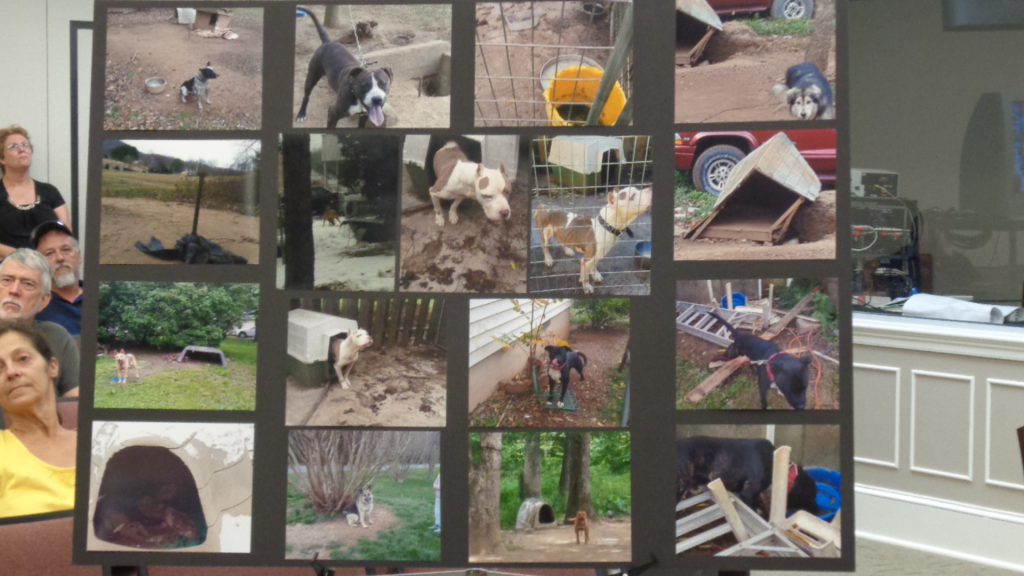
A closeup of Vorous’s ‘adequate shelter’ board.

While saying he “probably would vote for” the code proposal, Tewalt re-stated his belief that legislating treatment standards of pets was beyond the scope of municipal government. Council and other elected municipal bodies should limit their legislation to the provision of utilities or other public infrastructure needs, the former town public works director stated.
The vice mayor’s comment seems to ignore public safety as one of government at all levels’ primary functions – unless he doesn’t consider non-human, non-taxpaying town residents as worthy of that net of local public safety. It is an interesting philosophical question – and one that may be debated further on November 13.




UVA Health Review Examines Real-World Results of Incisionless Liver Tumor Treatment

Maximilian James Donora (1995 – 2026)

Dollars for Dolly Campaign Aims to Turn Small Gifts Into Big Community Impact

Clean Virginia: NextEra’s Utility Takeover Attempts, Alleged Political Moves Relevant to Merger Case

Commentary: If You Enjoy Virginia’s Wildlife, Thank a Hunter or Angler

Spanberger Presses Congress for AI Guardrails as States Forge Ahead

‘Drive Them Into Hell’: Trump Ponders Destruction of Iran at United Nations

National Chicken Month Celebrates a Versatile Source of Protein

Face Paint That Can Read Your Heartbeat

Leisa Wood (1961 – 2026)

GO VOTE: Because Complaining Alone Isn’t a Good Strategy

The Third Most Important Gift Is Laughter

Skates, Treats and Safety: Warren County Sheriff’s Office Foundation Pack October with Community Events

Celebrate Kids Day Returns Sept. 27 With Family Fun, Activities and a New Train Ride

Survey Finds That More Than Half of Virginia Families With Children Face Food Insecurity

Could Virginia’s New Law Allowing 1% Sales Tax for School Construction Need a Fix?

Now They Want to Rein It In

From Oil Field to Gas Pump: What Really Determines What We Pay?

When Fields Flood: How Farmers Protect Crops and Plan for the Future

Draw Your Circles: A Map of the People Who Matter

A Heartfelt Farewell and Thank You
Data Centers Are Necessary. That Doesn’t Mean Warren County Needs One

Diesel Prices Shoot Upward as Top Farm-State GOP Senator Begs Trump for Export Embargo

From One Barrel of Oil: What Do We Actually Get?
